Only the first page of this book is left. We lost the rest in October 2026.
We lost access to the service that stored them, and no other copy exists. We're sorry.
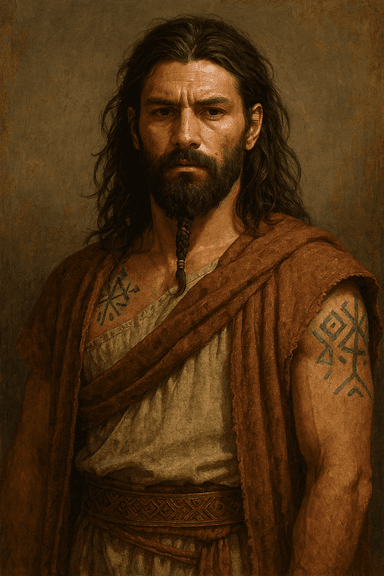
In an age before recorded history, Valentrexis of Thalmyra is a philosopher‑priest who dares to ask the one question his world forbids: must death rule all things? His pursuit of transcendence leads him into the Cavern of Sorrows, where the souls of the dead gather in unending grief. There, in the shadow of Zalmor, god of the underworld, Valentrexis breaks the oldest law and pays the oldest price.
He emerges immortal, radiant, and changed, no longer bound to time. Yet the gift he sought becomes a curse that will echo across six ages of history. Anyone who becomes his true beloved, anyone bound to him in the deep recognition of soulmates, dies. Their soul is dragged screaming into the Cavern of Sorrows, enslaved to the very darkness he once challenged. Valentrexis gains eternity, but he becomes a walking fulcrum of love and annihilation, a rift in the natural order of life and death.
Across millennia, his curse evolves into legend, cult, empire, and finally a cosmic war.
This book follows the entire arc in one sweeping, interconnected narrative, capturing the essence of all six planned volumes.
Book I: Valentrexis Rising – Ambition and the First Transgression
In ancient Thalmyra, Valentrexis is an inquisitive priest and philosopher whose restless mind cannot accept mortality as the final truth. Guided by fragmented Zalmorite texts and the cryptic Oracle of Zereth, he ventures into the forbidden Cavern of Sorrows, determined to glimpse what lies beyond the veil of death.
Inside, he finds not only the echoing cries of the dead, but the living presence of Zalmor’s domain – a realm structured around memory, pain, and unending lament. In trying to wrest immortality from this abyss, Valentrexis breaks a cosmic boundary. Zalmor answers not with rage but with implacable law.
Valentrexis returns to the surface changed: unaging, luminous, revered by some as chosen and feared by others as an affront to the gods. His breath no longer steams in winter air; wounds close without scars; time slips off him like rain from stone. Yet beneath his apparent ascension something is deeply wrong. The balance between life and death has tilted. The Cavern’s murmur follows him like a distant storm.
In a pivotal revelation, his immortality is bound to a hidden clause. When a soul joins his in true, soulmate‑level love, that soul is claimed by Zalmor and dragged into eternal captivity. The Cavern of Sorrows opens to him as faint whispers, but their full horror still lies ahead. Valentrexis has become mythic, but the myth is poisoned at its source.
Book II: Valentrexis’ Lament – Love, Loss, and the Weight of Souls
Centuries later, in a classical age of city‑states and scholars, the immortal Valentrexis walks the world as a tired wanderer. He hides his identity, conceals his ageless face, and avoids deep connection. Children of those who once knew him sing fragments of his name. Statues carved in his likeness erode beneath the rain. To be remembered is to be haunted. To be loved is to kill.
In this era he meets Seraphyne, a healer whose spiritual sensitivity feels like a mirror to his own soul. Their connection is immediate, a recognition that transcends words or ritual. She sees through the layers of his disguise and finds the man inside the myth. For the first time, he allows himself to believe that love might be possible even for one damned to live forever.
When Seraphyne dies in his arms, the true extent of his curse is unveiled. He sees her soul torn screaming from her body, feels the Cavern yawn wide, and hears Zalmor’s sorrowful yet merciless decree. In the same breath that condemns Valentrexis to endless life, Seraphyne is consigned to unending death, her soul locked within the Cavern of Sorrows. In that moment, the crystal she carried – a simple token that will become his private icon – grows faint, its light dimmed to a feeble, aching glow.
The Flamebound cult arises in the wake of this tragedy. They teach that Valentrexis’ curse is divine punishment, that his suffering is sacred, and that his very name is a pathway to power. They twist his grief into doctrine and his failure into worship. When love finds him, death follows. When faith finds him, fanaticism blooms. Valentrexis recedes into isolation, his journals filling with guilt and despair as he listens to the growing chorus of the dead, Seraphyne’s pain at the center of it all.
Book III: Valentrexis’ Endgame – Sacrifice and Vanishing from History
As centuries stretch into late antiquity, myth gathers around his name like dust. Empires rise and fall. Temples to forgotten gods crumble. Valentrexis remains, unchanging, weary, hunted by both devotees and enemies. The whispers from the Cavern swell. Seraphyne’s presence threads through them, a constant, almost unbearable note in a chorus of anguish.
In nameless ruins he discovers the Ashen Accord, a prophecy that promises an end: if he voluntarily relinquishes his immortality and walks into the Flame of Zalmor, the curse will break. The souls bound by his love will be released. His existence will end not in glory, but in silence. This is not mere escape. It is an intentional relinquishing of the power he once stole.
Valentrexis prepares for this final act under the watchful eyes of cults that argue over his meaning. The Flamebound splinter into factions, some devoted to preserving his supposed godhood, others seeking to annihilate his legacy. He no longer argues with them. He has one clear objective: free Seraphyne and whoever else has suffered because of his defiance.
He enters the Vault where the Flame of Zalmor burns, and in a ritual he barely comprehends, he surrenders the gift he fought so hard to obtain. To the world, it appears that Valentrexis finally dies. The immortal man vanishes into myth. The crystal associated with Seraphyne’s memory, carried through the ages by his unending grief, quietly fractures at the edges.
The world moves on, believing that he is gone forever. Libraries record his story as a cautionary legend. The gods remain enthroned. The Cavern still aches with imprisoned souls. Only in deeper, older spaces of reality does something vital remain unresolved.
Book IV: Valentrexis’ Rebirth – Resurrection, Manipulation, and False Peace
Thousands of years later, in a distant future where arcane rites and high technology intertwine, Valentrexis opens his eyes again in a world he does not recognize. He has been resurrected by Kaelith Zereth, a descendant of the first Oracle who cursed him and a brilliant, ruthless sorcerer‑scientist of the age.
Kaelith has built a neo‑Flamebound empire that spans worlds. She wields forgotten liturgies and quantum engines with equal ease. To her, Valentrexis is not a man, but a keystone. His curse, once a personal tragedy, has become a foundational myth and a practical tool. In her laboratories and shrines, she binds fractured souls, resurrects the dead in broken, half‑living forms, and claims to offer salvation in his name.
When Valentrexis returns, his immortality is reattached like a reopened wound. His curse reawakens. The Cavern of Sorrows stirs. The souls who once murmured at the edge of his consciousness now howl in fragmented torment, especially those that Kaelith has dragged back into unstable life. Their suffering is sharper, wrong in a new way. Death itself has been violated.
In this era, everyone knows his name. Statues of Valentrexis tower over cities. Holographic icons of his face shine above temples and starports. The future wears his legend like a crown. Yet he knows the truth: he is again a prisoner of fate, a tool in the hands of another, forced to witness how his story has been mutilated into dogma.
Kaelith believes she is approaching godhood. She thinks of herself as the rightful heir to Zalmor’s dominion. Valentrexis bides his time, his journals becoming sharper, angrier, and more focused. He discovers a path: one final way to die, to end his curse, to free Seraphyne’s soul, and to collapse Kaelith’s empire from within.
The climax of this era is cataclysmic. In a deliberate act of self‑sacrifice, Valentrexis engineers a ritual that destroys the neo‑Flamebound, severs Kaelith’s hold over the Cavern, and shatters the crystal that has symbolized Seraphyne’s bondage across millennia. Her soul is finally freed from the Cavern of Sorrows. In that success, his own consciousness begins to fall into darkness.
For a heartbeat, it feels like a true ending. The curse is silenced. The cult is broken. The man who lived too long has finally found death.
Then, from the edges of oblivion, he hears them.
The voices of the lost, disfigured souls that Kaelith resurrected not into peace, but into unending distortion, cry out to him. They are bound neither to life nor to proper death, trapped in a void his story unintentionally created. In that anguished chorus, Valentrexis understands that his work is not finished. He cannot remain in rest while the cosmos chokes on unresolved grief and broken spirits done in his name.
Book V: Valentrexis’ Retribution – Rebellion, Fallen Gods, and the End of Empire
Drawn back by the cries of the forsaken, Valentrexis is reborn into a far‑spanning galactic age. Now, his immortality returns with a clear obligation rather than blind torment. The soul‑chorus that once tormented him begins to evolve into a guide. Among them, Seraphyne’s freed soul moves with new strength and purpose, though he does not yet see her fully.
The neo‑Flamebound have reconstituted themselves on an even vaster scale, a theocratic empire threaded through star systems. They invoke Valentrexis as a god while weaponizing his myth to justify conquest, sacrifice, and experiments that fuse magic with advanced technology at the cost of countless lives. Old gods linger as flickering powers tied to scattered worship, but Kaelith’s designs reach higher: to merge with Zalmor, to usurp the role of arbiter over death and memory.
Valentrexis no longer hides. He leads an uprising of cursed immortals, revenants, and those whose souls have been twisted. He stands in judgment over temples and priesthoods that perverted his pain into faith. He burns their sanctuaries, tears down the machinery of their false salvation, and confronts their leaders face‑to‑face. He spares innocents, warns the undecided, but shows no mercy to those who persist in enslaving souls under his stolen name.
His anger is formidable, but something deeper than vengeance drives him now. In his few quiet moments, the whispers of the souls swell into something almost like a choir. They are not only his torment; they are his responsibility.
The decisive confrontation with Kaelith is both intimate and immense. She has ascended to the brink of divinity, drawing near to Zalmor’s fading presence to fuse with the old god and secure a throne over the dead. Valentrexis meets her not just with power, but with a ruthless truth: godhood is not triumph. It is custodianship of pain.
He offers her the “truth of godhood” by inviting her to take on his curse. She believes it to be an ascension. Instead, as she accepts, she finds her consciousness flooded with the unending grief, fear, and shattered prayer that define her empire’s victims. “I see it now…” are her final, fragmented words as realization breaks her composure. Valentrexis watches with a quiet, wordless sorrow as she is pulled into the void and becomes what she forced him to be. His hatred shifts, in that instant, into tragic recognition.
Her fall tears great holes in the structures that sustained the old gods. As he destroys temples and dismantles priesthoods across worlds, worship bleeds away. Deprived of devotion and fear, the gods begin to fade, not with thunderous collapse but with a slow, inevitable dwindling. Their reign ends not in a single battle, but in the attrition of belief.
Amid all this, Valentrexis reaches a final turning point. In a quiet inner space that takes the form of the Garden of Thalmyra, unchanged from the days when he and Seraphyne once walked its paths, he collapses into her arms. She has long since forgiven him. The crystal that once symbolized her imprisonment pulses faintly with a remembered heartbeat of light.
For the first time in ages, he weeps without restraint. His guilt, which has stood as both shield and prison, cracks. Seraphyne tells him that she never needed his punishment, only his acceptance of the greater duty he has tried to avoid. The chorus falls silent in reverence.
When Valentrexis rises from his knees, Seraphyne shows him what she has done. In her freedom, she has gathered the anonymous silhouettes of countless souls around the Garden’s edges, each haloed in a soft aura of light. They wait not for his penance, but for his guidance.
As he takes a single step toward them, the crystal in his hand throbs like a living heart, and the auras of the waiting souls flare in response. In that lyrical, almost cinematic instant, he understands his life’s purpose without doubt: he is meant to become the Last Light, the guide who will lead all lost souls beyond grief into a final peace.
Book VI: Valentrexis’ Apotheosis – The Last Light at the End of Time
In the age beyond ages, when stars gutter and galaxies thin into darkness, Valentrexis walks at the Edge of All Things. The gods of old have faded into forgotten fragments, their names lost, their thrones empty. What remains is something deeper than deity: the raw fabric of memory, sorrow, and the longing for rest that every soul carries.
The chorus that once tormented him now travels with him as a voluntary company. Seraphyne moves among them, not as a prisoner, but as a luminous presence and quiet partner in his final work. Together, they approach what was once thought to be Zalmor, only to find not a personified god but a cosmic current, an impersonal force shaped by eons of unresolved grief.
Valentrexis offers a new path. He will become a beacon that gathers and transforms this pain into release. Not as a tyrant of death, not as a cultic idol, but as a final act of love extended to every captive soul. His Apotheosis is neither demanded nor forced. It is chosen, fully and calmly, as the culmination of both his penance and his destiny.
He steps forward into the collapsing fabric of reality. The chorus of souls joins him, not as a chain, but as a consenting multitude. In a moment that transcends language, he becomes a point of quiet radiance that threads itself through the dying universe, a Last Light that calls wandering spirits home.
As time itself unravels, those who were once trapped in Caverns and cults pass through that light into rest. The need for gods dissolves. The architecture of fear and worship falls away. What remains is a profound, settling peace.
Valentrexis does not die in the way mortals understand death. His individuality thins into a gentle, omnipresent breath that lingers between stars, guiding the last flickers of consciousness into stillness. He becomes myth again, and then something even softer than myth, a silence at the heart of all endings.
At its core, Valentrexis: The Breath Between Stars is a philosophical epic about ambition, guilt, love, justice, and ultimate transcendence. It follows one soul’s journey from reckless defiance of mortality, through ages of self‑inflicted torment and unintended harm, into a final, voluntary transformation that rewrites the meaning of death itself. Through tight point of view, interwoven journals, and carefully evolving inner voice, the saga invites readers to walk beside Valentrexis across six eras and to ask with him the question that shapes his fate:
What if the truest victory over death is not to escape it, but to guide every suffering soul through it into peace?