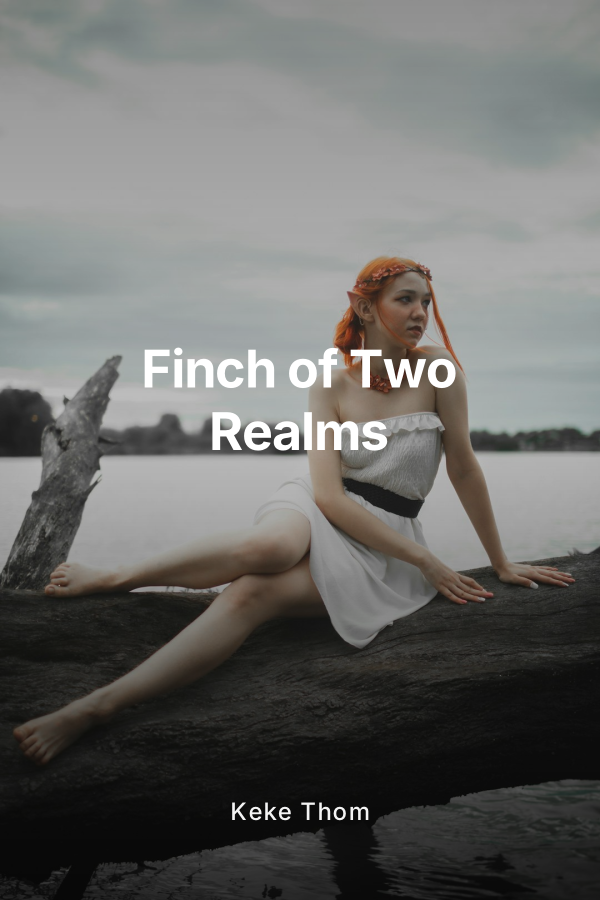
In a world where magic is hoarded by scholars and feared by nobles, Finch should have been nothing more than a scandal whispered behind painted fans. She is the daughter of a nobleman and a Scarlet Lady, conceived beneath caravan lanterns and raised on fiddle songs, roadside alchemy, and the casual witchcraft of wanderers. She is also something far older and far stranger than any child has a right to be.
Once, she was the Puppeteer, a half elven witch whose hexes ruined dynasties and toppled proud names from their pedestals. Hated and hunted, she built a quiet empire of curses and favors, answering to no one save the Patron Dreamer who granted her the forbidden gift of walking the dreamscape. Then came betrayal, flight, and a last desperate bargain that scattered her power, sealed her past, and left her sleeping patron hidden away behind layers of protective magic.
Now she wakes again in a smaller body with shorter legs, in a life that belongs to a girl named Finch. The curse clinging to Finch is the sort an apprentice might recognize and a practiced witch could pick apart, a petty misfortune charm that ruins meals, trips heels, shatters glass, and lures disaster just close enough to sting. The Puppeteer could break it with a gesture and a word. She chooses not to.
Because curses are maps as much as chains, and Finch intends to find whoever set this one.
While awake, Finch must trade caravan dust for polished floors and painted ceilings. Sent to live with her father, head of a minor noble house, she steps through the iron gates with a battered satchel, a secret reservoir of forbidden knowledge, and the distinct feeling that this entire estate would crumble if someone so much as breathed the proper spell near it. Her father admits her out of duty and fear of scandal, his lady wife refuses to look at her, and her three half brothers hang in an awkward orbit around this unwanted new sister.
Finch refuses to behave like a regret.
The youngest, swayed by his mother’s disdain, snubs her with all the hauteur a boy his age can summon. Forced into shared lessons, Finch irritates him with wicked precision, needling his pride and tripping him with carefully chosen words rather than spells. The eldest, eager to appear composed and gracious, tries to “tolerate” her. Finch tests the limits of that tolerance daily, slipping barbed comments into polite conversation and obeying his requests so literally that he ends up the fool. Only the second son, quiet and watchful, regards her with anything like neutrality. He is the one Finch chooses not to torment.
Within this house she wields her sharpest weapon: malicious compliance. Tutors arrive to shape the bastard daughter into something presentable, only to find their instructions followed with unnerving accuracy. Every vague directive, every smug command, every lazy assumption about her ignorance turns on them as Finch obeys to the letter. A poorly worded instruction turns a lesson into farce. A pompous lecture collapses under the weight of her clarifying questions. Punishments follow, of course. She spends hours standing on one foot with a book balanced on her head, face to the wall, but behind closed lids she is laughing and sorting through centuries of memory.
She has no patience for the cruelties of etiquette that serve only to break bodies and spirits. Narrow heels are an absurdity for someone living under a misfortune curse, so Finch would rather be barefoot than snap an ankle tumbling down a staircase. She dances as she did with the caravan, whirling like a street performer, bowing like a commoner mid celebration. She plays the household violin as if it were a fiddle, drawing out songs that belong to crossroads and firelight instead of gilded parlors, notes that carry the ache of old roads and the fierce joy of people who have nothing except what they can carry.
She keeps most of this to herself, avoiding spectacle in “civil company.” Within the estate she is an oddity the staff whisper about and the tutors complain of. Outside of it, to wider society, she is merely an inconvenience at the edge of rumor. That suits her just fine.
Yet the stillness of noble life hides a revelation that shakes even the Puppeteer’s ancient composure. Finch has assumed magic is kept silent in the house by choice, that the noble family has renounced spellcraft for political safety. The truth is far more ridiculous. None of them know how. Their bloodlines carry dormant potential, but they have never been taught so much as a basic cantrip. The few apprentice mages in their employ are clumsy and half trained, more dangerous to themselves than to any foe.
The realization leaves Finch stunned and outraged. In a single, unguarded moment she abandons caution and demands answers, grilling staff, family, and apprentices alike. How can anyone move through a world woven with arcane currents and yet remain so helpless? How do they lock their doors without warding them? How do they sleep without barriers against spiteful spirits?
In the same breath she lets slip one truth too many. She can unlock nearly anything, she says, if it was closed by hand or spell. She knows the logic of curses intimately and can unspool the knotwork of wards and bindings as easily as most people untie their shoelaces. Most present dismiss her claim as a child’s dramatics, thrown in a fit of pique. The second son does not. He hears in her words the outline of a weapon, or perhaps a key, and curiosity takes root where indifference once lived.
Finch returns to her silent projects, pretending nothing has shifted. Beneath the estate, in a neglected alchemy wing that smells of dust and old smoke, she resurrects another life. Shelves that once held formal tonics and sleeping draughts now fill with hand labeled vials, dried leaves, and powders only a seasoned witch would recognize. Her previous self’s research rests safely tucked in magic storage, reachable through a minor rip in reality only she can open. From these notes she resumes her experiments, pairing new herbs with old formulas, learning how local flora responds to the solvents and catalysts she once favored. This is not a bid for power so much as a continuation of an obsession. The Puppeteer was always a maker of things, and Finch sees no reason to stop.
When she slips away from stone and glass, she moves beneath the trees. The forest bordering the estate is no gateway to the dreamscape, only a patch of living green where she can breathe as herself. She forages for roots that stain fingers red and blossoms that smell of rain on copper. She listens to the creak of branches, gums sap from bark, and watches the way light shifts between leaves, satisfied with the simple magic of ordinary life. The spirits here are subtle, half sleeping things that leave her alone so long as she does not prod.
Her curse hums at the edge of everything, a background dissonance that warps timing and probability. Cups slip from hands inches from her fingers. Floorboards find the exact moment of her step to creak loudest. Ink bottles topple near her notes. She lets it stand, weakened but not broken, both as shield and signal. Whoever laid it upon Finch’s original self left behind a trail Finch intends to follow when the time is right.
At night, another world quietly opens. In her dreams she walks a shifting realm of impossible architecture, where rivers pour upward into starless skies and trees sing in tones that vibrate through bone. Here magic follows different rules, thick and soft as fog, mutable in ways waking sorcery can only envy. Here also she is not alone. Spirits, thought forms, and beings like Mr. Frog move through this landscape with unnerving ease.
Mr. Frog is some manner of human sized amphibian in a tophat who lives to cultivate chaos. The dreamscape refuses the simple logic of waking spells, but Mr. Frog moves through it with a sly, inexplicable authority, undoing order whenever he can. He upends Finch’s attempts at structure, warps her explorations into games, and turns promising paths into absurd disasters. He slips every trap she sets for him, leaving only laughter and confusion behind. Their rivalry has become a strange anchor to her nights, half infuriating and half strangely comforting.
Some nights she does not quite reach the dreamscape. Instead reality blurs as if seen through warped glass, and daydream sours into something too dense to ignore. To onlookers it appears as though she has been struck by sudden dizziness, as if she has swallowed the wrong tincture or is nursing an inexplicable migraine. To Finch it feels like the universe is briefly trying to speak in two voices at once. The moments pass without consequence, but each reminds her that the border between waking and dreaming is not as absolute as most believe.
In both realms, the Patron Dreamer remains distant yet ever present. Long ago this towering tiefling, altered by dream power and resting in endless sleep, promised protection and gifts in exchange for sanctuary. It was a pact that made the Puppeteer into something more than mortal, giving her the keys to corridors most witches never glimpse. Now, as Finch, she senses the Dreamer’s slumber like a star buried deep beneath the earth, unreachable and yet impossible to forget. Whether their pact survives her rebirth remains an unanswered question that hums beneath the story like a suppressed chord.
Across five chapters, Finch of Two Realms follows this odd child witch as she threads herself through a household that would prefer to pretend she does not exist. Each chapter dives deeper into a different layer of her existence.
In the early chapters, Finch arrives at the estate and measures it with the practiced eye of a predator pretending to be a lamb. She learns the rhythms of the staff, the temper of her half brothers, and the limits of the lady of the house’s cruelty. We see the first sparks of malicious compliance as Finch weaponizes obedience against condescending tutors and rigid rules, refusing to surrender the caravan’s honesty for the hollow comforts of nobility.
Later chapters reveal the house through an alchemist’s gaze. We walk with Finch into the forgotten laboratory, watch her methodically resurrect old experiments, and see her begin to map how the local environment can fuel or hinder the arts she once used to terrify powerful patrons. This same analytical eye turns on her curse as she probes its structure, tracing faint echoes of the witch who laid it.
Parallel to this, we follow Finch’s nights. The dreamscape gradually unfolds, not as an echo of the waking world but as a separate, wild kingdom where creatures like Mr. Frog wield authority no court can challenge. Finch tests the borders here, searching for hints of the Patron Dreamer, cataloging the dream realm’s hazards and its strange beauties. Yet the dream chapters never overwrite the waking story. They serve as counterpoint and context, a second melody twining around the first, revealing how a child shaped by absurdity can maintain her equilibrium in a rigid, joyless house.
The heart of the book lies in Finch’s relationships. There is no sudden reconciliation with her father, no dramatic collapse into pure villainy from her stepmother. Instead there are brittle dinners, half heard arguments behind doors, and fleeting moments where something like understanding threatens to appear and is swiftly stamped flat. Finch’s bond with her brothers shifts as they each discover that the “bastard witch” is neither as harmless nor as monstrous as rumor suggests. Of them all, it is the second son’s slow, pragmatic curiosity that creates the closest thing Finch has to an ally, thanks in no small part to her confessed talent for unlocking what was meant to stay shut.
By the end, Finch has not seized power nor miraculously mended a broken family. What she has done is far more dangerous. She has learned how this house thinks, where its walls are thinnest, and how to move within it without losing herself. She has indexed its secrets alongside her vials and formulae, added its small tragedies to the vast ledger of human folly she began keeping centuries before. She has remained defiantly herself, a caravan witch in borrowed silk, a child with the mind of an old predator who still finds joy in small rebellions and dark humor.
Finch of Two Realms is an epic fantasy told from the quiet corners. Instead of battlefields and thrones, it offers a laboratory cluttered with strange glass, a library where a cursed child traces the histories that tried to forget her kind, and a dreamscape where a girl chases an infuriating amphibian across shifting, impossible terrain. It is the story of a being too old to be innocent and too young to be resigned, learning how to inhabit both lives at once without letting either define her.
Most of all, it is the story of a witch who refuses to bow, whether to curses, to nobles, or to the very structure of reality itself.