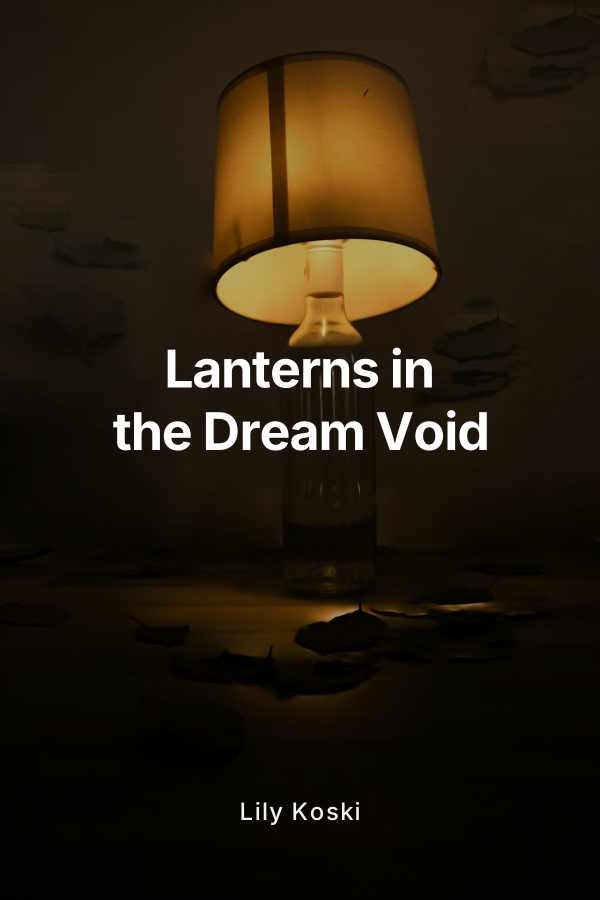
Lanterns in the Dream Void follows Elia, a gifted but fractured young woman who works at the most revered company in the city: Dream Management. In this world, dreams are not accidents of sleep. They are scripted, designed, and delivered by teams of specialists who travel through the dream void to gather what the waking world needs. Clients rent velvet-lined rooms, lie back under soft lantern light, and step safely into curated dreams that promise healing, clarity, or escape.
Publicly, Dream Management markets itself as a sanctuary of peace. Behind its polished glass halls, however, the company thrives on quiet exploitation. Workers are nudged into emotional extremes, clients’ vulnerabilities are carefully amplified, and all that unspoken pain is harvested as fuel for more powerful dreams. The more intense the feeling, the more potent the product. No one says this out loud. They simply smile.
Elia has always been good at smiling. She came to Dream Management because her past was already in ruins. Childhood for her is a tangle of foggy fragments: a blur of night, a sense of drowning, a voice silenced before it could cry out. She feels “broken” without knowing exactly how she shattered. The job offers structure, purpose, and the illusion that she can build something new without understanding what went wrong before.
At first, Elia flourishes. She joins a small dream void team that specializes in nighttime missions, traveling under dim lanterns into the shared subconscious of their clients. Inside the void, the world shifts into cattail reeds, twilight bogs, crumbling treehouses, and an endless hush where time crawls forward but never stops. In these surreal landscapes, Elia feels paradoxically at home. Here, her numbness is an asset. Here, her practiced smile keeps the team steady when things turn strange.
Her coworkers quickly pull her into a warm, if fragile, camaraderie. There is:
• The Treehouse Girl, an ambitious colleague who once built her life from scraps and hard work. She fought to get into Dream Management and is now climbing the ranks with fierce determination. To her, every promotion is another board in the treehouse she constructed by hand. She craves simple safety and real friendship, but she repeats to herself that she must be sharp, efficient, and unemotional if she wants to keep what she has built.
• The Loyal but Blackmailed Coworker, a quiet man whose loved one’s safety hangs over his head. He does what he is told, even when it sickens him. He trains himself not to see patterns of cruelty in the company’s practices. Secretly, he longs for courage, to say no just once, to protect both his family and his own conscience.
• The Carefree, Memory-lost Guy, a teammate whose past was accidentally erased during a mission gone wrong. He moves through the workplace with a lightness that feels almost impossible there. He tells jokes in the elevator, invents games on long night shifts, and brings joy to everyone around him. Underneath his silliness is a deep absence, a missing history he cannot name. His genuine laughter becomes both a balm and a quiet ache.
Within this mix of ambition, fear, and fragile happiness, Elia begins to sense that something is fundamentally wrong. The dream void seems to recognize her. Certain missions flicker into scenes that feel uncomfortably familiar. A child in a client’s dream stares with Elia’s own eyes. A stone bird, silent and heavy, appears at the edge of multiple assignments. Each time, a thin fog curls through the scene, and her mind tugs at something just out of reach.
Dream Management rewards results, not questions. Elia’s early success depends on her ability to keep smiling, to accept “the process” without complaint. Her own coping strategy fits perfectly with company culture. She learned long ago that smiling through pain makes the world easier to navigate. Now, her superiors praise her “professionalism” and “stability.”
The turning point comes gradually, then all at once.
A high-profile internal project, known informally as “the bog,” begins to spread through whispered conversations. Officially, it is a new initiative in deep therapeutic dreaming. Unofficially, it is a dangerous venture into unstable regions of the dream void, where truths sink and never rise again. The bog promises unprecedented profit and control. It also requires workers to cross ethical lines, to push clients past what is safe toward what is profitable.
When Elia refuses to “sweeten” a mission report and denies that a particularly distressing dream was beneficial, the thin veil of corporate kindness tears. Her supervisors interpret her honesty as disruption. Her refusal to manufacture a soothing narrative interrupts the company’s carefully curated calm. The fake peace wavers.
Elia is punished.
Demoted to a low-status position she once secretly looked down upon, she is reassigned to the riskiest night missions. Her life is treated as expendable, her contributions as replaceable. Former peers avoid her for fear of guilt by association. Her cheerful mask cracks, and her mental health spirals. Panic surges in the dream void. She experiences jagged flashbacks that arrive as sudden fog, a recurring dark swirl at the edge of her vision that signals a memory she cannot quite touch.
In this descent, she encounters the full force of Dream Management’s corruption. Some of her superiors, who once spoke in soft, polished tones, reveal their true nature. In hallways and debrief rooms, they gaslight her, belittle her contributions, twist her words, and mock her instability. Their cruelty teaches Elia brutal lessons: in a broken system, the corrupt often rise faster than the sincere, and performance can be valued more than truth.
Paradoxically, the humiliation and danger begin to transform her. Stripped of status, Elia starts to see the people she never noticed before: the night janitors of the dream rooms, the overworked technicians, the mission runners who come back shaking and are told to “be grateful for the opportunity.” Her demotion pulls her out of her bubble and into deeper empathy. She becomes more aware and respectful of others’ burdens, more emotionally connected to the coworkers she once dismissed.
Her dream missions, too, take on a different tone. The cheerful teammate without memories jolts her out of panic with silly improvised songs, whispers jokes as they tiptoe through shadowed glades, and offers a kind of acceptance that does not demand a smile in return. The blackmailed colleague’s stolen courage begins to show in small acts of defiance that only she seems to notice. The Treehouse Girl, catching glimpses of cracks in the company’s promises, wavers between ruthless ambition and a fragile desire for a life that is not built on fear.
As Elia’s own emotional awareness grows, the dream void starts to mirror her inner struggle. Darkness thickens into swirling fog whenever she brushes near a repressed memory. Dashes of light cut through scenes when she is close to honesty. Lanterns flicker brighter when teammates share genuine feelings rather than corporate slogans. Each mission begins with the team leader’s clipped announcement and a sterile briefing file, but what actually unfolds inside the void becomes messier, more human, and increasingly out of management’s control.
The more Elia refuses to mask her emotions to keep clients comfortable or executives satisfied, the more the dream scenarios shift. Dreams that should be placid and marketable grow raw edges. Long-concealed traumas surface. Clients see glimpses of their own patterns instead of soothing illusions. The company interprets this as system instability. Elia begins to understand it as truth trying to reach the surface.
Eventually, her search for how she became “broken” collides directly with Dream Management’s history. She discovers hints that the company once experimented with vulnerable children. Old mission files, buried deep in restricted archives, contain fragments that resemble her own life: a nameless subject who forgot childhood, a girl whose fear was harvested as a “promising resource.” Whether Dream Management caused her trauma or only preyed upon it becomes less important than the reality before her: this place profits from unhealed wounds.
Faced with this knowledge, Elia stands at a crossroads. She could retreat into numbness again, comply quietly, and cling to what little stability she has left. Or she can risk everything by telling the truth.
The heart of Lanterns in the Dream Void lies in this slow, courageous shift. Elia learns to draw boundaries in a world that respects none. She starts saying no to missions that cross ethical lines. She names her own fear instead of hiding it behind a smile. She refuses to let supervisors rewrite her experiences. In one pivotal scene, she stands in a dream consultation with a vulnerable client and, instead of selling them a polished fantasy, gently speaks about what real healing might require. It is a small act, but it is the first fully honest use of her voice.
Her awakening sends ripples through her inner circle. The Treehouse Girl, who has spent her life clinging to the height she fought to reach, faces the possibility that safety cannot be built on exploited foundations. The blackmailed coworker is forced to decide whether protecting his loved one is worth sacrificing everyone else. The carefree colleague, confronted with traces of his stolen past, must choose between the comfort of forgetting and the pain of remembering.
In the end, the story does not offer a tidy overthrow or a grand, cinematic war. Instead, it shows how truth moves through a system like a quiet crack, widening over time. Elia exposes Dream Management’s practices through a combination of recovered files, testimonies, and one daring dream mission that severs the company’s grip on the void. When the chains between the corporation and the dream world finally break, people begin to dream on their own terms again. Nightmares still exist, but they are no longer engineered for profit.
New laws begin to take shape. Newspaper headlines hint at hearings and reforms. Former workers organize support groups and community spaces for real mental health care. A small article about “ethical dream practice” appears beside a public notice of Dream Management’s restructuring. Yet the narrative lens stays close to Elia and the friends who walked through the darkness with her.
In a quiet closing sequence, the team gathers in a simple, hand-built space that recalls the childish hope of a treehouse. It is not high above the world but nestled among real branches and leaves. They sit there with no mission files, no scripts, no client expectations. For the first time, they are allowed to speak without performance. They talk about their fears, their mistakes, their regrets, and the futures they want to build.
Elia does not feel perfectly healed. She still has foggy memories and scars that pull at her on certain nights. But she has something she did not have before: an honest voice she trusts enough to use. Her boundaries are no longer made of stone walls but living lines that protect her while allowing others in. She understands that adventure is not just contained in surreal dreamscapes but in the daily choice to live truthfully, to seek help, and to walk away from places that demand silence.
Lanterns in the Dream Void is a blend of surreal workplace fantasy and emotional coming-of-age. It explores how systems can weaponize smiles and how individuals can reclaim their humanity from behind carefully managed masks. Through warm, humorous interactions and gently luminous imagery, it carries a hopeful tone even as it acknowledges the heaviness of trauma, manipulation, and loss.
By the final pages, readers are invited not only to witness Elia’s journey from caged songbird to self-voiced dream traveler, but also to consider their own “treehouse” moments. The book ends on a note of quiet inspiration: the sense that the truest adventure begins when we stop numbing ourselves, look directly at our pain, and take the first trembling step toward a life where our voices no longer belong to anyone else.