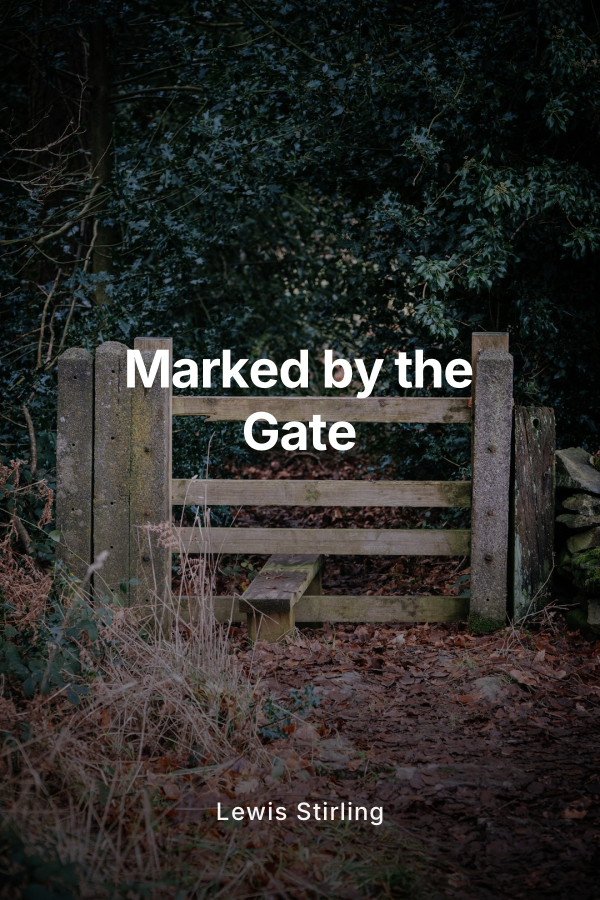
In the frozen dark of late December 2025, the seams between worlds are thinning, and the things that leak through do not care if humanity survives the winter.
Hidden behind layers of classified budgets and plausible deniability, the Agency of the Gate exists for a single purpose: to guard the fragile barrier that separates the human world from countless supernatural realms. Wraiths, soul-eaters, seam-ripper demons, half-forgotten gods, and the layered engines of hell all press against that barrier every night. When it fails, people die in ways that never make the news.
Kaine is the Agency’s most dangerous weapon and its most fragile liability. Branded as a child by a seam-ripper that murdered his legendary parents, he carries a hellish rune that marks him as a future vessel. At fifteen, broken and rootless in the foster system, he forged an eternal pact with Azarell, a child-like demon who hates hell more than any human could. The bond gives Kaine immunity to possession and the ability to borrow demonic senses and strength, but it also ties him to infernal politics he barely understands.
Recruited at seventeen by Alex Tome, the apparently carefree director of the Agency and human host to the gate-guardian god Venturn, Kaine spends the next decade becoming a myth in his own right. Alongside his partner and closest friend Natalia Hesk, he fights things that should not exist, seals rifts that should never have opened, and wins a living blade that drinks the souls of the enemies it cuts. By twenty-eight, he is scarred, lethal, and certain of one thing: people marked by hell do not get happy endings.
June wants nothing to do with any of that. At twenty-three, she is a solitary Gothic art student at Haven University, her world narrowed to canvases filled with nightmare visions she thinks are only imagination. At a gallery show, an enigmatic curator named Mr. Shu compliments her work and rests a gloved hand on her shoulder. The touch burns for a heartbeat, then fades.
That night, a massive infernal rune blooms across June’s back, invisible to her eyes but neon-bright to every predator on the other side of the veil. It is the same mark on Kaine’s skin, the same promise of future use. This time it is bait for a red oni, a relentless hunter tied to Mr. Shu’s secret ritual. The summoner’s goal is not chaos or random killing. He wants ascension. To reach godhood like the imprisoned entity DN-14, he needs marked souls, and June is the final, perfect catalyst.
When Kaine and Natalia follow the flicker of an active seam to the Eclipse Gallery, they brush against Shu’s masquerade and glimpse the oni lurking in the shadows. The trail leads them to June’s dorm. Kaine arrives at her door covered in old scars and quiet urgency, strips off his shirt to show his own rune, and warns her that what touched her is coming back to collect. June, convinced it is a cruel elaborate prank, slams the door and throws his card away.
The oni proves him right.
It tears through the university’s art building on Christmas night, hunting June with single-minded, infernal focus. Cornered, humiliated, and paralyzed by terror, she survives only because Kaine quite literally drops in from above. Borrowing Azarell’s power, he teleports, carves illusions into the air, taunts the demon until its molten rage peaks, and finally takes its head with the humming Sword of Souls in a brutal, acrobatic kill.
June’s world ends in that amphitheater. Hell is real, the mark on her back is a beacon, and she is a piece in someone else’s ritual. Kaine carries her home, cleans her without judgment when she breaks in the ugliest, most human ways, and leaves with a promise to explain everything if she will listen. It is the first time in years that June has been handled like something fragile and worth saving, and the first hairline crack in Kaine’s conviction that he is meant only to bleed for others.
From there, the circle tightens.
Kaine, Natalia, and Alex tie the oni to six previous soul-drain killings spread across the city. The crime scenes and dates form the faint outline of a sigil too complex to be coincidence. They consult Prisoner DN-14, the ascendant thing that once took an agent’s body and nearly tore open a seam inside Agency headquarters. From behind reinforced glass and sanctified locks, DN-14 whispers about echo binds, borrowed power, and a summoner named Shu who is reaching for the same impossible state.
A second oni confirms the threat. Armed with a soul shield rune formed from tormented spirits, the creature nearly kills Kaine and Natalia in a deserted gallery soaked in old paint and fresh blood. Rune Master Geoffrey Yates diagnoses the armor as forbidden work that should require direct sanction from the top of hell’s hierarchy. Someone has obtained infernal permission that nobody on Earth was meant to hold.
To find out how far the corruption runs, the team must walk into hell’s local embassy.
The Lux is a nightclub pocket realm permitted by Lucifer himself, a cathedral of red light and temptation where demons, humans, and hybrids mingle under strict unspoken rules. Alex authorizes a visit and insists June come. She needs to see what hunts her, and they need the devil’s honesty more than his favor.
Inside the Lux, amid the throb of music and the press of inhuman eyes, boundaries blur. Kaine remembers nearly accepting a drink from Lucifer as a reckless nineteen-year-old, the way his mark flared and seared as warning. He keeps June close, recites the rules again and again: no drinks, no conversations, no eye contact, no deals. When they finally request an audience, the world narrows to a dark back office and a figure who steps out of mythology.
Lucifer appears first as a towering silhouette with molten eyes and curling horns, then as a devastatingly handsome man in a black suit who never quite leaves the shadows. The meeting is not a bargain, not yet. Instead, Kaine places an infernal coin on the table, an artifact potent enough to buy exactly five yes or no answers that hell cannot twist.
In the sharp, terrifying quiet that follows, Kaine spends those questions with clinical precision. He confirms that Mr. Shu is not Lucifer’s agent, is not protected by any of his lieutenants, and yet somehow wields authorization for magic that should be far beyond a mortal. He learns that Shu’s aim is not a simple rift or a petty power grab. The summoner wants ascension. To achieve it, he intends to devour June’s marked soul, using her as the final key in a chain of killings that will pry him loose from human limitation.
Lucifer smiles as he confirms each truth, feigning irritation at unauthorized vulgar magic while clearly savoring the drama. As they leave, he flicks one last barb at Kaine’s back: a casual instruction to say hello to Azarell, proof that even a demon who hides from hell’s politics cannot truly escape its gaze.
The fallout is immediate and brutal. In the SUV’s dim interior, June’s composure shatters. She has just stood in a room with the devil, learned that her soul is a carefully chosen ingredient in a ritual for godhood, and watched the people who claim to protect her barter with monsters. Panic claws up her throat in a full, crushing attack. Natalia, battle-hardened and quietly in love with the man sitting in stunned silence across from her, moves first to comfort June. She talks her down, treats her like a new recruit rather than a victim, and in doing so starts a bond that will cut all three of them open later.
From here, the horror escalates on every front.
Kaine and Natalia sift through Shu’s financials, properties, and cultural fronts, discovering layers of shell galleries, private collections, and charities that all feed into his ascension map. They fight more creatures armored in impossible runes, each encounter digging the hooks of forbidden magic deeper into the city. Venturn’s presence behind Alex’s eyes grows sharper. When the gate itself is threatened or Alex’s people are pushed too far, anger drags the god to the surface.
On those rare occasions, the room goes black. A searing backlight outlines Alex as a colossal armored knight with four horns and a shifting cape, and a voice like a tectonic shift speaks in his place. Venturn does not emerge often, but when he does, the Agency sees the hierarchy they truly serve. Alex and his god may share goals, yet everyone else is painfully mortal in comparison.
Amid the blood, the terror, and the slow revelation of how fragile the gate has become, human connection insists on existing.
June trains under Kaine’s reluctant supervision, learning to throw a punch before a spell, to use her fear instead of letting it drown her, to stare into the wrongness that hangs around seams without losing herself. The first kill leaves her shaking in a safehouse shower while Kaine waits outside the door, wordless but present. The first time they sleep together, it is not designed as cure or escape. It happens because they have bled together, seen each other humiliated and weak, and need proof that they are still human in bodies that hell has marked.
Their intimacy is not the axis of the story, but it changes the tilt of every decision that follows. June falls first, quietly and without hope, fully aware that Natalia has ten years of history she can never touch. Kaine resists longer, buried under guilt, old trauma, and the unspoken expectation that he and Natalia will eventually cross the line everyone has always seen between them. When his feelings for June finally breach those walls, they do so in a world where no one has time for romance and everyone has too much to lose.
The resulting triangle is not a soap opera but a raw fracture in an already stressed team. Natalia is a soldier first, an agent who has killed and almost died beside Kaine more times than she can count. She can read his micro-expressions in combat, match his reckless dives into danger, and predict when Azarell’s influence sharpens his movements. She sees his shifting attention, the way he takes one step closer than necessary to June during debriefs, and she feels the ground move beneath her feet.
Their personal fault lines collide with the external war at the worst possible moment.
Shu’s final preparations force a confrontation where retreat means the gate itself might splinter. Natalia realizes with brutal clarity that there is only one way to keep Kaine alive and the ritual from completing. The sacrifice is not a noble surprise. She knows she will die. Kaine sees it coming in the split-second before she moves and understands that there is no alternative.
Her death is a choice. It is not clean, not gentle. She buys them the one narrow opening they need at a cost written in her own blood, and that knowledge will haunt Kaine and June long after the last spell is cast. Whether Natalia has time for final words or simply leaves behind unfinished conversations, what matters most is what her absence carves out in those who stay. Kaine can no longer pretend that he is meant only to be the shield that always breaks. June can no longer allow herself to be defined only as prey.
By the time the story reaches its climax, the Agency of the Gate stands at a crossroads where institutional duty, divine oversight, personal love, and infernal temptation all intersect. Venturn and Alex must decide how much of their humanity they can risk to prevent a single man’s ascension. Azarell must choose between continued obscurity and the danger of drawing Lucifer’s gaze to protect the one mortal he has tethered himself to. Kaine and June must decide if any love, however quiet, can survive in a life that requires this much blood.
“Marked by the Gate” is a dark urban fantasy that refuses to flinch. It combines vivid, graphic horror with kinetic action, infernal politics with intimate trauma, and cosmic stakes with painfully human choices. It asks whether anyone marked by hell can ever truly choose their own fate, whether godhood is anything more than refined selfishness, and whether the smallest acts of tenderness can hold their shape when everything else is built on sacrifice.
At its core, beneath the screaming seams and the distant echo of Lucifer’s laughter, the book is about three people who should never have met, bound together by a mark that should never have been made, trying to carve out a human connection in a war that wants to turn them all into tools.