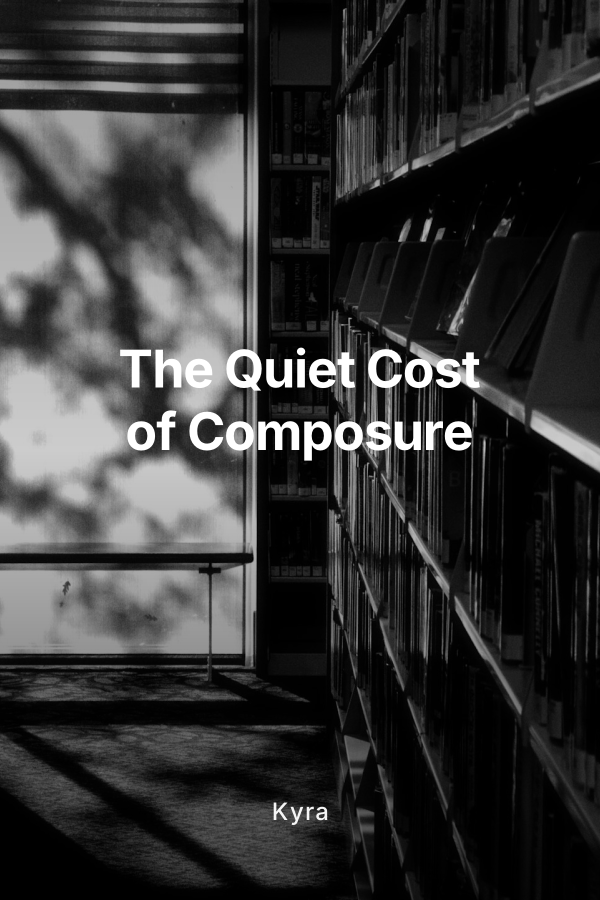
This book is a quiet, psychological slice of life that follows Kiora, an 18 year old high school senior who appears disciplined, calm, and perfectly composed while silently deteriorating under the weight of grief, abandonment, and an unnamed war with her own body.
Outwardly she is the model student. She plans to study finance and accounting, always hands in polished work, and maintains an almost serene politeness that teachers and classmates read as maturity. Inwardly, however, she lives in a cold, echoing landscape of self criticism, existential questions, and a fragile sense of self that has never recovered from recurring loss. Her composure is not proof of strength. It is armor.
Spanning the final months of her last school year, the narrative moves between the ordinary texture of Kiora’s days and the private storm she never shows. The external world is soft and deceptively simple: math lessons with Mr. Z and his precise, logical explanations; English class with the loud, warm Ms. A, who encourages Kiora to write more; chaotic evenings at home with her sister Madi and her overstimulating niece Ai; sparse, practical conversations with Ray, her disciplined online friend who chats with her about schoolwork, routines, and plans.
Underneath this ordinary structure beats a far more volatile inner life. Kiora’s inner monologue is present throughout, revealing a girl who is melancholic, lucid, and painfully self aware. She analyzes herself with almost clinical sharpness at times, then dissolves into raw, spiraling emotion at others. She knows she is masking. She knows she is performing a role. Yet she cannot imagine putting that mask down.
Two offscreen presences become the gravitational centers of her inner world: Ray and Adam.
Ray exists mainly in chat logs. With him, Kiora plays the role of the capable planner: they share schedules, grades, goals, methods for staying disciplined. She jokes lightly, talks about exams and university applications, sends him advice she barely follows herself. She never lets him see the part of her that feels paper thin. The tragedy is not that he fails her. It is that she never gives him the chance to truly see her.
Adam, by contrast, is not there at all. He vanished months before the story begins, after years of intimacy online. He was the one person Kiora fully trusted. In the past, during overlapping grief and misfortune, she poured herself into their late night chats and calls. He saw more of her than anyone. He promised he would always be there for her. He even joked once about coming to Canada to meet her. That promise becomes the thread she clings to, then strangles herself with.
His disappearance rips open a fault line she had kept sealed. Kiora’s diary entries, scattered through the book in brief first person passages, reveal the magnitude of the attachment she never admitted out loud. Her tone when she writes about him is idealizing, childlike, desperate, cutting, and painfully honest. She loops through betrayal and self blame, envy of his girlfriend, fear that he has replaced her, and shame at how much power he holds in her mind. She writes about waiting for him “like a dog,” both disgusted with herself and unable to stop.
Around this emotional wound grows a hidden habit that becomes her secret coping mechanism. She never names it clinically, but the signs are there in subtle, accumulating detail. A sore throat that lingers for months and is brushed off. A faint scar on her knuckle that no one bothers to wonder about. A pattern of always going to the bathroom after meals, planning her day around when she can be alone. A growing tiredness and occasional dizziness that she attributes to stress, work, and senior year pressure.
In her thoughts and in her diary she sidesteps direct labels. Instead she confesses a quieter, more general wish: that she did not need anything at all. That her body did not insist on demands. That she could erase the need to eat, erase sensation, erase the feeling of being out of control. After episodes in the bathroom, she experiences a brief, dangerous relief. Soft joy. Quiet. A sense of resetting herself and wiping the slate of her emotions clean. The story never glamorizes this. It simply lets the reader stand beside her while she teaches herself to equate harm with calm.
Externally, nothing looks catastrophic. Her grades stay respectable, her conversations with Ray sound normal, and she continues to present as the responsible, composed girl who has “been through a lot” but “is strong.” Teachers praise her discipline. Her family is too absorbed in their own routines, noise, and financial worries to scrutinize the tiredness in her eyes. No one asks why she always excuses herself right after a meal. No one counts how often she clears her throat.
Kiora herself lives with a sense that misfortune arrives in cycles. Every one to three years, something tears her life open a little more. The deaths of her parents. Fragmented relationships with siblings. Losses that never got the dignity of being named as trauma. Adam’s disappearance fits, in her mind, into this pattern of inevitable recurrence. It both confirms her hopeless worldview and breaks something she still secretly hoped was safe.
Throughout the book, the structure reflects her double existence. Scenes of daily life are quiet, even gentle: a planner open on her desk with neatly ruled boxes; careful budgeting of time and money for future university costs; moments of genuine admiration for Mr. Z’s clarity; Ms. A reading one of her more restrained pieces of writing and praising her subtlety without realizing what it hides. Interleaved with these are shards of diary entries, flashes of late night thoughts, and small hints that the cost of this composure is climbing higher.
Her inner world moves on a pendulum between hope and fatalism. On some days she is genuinely planning: researching programs, building spreadsheets, plotting how to support herself. On others she quietly thinks she will never live to see any of it, though she continues to act as if she will. This split is never announced, only felt. The reader watches her draft a careful future with the same hands that are, unbeknownst to everyone else, slowly dragging her body toward collapse.
The climax arrives not with melodrama but with an eerie stillness that cracks. In an ordinary classroom, during an ordinary lesson, Kiora’s body finally gives out. The scene stretches into slow motion from her perspective. Light blurs. Sounds become distant and muffled, as if underwater. She struggles to keep her focus on the board, on her notes, on anything that might anchor her, but her awareness sinks inward. Her heart races, yet her limbs feel heavy. She is stuck inside her own head as her sense of the room dissolves.
Her inner monologue in these final moments is raw and spiraling. Memories flicker through her mind with startling clarity and softness: Adam’s voice promising, during her grief, that he would always be there for her; his half joking question about flying to Canada to meet her; laughter in a game chat; the glow of a screen where he typed comfort when she thought she would shatter. These memories overlay other bright fragments: her mother’s presence, fragments of childhood safety, moments when life felt less unreal.
As her vision narrows, she hears someone close by say, “I’m here for you,” and the phrase collides with Adam’s voice in her head. In her fading awareness she notices the dissonance. That is strange, she thinks. Adam told her that all the time. But he is not here. That is right. He is not here.
Her thoughts drift into a small, frantic circle. “I wish you were here.” “Would you pity me if I were hospitalized?” “Come back to me.” These ideas begin as full sentences and then fracture into pieces. Around and between them flickers a deeper regret: that she did not keep him closer, that she let distance form and did not fight harder. She scolds herself with a semi gentle cruelty. Naive. Foolish. Too hopeful. Yet through this self directed anger flows something softer. A wish that he is happy, wherever he is. A plea that he will be okay, even if she is not.
Sound distorts further. The scrape of chairs. A teacher calling her name. Someone dropping to their knees, lifting her head, talking about an ambulance. She recognizes no one. The faces smear into light and shadow. All that remains sharp is her attachment to a boy who is not there and cannot hear her. In those last seconds, one thought forms clearly in the middle of the chaos, clean and bittersweet: maybe in another life, they could have grown up, met, married the way she has quietly, foolishly dreamed over the past year. Maybe in another life, the timing would have been kinder.
She does not wake up again.
Only after that quiet, unseen death do the people around her begin to piece together fragments of who she really was. A journal is found, its entries ranging from controlled reflections to unfiltered spirals. It is not a full record, only glimpses. No one had known the extent of her attachment to Adam. No one had seen how the loss of that online presence echoed the earlier griefs she had survived in silence. Among her things lies a will she prepared with the same methodical care she invested in her study plans, a testament to how seriously she took the possibility that her pattern of misfortune would catch her again.
In that will, there is a specific instruction: a portion of its contents, along with a personal letter, is to be sent to Adam. Another letter, separate, includes details about her funeral. The narrative does not linger in the logistics. It simply confirms that, in the quiet interval after her passing, the arrangements are followed.
The story’s final glimpse shifts briefly, distantly, to the boy who never knew her full inner landscape. An envelope reaches him. Inside are official pages that mention his name and a separate, more personal letter in her handwriting. The reader does not see every word she wrote to him, only understands that it reveals the depth of her trust, her longing, and the pain she never allowed herself to show while she was alive. Somewhere outside the story’s main stage, a hand grips paper until it crumples. A single tear drops. His mouth shapes her name once, softly: “Kiora…”
Then it ends.
There is no redemption arc, no last minute intervention, no neat understanding from those who remain. The book closes on that unresolved, aching space where a life full of quiet courage and concealed suffering has ended, and the world that admired her resilience never truly saw the cost of it. The emotional residue left with the reader is heavy, sorrowful, and difficult to shake: a mixture of shock, pity, confusion, and a haunting recognition of how easy it is to miss the signs in someone who seems perfectly composed.
At its core, The Quiet Cost of Composure is a melancholic study of masking, control, and the small, invisible negotiations a person makes every day just to stay upright. It explores what it means to be seen as “strong” when that strength is really silence, and how an apparently ordinary life can conceal a devastating battle that ends not with spectacle but with a girl quietly slipping away in a classroom where no one ever thought to ask if she was actually okay.