In the sooted veins of Victorian London, where coal smoke blurs the boundary between heaven and hell, two monsters walk among the living and pray for a salvation they scarcely believe they deserve.
Emilia Concordia, florist of Chancery Lane, should be the picture of gentle domestic virtue. Yet beneath her apron and the scent of roses, she hides a body traced with scars and a soul gnawed by guilt. Twice married, twice broken, declared barren by human doctors and despised by her own hidden kind, she carries a feral secret: Emilia is a werewolf. Once, in a storm of terror and long-stifled rage, she tore her abusive second husband apart and devoured him. Since that night, she fears not men, but herself. She tends her flowers as if they were fragile prayers, clings to her faith, and locks the beast inside. Love, in her imagination, has become nothing but a trigger for slaughter.
Klavdiy Dremont is older in spirit than his thirty-seven mortal years suggest. A Russian expatriate who keeps to London’s shadows, he dresses in stark black and white, his open collar revealing dark chest hair and the faint trace of a blasphemous tattoo on his wrist, twin to the larger sigil spread across his back. Once, he was simply a man who died of heartbreak when the woman he adored betrayed him. In that moment of despair, something ancient and malign reached for him. Now he lives again as a vampire bound to an evil force he never consciously chose, his bloodless pale skin and weary eyes hiding a creature that, when fully awakened, is a vision of decay: rotting flesh, hollow sockets, and a bleeding wound where a heart once beat.
Klavdiy bears his satanic markings as the brand of a loyalty he regrets. He feeds when necessary, kills when reason demands it, and stands apart from his own kind, who revel in refined cruelty. He prefers his piano to the hunt, nocturnes to screams. He is patient, precise, brutally honest, and convinced that feeling nothing is safer than breaking again. Yet on his finger rests a ring he cannot discard, the last relic of the love that ruined him.
Emilia and Klavdiy belong to rival monstrous breeds locked in a tense and ancient hostility. Vampires pride themselves on elegant sadism, notorious for preying upon “pure” women and leaving tragedy in their wake. Werewolves are territorial gluttons whose lust and possessiveness twist easily into brutality. Both species have learned to hide beneath respectable human faces, masking their scents with special perfumes, slipping unnoticed through crowded streets, opera houses, and church pews. To the majority of Londoners, they are myths best suited to sermons and folktales, yet the Church whispers of their sins and hunters quietly arm themselves with silver, stakes, and ritual rites.
Into this secret world steps an elderly human scientist with a dangerous vision. Learned, soft-spoken, and apparently devout, he gathers rare specimens from the fringes of society. He claims that vampires and werewolves can be studied, purified, and restored to true humanity. To him, redemption is not a prayer but a formula. Behind locked doors and under gaslight, he runs an illegal organization that traps rogue creatures whose evil has overwhelmed any vestige of reason.
He offers Emilia and Klavdiy what no one else can: a structured path toward redemption and, perhaps, a chance to be human again in flesh as well as spirit. Both are starved enough for hope to listen.
Emilia joins him first, desperate to believe that the beast that once massacred her husband can be leashed or excised. Her faith tells her that even the worst soul may be forgiven, yet every time she feels anger rise, she tastes phantom blood on her tongue. The scientist assures her that science and discipline can succeed where prayer has failed. Her work among captured monsters is framed as charity through horror, a brutal duty in service of a higher good.
Klavdiy comes to the organization more reluctantly. Tired of his blood-soaked half-life, he agrees to assist, partly out of curiosity, partly because he senses in the scientist a man who, like himself, walks too close to the abyss. If there is even a shadow of a chance to sever the hidden pact that chained him to Satanic power, he will take it. He will dissect his own kind if he must. They have earned no less.
Brought together under this grim banner, Emilia and Klavdiy begin as uneasy co-workers. She smells the faint trace of vampire beneath his perfume and feels instinctive revulsion. He hears the hush of her heartbeat and recognizes the caged power of a wolf. Their very natures urge them to circle, bristle, and bare fangs. She is warm devotion and repressed rage. He is cold intellect and masked despair. To trust the other is to embrace everything their species has taught them to loathe.
Their missions demand cooperation. They track feral rogues through fog-bound alleys, confront half-mad specimens in underground cells, and witness the scientist’s methods. Needles, restraints, calculated deprivation, and ritual-like procedures blur the line between treatment and torment. Victims become subjects. Subjects become data. Emilia’s religious conscience recoils even as she participates. Klavdiy’s disdain for his kind justifies much, yet not everything.
As they work, tensions that began as species hatred transform into something more personal. Emilia’s fear of men kneels at war with the small, unsettling safety she feels in Klavdiy’s calm presence. He does not touch her without invitation. His brutal honesty, spoken in a deep, smoky accent, cuts through her self-loathing. He never flatters, yet somehow never condemns. Where others called her useless, he notes her precision, her courage in the face of her own nature.
For Klavdiy, Emilia becomes an intrusion of sunlight into his carefully managed gloom. Her kindness, though cracked and trembling, is stubborn. Her reverence for God torments him, because it reminds him of everything his tattoos deny and everything he once believed could never be his again. He watches her tend to flowers after a night of bloodwork, fingers still shaking from experimental horrors, and feels the first hairline fracture in his stoic shell.
Their bond grows in the spaces between missions. Shared confessions spoken in cramped laboratories and candlelit chapels, a hand steadied here, a shoulder offered there. The distrust that defined them softens into a fragile, unsanctioned friendship. Yet the closer they draw to each other, the more their inner demons stir.
Emilia’s wolf reads his presence as claim and territory. The thought of him in danger ignites a raw, possessive fury that terrifies her. If she loves again, will she cage her beloved or cannibalize him? Klavdiy’s dead heart flinches at the memory of betrayal. To care for Emilia is to risk another shattering, another metaphorical death he may not escape this time.
Everything changes one terrible night when a mission unravels into catastrophe. In a deserted warehouse, among rusted chains and holy-laced weapons smuggled by hunters, Emilia faces her worst nightmare. A rogue creature and human zealotry collide, and she is caught at the center. Wounded, drained, and half-shifted, she hovers at the edge of death. It is then that Klavdiy chooses.
Instead of fleeing, he steps between her broken body and a consecrated strike that could end her. He offers his own cursed flesh to the instruments meant to destroy monsters. It is not calculation. It is not research. It is a pure, reckless, selfless act that rips through his carefully guarded indifference. The pain that follows is a kind of martyrdom he never sought, a sacrifice no demon-bound vampire should be willing to make.
Both survive, but nothing between them is the same afterward. In the aftermath, as they heal in flickering half-darkness, their unspoken feelings rise to the surface with the inevitability of the tide. They try to deny it. They label stolen kisses as accidents, shared beds as necessities of recovery, whispered pledges as weak moments. Each time they touch, they swear it will be the last. Their minds refuse what their bodies and wounded spirits already know.
It is Klavdiy who speaks the truth first, confessing love that is not grand or theatrical, but steady and terrifying in its sincerity. Emilia recoils, not because she does not share it, but because she does. Love is what woke her wolf to terrible violence once before. Love is what killed him. They teeter on the edge, torn between desire and fear, devotion and the dread of what they might become to each other.
Around them, the scientist’s benevolent mask begins to crack. The more the pair question the morality of their work, the more inconsistencies they uncover. Rogue outbreaks that appear too conveniently timed. Records that vanish. Subjects whose “redemption” seems less like healing and more like reshaping. Slowly they realize that the old man’s quest for salvation is not for the monsters he collects, but for himself.
Haunted by his own past and consumed by his need to master sin through science, he has crossed line after line, justifying every cruelty as a step toward a holier outcome. The organization’s apparatus of containment and cure becomes a silent cathedral of hubris. When Emilia and Klavdiy begin to refuse his orders, to spare certain creatures, to prioritize mercy over data, they paint targets on their own backs.
Their rebellion triggers the story’s most harrowing descent. Turned from hunters into quarry, they must navigate secret cells, corrupted liturgies, and the scientist’s growing willingness to sacrifice anything, including them, for what he perceives as the ultimate experiment: proving that monstrous natures can be extinguished, even if it means extinguishing the subjects themselves.
At the heart of the final conflict lies a terrible choice. To bring down the organization and end the scientist’s reign, Emilia and Klavdiy must confront not only their oppressor, but also the darkness within themselves. Emilia must finally accept her wolf, not as a curse to deny, but as a part of herself that can be bent to protection rather than destruction. Klavdiy must reject the terms of the evil that resurrected him and offer himself wholly, not to damnation, but to love and to a sacrifice that costs him nearly everything.
Their joint act of selfless defiance, born of mutual devotion rather than obligation, breaks a chain no ritual could sever. In choosing each other and the innocent over fear, pride, and self-preservation, they accomplish the very miracle the scientist tried to fabricate: authentic redemption. The organization collapses, its laboratories silenced, its doctrines exposed as a twisted parody of grace.
In the quiet that follows, a different transformation unfolds. No potion, machine, or incantation grants it. Instead, it is the slow, almost imperceptible blossoming of true humanity from soil drenched in blood. Their monstrous forms recede. Hunger and howl fall silent. Flesh warms. Hearts beat. The vampire and the werewolf awaken one morning to find that they are simply a man and a woman again, scarred but alive, freed from the bodily tyranny of their former natures.
Years later, beneath the softened London sky, their story resolves in a humble, luminous coda. Emilia and Klavdiy, now husband and wife, walk to church with three small children tumbling around them. The old tattoos on his skin have faded to ghostly shadows. Her hands, once weapons, now guide little fingers in weaving flower crowns. They sit in a pew not as outcasts hiding among the devout, but as part of a fragile, ordinary congregation.
Yet the past is not erased. It hums softly in Klavdiy’s occasional nightmares, in the way Emilia sometimes pauses at the scent of rain as if expecting a howl in the distance. One child lingers a little too long at stained-glass depictions of angels and demons, sensing more than the priest intends. The gothic undercurrent remains, a reminder that light gained is only precious because of the darkness endured.
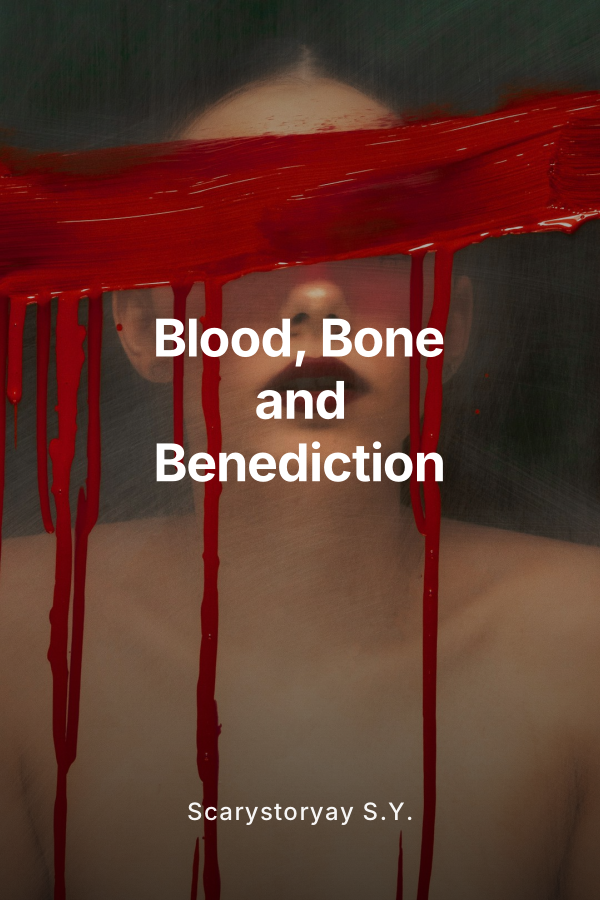
Blood, Bone and Benediction is a gothic romance threaded with horror, a supernatural thriller of Victorian alleys and secret laboratories, and a drama about two broken souls learning that true redemption cannot be manufactured or forced. It must be chosen, again and again, through acts of courage, tenderness, and selfless love.
In a world where vampires are proud predators and werewolves ravenous beasts, Emilia and Klavdiy defy the scripts written for them. They are not cleansed by denial of their sins, but by facing them together, bearing the weight side by side. This is not the story of monsters turned saints, but of monsters who, at last, learn how to become human.