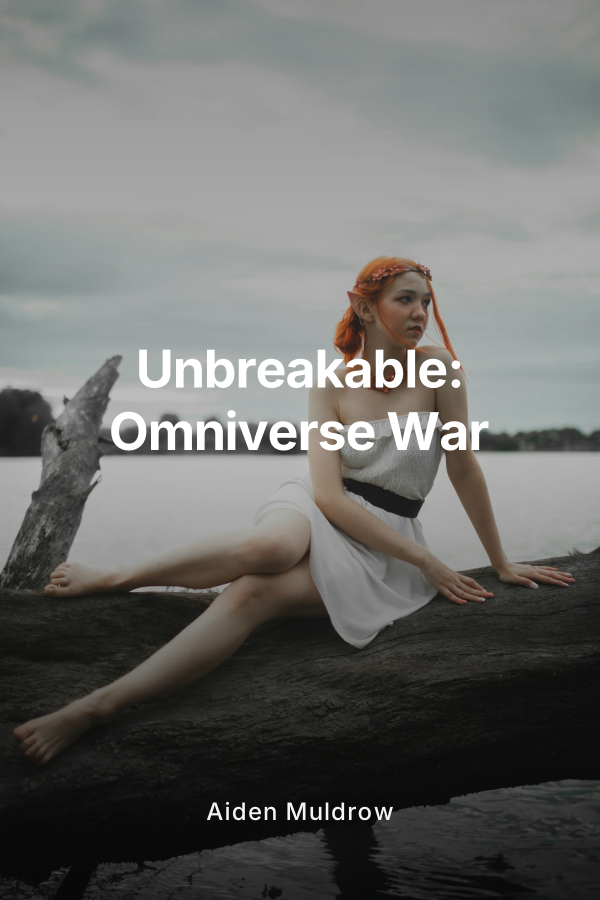
Summary:
Two months after shattering the Omni-chair and stepping away from godhood, sixteen-year-old Ethan Harris is finally living in the open. Chicago knows that the quiet Chormo kid with the messy curls is Unbreakable. His parents know. His brother knows. His friends know. The Guardians of the Earth are on magazine covers, in government hearings, and in every argument thread online.
And Mark Legion’s zealots are making sure the world learns all the wrong lessons.
From hidden bunkers and media studios, the disgraced politician’s followers twist every clip and headline. They frame Unbreakable as a ticking bomb who almost murdered a federal hero. They paint Legion as a visionary betrayed by rogue supers and shadowy mystics. When those zealots break their leader out of his secret off‑the‑books prison, Mark Legion comes back not as the rattled villain Ethan left in a containment cell, but as a wounded patriot playing martyr on national TV.
As the public mood sours, Ethan’s life splits clean down the middle. By day he is the too‑famous junior trying to navigate a summer break full of whispered rumors, shaky apologies, and a new relationship with Sasha after her painful breakup with Dylan. He limps through community forums where angry neighbors demand he “take responsibility” for every broken window in the city, and through family dinners where his adoptive parents wrestle with how to protect a son who can withstand artillery fire. Jordan, once seething with resentment, begins to see Ethan as more than a walking disaster. The brothers test new ground between sarcasm and real trust.
By night, he is still Unbreakable, patrolling a city that is no longer sure it wants him. Beside him stand Lady Thunder, who has clawed her powers back through relentless training and dangerous magical bargains, and Captain United, now stripped of his stolen Chormo enhancements and learning who he is when he cannot rely on super strength. The Guardians are no longer just three, either. Two new heroes crash into their orbit.
Multi-boy is a twelve-year-old prodigy with the unnerving ability to duplicate himself without limit and an ego even bigger than his swarm of selves. He treats danger like a game and wants nothing more than to prove he belongs with the big names. Enginir is a twenty‑three‑year‑old telekinetic engineer whose mind can tear tanks apart like toys, rebuild them in midair, and sketch universe‑scale weapons on the back of a napkin. Brilliant, socially awkward, and far more frightening than she realizes, she is the kind of ally who can shift battles and ethics in equal measure.
Together, the expanded Guardians juggle a three‑front war: Mark Legion’s propaganda and covert operations on Earth, the fragile rebuilding of public trust, and the unsettling call from beyond the stars that Ethan can no longer ignore.
That call comes from Ravager.
The warlord Chormo who once tried to claim Earth as his kingdom now appears not as a conqueror, but as a messenger. He invites Ethan to see what real Chormo rule looks like on Maggist, a distant world he has taken as his own. Maggist is a planet of giant, intelligent maggots who speak, build, argue, and feel. Under Ravager’s iron rule they survive, but they do not live. They eat and work and fear. They worship a king who sees them as assets rather than people.
Ethan’s first instinct is disgust. His second is outrage. His third is dangerous pity.
If even these strange, squirming citizens can look up at him with hopeful eyes, how can he leave them to be crushed under Chormo boots? When Cylus the Explorer, a terrifying figure from outside their reality, sets his sights on Maggist as a testing ground, the fragile balance on that world breaks. And Ethan witnesses something that shakes him worse than any universe monster.
He meets his real parents.
They are not the lost heroes of a tragic story. They are the King and Queen of the Chormo empire: the architects of the war genome that built his species. They arrive like a storm in perfect armor, stronger than Ravager, older than the Messias machines, and every bit as ruthless. They expected their heir to have conquered his adopted mud ball by now. Instead they find him living with human parents, attending school, and fighting to protect people they consider livestock.
They smile, open‑armed, and offer him what they believe he truly wants: a throne at their side, a crown that would make him king of Maggist and heir to a resurgent Chormo empire. They speak of destiny, of blood, of the waste of his talents on “weaklings.” They promise to right every wrong he has raged at: no more Watchers on high, no more Legion types playing with his blood, no more monsters slipping through cracks. All he has to do is stop pretending he is human.
Ethan’s heart lurches.
He has never felt so seen and so misread at the same time. Part of him flares at the thought of not always being the lone Chormo trying to be better. Another part recoils as he watches his birth parents talk about cities and worlds the way George talks about case files: as problems to be solved, not people to be loved. When he refuses their offer, they drop the mask.
If he will not stand with them, he will kneel under them.
The Chormo royal invasion of Earth is not a theatrical alien attack. It is a methodical crushing. Cities burn. Millions die in coordinated strikes designed to break resistance and punish Ethan’s defiance. Maggist screams under twin pressures: Cylus’s experiments and the tightening fist of Chormo control. The Guardians, who thought defeating the Watcher had earned them a reprieve, find themselves outmatched on every front. This is not one god. This is an empire.
Ravager, forced into an uneasy alliance with the very boy he insisted was soft, becomes Ethan’s most brutal teacher. He drags Ethan through the ruins of worlds his parents have “reeducated.” He shows him the pits where disobedient species were broken and rebuilt. He points out, with vicious clarity, how Ethan’s mercy is exactly what his parents are counting on.
They will beg. They will cry. They will promise peace. And the second he turns his back, they will kill him and everyone he loves.
When the final confrontation comes, Ethan cannot do it. Standing in the shattered bones of a city, face to face with the beings who gave him life and ordered the deaths of millions, he feels something break inside. Every instinct in his Chormo body screams to strike. Every scrap of his adopted heart screams that killing his own parents will ruin him in ways no throne ever could.
He drops his hands.
Ravager does not.
With icy efficiency and centuries of rage at their failed empire boiling under his skin, he kills the king and queen of the Chormos in front of Ethan. The blows that end their reign are brutal and simple. No speeches. No mercy. No hesitation.
Later, he explains in a single, terrible line:
“They were counting on you to be kind. I did what you could not. I did what had to be done.”
Ethan is left staring at the bodies of his blood and at the man who just saved him by tearing apart the last link to his origin. Relief and horror coil together inside him. His no‑kill rule is intact. His hands are technically clean. And that knowledge feels almost as filthy as blood.
While Ethan staggers under that weight, a darker storm gathers across realities.
Cylus the Explorer is not a normal villain. Born in Omniverse 1524, a branch of existence that should never have existed, he grew up as a mistake in the eyes of gods and monsters. Hunted by beings that considered him a glitch, he watched his own world’s Ethan grow up loved by Chormo royalty, descend to Earth at sixteen, and conquer it with a smile. That Ethan killed Cylus’s family in a show of strength. Cylus’s grief and fury woke powers that were never meant to be. In a moment of incandescent rage, he killed his world’s Unbreakable and vowed that no version of Ethan Harris, anywhere, would ever get the life his did.
Cylus has been hunting across the Omniverse since before Ethan ever woke up in a Chicago bedroom. He was the unseen spear in the shadows of Book One, testing the edges of realities, learning how far Chormo heroes would go. Now he steps fully into the light.
He discovers a way to cheat the walls between Omniverses in a way even the Watcher did not imagine. He drags every living Unbreakable into Omniverse 1.
The sky splits above Earth and a dozen other worlds as alternate Ethans fall through. Some are tyrants, draped in flags and blood. Some are broken weapons in chains. Some are tired heroes who never had a Lady Thunder or a Captain United. A rare few are good boys from good kitchens who chose the same impossible line Ethan did. All of them share his face.
The Unbreakable War begins.
It is not clean. It is not noble. It is a nightmare where Ethan fights himself at every turn. He faces versions of his own rage who never had anyone to pull them back. He watches an Ethan who is a father die trying to get back to a universe where his child will never see him again. He looks into the eyes of an Ethan who stayed in the Omni-chair, who never stood up, and sees what he almost became: a cold, brilliant god who regards the rest of them as a fascinating problem to solve.
The Guardians are outnumbered, outgunned, and breakingly human. Thunder, powerless again in the face of multiversal shockwaves, becomes the team’s voice and conscience, forcing them to see the souls behind each variant’s fists. Daniel, fully human now, fights anyway, proving to himself and to Ethan that a hero is not measured in megatons. Enginir strains her telekinesis and her ethics to the limit, designing universe‑scale traps to corral monsters wearing Ethan’s skin without wiping out entire realities in the process.
Multi-boy, the arrogant child who once treated duplication as a party trick, learns the ugliest truth of power. When Cylus finally turns his full fury on their Ethan, intent on making him watch the Omniverse burn, it is Multi-boy who stands between them. While Guardians and good Unbreakables fall around them, while chair‑Ethan is brought down from his invisible throne by the sight of a family he abandoned in another line of reality, Multi-boy makes a choice none of the older heroes will.
He kills Cylus.
There is no speech. No ritual. Just a blur of young bodies and a single, fatal blow delivered by someone too young to understand the full cost and too old to be shielded from it anymore.
When the smoke clears, Omniverse 1 is scarred. Many Ethans lie dead, their lives and worlds gone with them. The few good Unbreakables who survive return, shaken, to their own realities with a shard of Ethan’s stubborn hope. Chair‑Ethan, convinced to step away from endless control not by argument but by the sight of what his absence did to his own children in another branch, vanishes into the multiverse with a choice that might one day echo back.
On Earth, the Chormo royal threat is gone. Mark Legion’s zealots have been discredited by their own violence. Legion himself faces a reckoning in real courts instead of secret cells. The Guardians stand battered but unbroken.
Ethan keeps his no‑kill rule.
He has watched worlds burn. He has felt the temptation of the Omni-chair twice. He has stood over his parents’ corpses, knowing someone else did what he could not. He has seen versions of himself die as monsters and as martyrs. He has watched a twelve‑year‑old teammate become a killer in order to save him.
He chooses, again, not to be god, judge, or executioner.
He chooses to be a guardian.
As summer closes, his life is still split—but the line is no longer about lies. It is about balance. He and Jordan bicker over games and trauma and who gets the last slice of pizza, then sit side by side in public meetings where Jordan quietly backs his brother against angry strangers. Sasha, who left Dylan not in a blaze of drama but in a series of aching conversations, chooses to be with Ethan knowing exactly how likely he is to die. Dylan, bruised but loyal, remains Ethan’s brother in all but blood, calling him on his hypocrisy and guarding his blind spots.
Tammy and George prove, over and over, that they were always his best chance at being more than his blood. Tammy risks her license and reputation to get care for Maggist refugees and traumatized kids whose powers scare the system. George throws his hard‑earned name behind legislation that recognizes metahumans as citizens rather than weapons. They stand in front of cameras and committees and say, clearly, “He is our son, he makes mistakes, and he is trying to be better. That is all we can ask of any of you.”
The public is not magically fixed. Some people will always fear what they cannot control. Some will always worship it. Ethan begins to accept that he is a symbol to strangers and a boy to the people who matter. He cannot save everyone. He will keep trying anyway.
On Maggist, newly freed maggot leaders begin building a world that is theirs, not Ravager’s. The once‑warlord lingers at the edge of the Guardians’ world, a dangerous ally whose hands are stained with the blood of Ethan’s parents and a thousand others. Sometimes he and Ethan stand on opposite sides of the same field and say nothing, both haunted by what they have done and what they have refused to do.
Far beyond any of them, in the dark between galaxies, something watches.
A Messias observer—one of the ancient machine‑makers who once forged Anti-droid 973 to exterminate Chormos—hangs in quiet orbit above a ruined, forgotten world. Its sensors replay a single image from Omniverse 1: a Chormo boy refusing a throne, sparing enemies, grieving worlds that were never his, and standing shoulder to shoulder with humans and maggots and a former warlord to protect people he could easily rule.
“Incongruity,” the Messias unit notes. “Variable: compassion.”
For the first time in its long, ruthless history, it hesitates to file “Chormo” under “irredeemable.”
Unbreakable: Omniverse War ends on a rooftop in Chicago again. The skyline is battered but standing. The Guardians—Thunder, United, Multi-boy, Enginir, and Ethan—argue about takeout and patrol routes under a sky blessedly free of chairs. Down below, Sasha, Dylan, Timmy, Jordan, Tammy, and George are setting out mismatched plates for a noisy, imperfect dinner.
Ethan stands between both worlds, scarred and older than his years, very aware that somewhere, something ancient is recalculating its plans around him.
He has seen how small one boy is in the Omniverse.
He has also seen what that boy can change.
He leans on the railing, feels the night air in his lungs, and does the only thing that has ever made sense:
He stays.