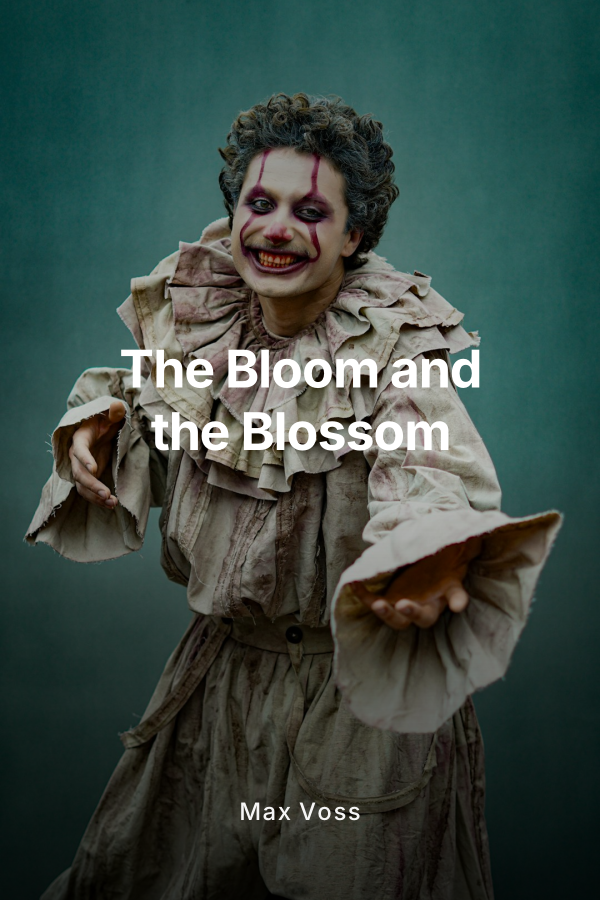
In a quiet, sunlit flower shop called Bloom & Blossom, Lexi thinks she has finally built a life that is hers alone. The petals, the colors, the gentle rhythms of customers and deliveries are a far cry from the dark, possessive genius she escaped: Mark, the man whose control once dictated every breath she took. A restraining order and three state lines stand between them, or so she believes.
When Mark steps back into her shop, he does not come with apologies or flowers. He comes with an invention. What begins as a grotesque act of domination, a calculated violation with a shining steel pump, twists into something no one expects: creation. In minutes, Lexi is forced through an impossible transformation, her body inflated beyond human limits, then driven into a brutal, accelerated labor on the shop floor. The child she births is not a memory of their past, but a product of his experiment, a life that, by his logic, belongs to him.
Lexi feels something different. The instant she holds her daughter, fear makes room for a love that eclipses everything Mark ever controlled. This is not his project. This is her child.
The Bloom and the Blossom follows Lexi in the aftermath of that impossible day as she navigates a new reality: a newborn in her arms, a madman who believes he has rewritten the laws of life, and a world that will not easily believe what happened among the roses and lilies. Mark is not just obsessed with Lexi anymore. He is obsessed with proving that his “creation” is a breakthrough, not a crime. To him, the baby is living proof of his genius, a key to fame, power, and a new kind of ownership over life itself.
As Lexi tries to rebuild a shattered sense of normalcy, she faces a gauntlet of disbelief and doubt. Doctors, lawyers, and authorities struggle to understand her story. There is no simple evidence, no conventional explanation, only a traumatized woman, her infant, and a man who knows how to sound plausible even while he descends further into fanaticism.
The town around Bloom & Blossom, once an easy backdrop to Lexi’s quiet second chance, becomes a battlefield of perception. Is she an unstable woman clinging to a delusion about her ex, or a survivor whose reality is too unsettling to accept? Mark, ever the strategist, exploits every gap in the system. He paints himself as a misunderstood visionary, Lexi as an unfit mother. Courts become arenas. Medical reports become weapons. The story of a nightmare birth in a flower shop turns into a contested myth.
Yet beneath the legal skirmishes and whispered gossip, something unnerving stirs around the child herself. She is healthy, but uncanny in small, unsettling ways. Her timing, her responses, the intensity of her presence hint that whatever Mark forced into Lexi’s body was not just air. Lexi begins to suspect that the “miracle” that terrifies her is also the reason she cannot simply disappear into anonymity. Her daughter might be proof of something extraordinary, and the wrong people are starting to notice.
As Mark’s obsession escalates, he crafts new “solutions,” new devices, and new schemes designed to reclaim what he believes is his. Surveillance, sabotage, and psychological games pull Lexi back into a spiral she swore she would never reenter. Yet this time, she is not the same woman he once broke. Motherhood arms her with a ferocity he never calculated. She is no longer just trying to save herself. She is fighting for a future in which her daughter is not a specimen or a trophy, but a person who can grow up free of his shadow.
Through five tightly woven chapters, the book traces Lexi’s journey from terror-stricken victim to strategic, battle-hardened protector. She learns to weaponize truth in a world that prefers comfortable lies. She builds unlikely alliances with people who begin to see past the absurdity of her story to the consistency of her courage. Mark, in contrast, spirals deeper into the prison of his own brilliance, unable to accept that the life he claims to have engineered refuses to belong to him.
The Bloom and the Blossom is a dark, emotionally charged fusion of psychological thriller and speculative fiction. It examines the thin line between innovation and violation, between creation and control. It asks what happens when a survivor’s story is too strange to be believed, and what kind of strength it takes to stand firm when the legal system, public opinion, and a relentless abuser are all aligned against you.
At its heart, this is not Mark’s story of invention. It is Lexi’s story of reclamation. The flower shop where her nightmare began becomes the place where she begins to fight back. Surrounded by fragile, living things that bloom in their own time and on their own terms, she slowly learns that survival is not enough. She must root herself, grow stronger, and refuse to let her past dictate her daughter’s future.
When the final confrontation arrives, Lexi stands in the place where it all started, no longer wilted by fear. Mark still believes in his “project,” in the supremacy of his idea, in the right to claim what he thinks he made. Lexi believes in something far more powerful: that the bond between a mother and her child cannot be engineered, patented, or possessed.
The bloom is her courage. The blossom is her child. Together, they are the one thing Mark never anticipated: a life he cannot control, and a love that breaks every mechanism he built.