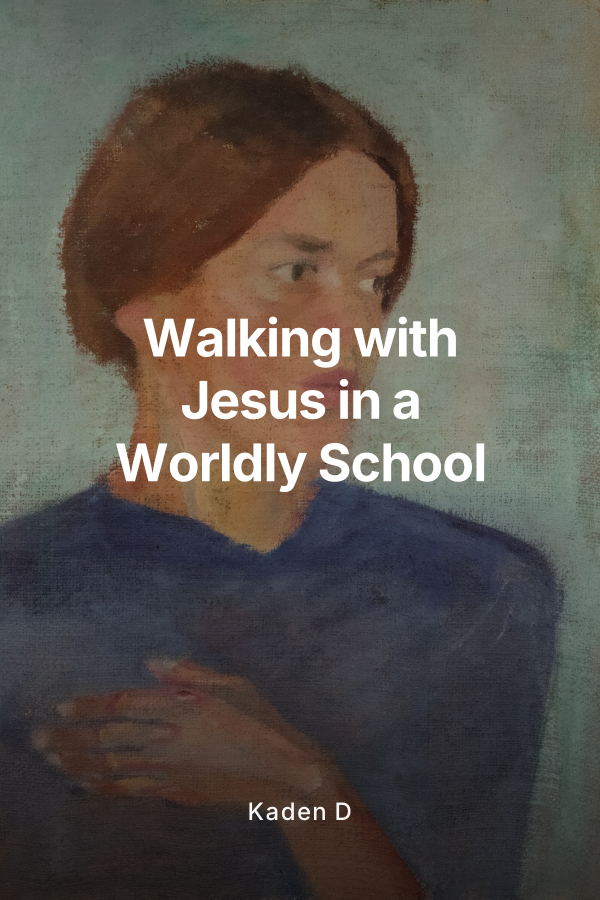
Only the first page of this book is left. We lost the rest in October 2026.
We lost access to the service that stored them, and no other copy exists. We're sorry.
Summary:
Ethan is fourteen when he steps into North Ridge High, a noisy, secular public school where Jesus’ name is rarely spoken and faith is often treated as something childish or strange. Quiet and thoughtful, Ethan feels invisible among the rushing crowds, the gossip, the parties, and the constant pressure to fit in. He is Catholic, but his faith feels small and fragile, more like something he remembers from childhood than a living friendship. Most days he walks the halls alone, wondering where God is in this world of lockers, loud music, and weekend plans he wants no part of.
Then he meets Olivia. She is not the loudest girl in school, not the most popular, and yet she carries a peace that Ethan cannot ignore. Olivia is openly Catholic in a place that does not understand it. She prays before tests, wears a simple cross, and does not laugh at crude jokes. Instead of preaching, she simply lives differently. When she notices Ethan sitting alone at lunch with a worn little pocket Bible, she chooses the empty seat beside him. That quiet choice changes everything.
Walking with Jesus in a Worldly School follows Ethan and Olivia from that first shy conversation through years of steady, simple, holy growth. At first, they are only classmates who share a faith. They begin reading Scripture together in small, hidden corners of their lives: a few verses after school, whispered prayers in Ethan’s living room, quiet reflections before Mass. Olivia gently shows Ethan what it means to walk closely with Jesus in daily life. She introduces him to the rosary not as a rule to follow, but as a chain of beads that helps a restless heart breathe. She shares stories of saints who faced pressure and loneliness yet stayed faithful, not as untouchable heroes, but as real people who chose God again and again.
Most of all, she guides him to confession. Ethan has never taken it very seriously. He has not done anything dramatic or scandalous. Yet he carries hidden darkness: resentment toward classmates who ignore him, shame about hiding his faith, small compromises he made just to avoid being noticed. Sitting in the confessional, he finally chooses radical honesty. For the first time, he tells the whole truth to Christ, through the priest, about fear, cowardice, and the quiet ways he has drifted from God. Grace washes in. Ethan steps out feeling unmistakably clean, lighter than he can ever remember. His classmates notice that he smiles more. Olivia sees it first and quietly thanks Jesus for the change.
As Ethan’s faith deepens, his relationship with Olivia changes too. Their friendship turns slowly, naturally, into a gentle Catholic romance with Jesus at its center. They do not drink, smoke, steal, or lie. They do not chase the wild parties that others brag about on Monday. Instead, they discover a different kind of adventure: the courage to stay pure in a world that calls purity foolish, the strength to say no when everyone expects a yes, the joy of sharing a love that is clean, honest, and rooted in God. They sit together on Ethan’s family couch, sharing a blanket and a well‑used Bible, fingers intertwined as they read the Word aloud and talk about what it means for their lives. Before they are a couple, they are brother and sister in Christ, and they protect that truth carefully.
The story does not depend on dramatic scandals or violent conflict. The tension is quieter and more real. Ethan and Olivia face the subtle weight of living differently in a school that runs on gossip, hookups, and weekend stories. They feel the sting of being left out. They wrestle with questions: Is a simple, holy life enough? Will they regret all the things they are not doing? Will they someday wish they had lived like everyone else? Again and again, they bring these questions to Jesus in Scripture, to the confessional in honest words, to the saints who once stood alone in their own cultures.
Across five chapters, the book traces their path through high school, into young adulthood, and all the way into old age. We see them navigate exams, graduations, first jobs, and the quiet decisions that shape a lifetime: where to live, how to work, how to be witnesses without preaching, how to let God be the heart of everything they do. They choose not to have children, not from coldness but from a shared sense that their vocation as a couple is a different kind of fruitfulness. Together they pour themselves into service at their parish, mentoring younger students who feel lost the way Ethan once did, quietly showing that a faithful Catholic relationship can be strong, clean, and deeply joyful even in a secular world.
Time passes. School lockers become distant memories. Yet one image remains the same. At fourteen, at twenty‑five, at fifty, and at nearly eighty, Ethan and Olivia sit together on a couch with a Bible between them. Sometimes they read long passages and talk for hours. Sometimes they manage only a few verses and a simple prayer. Sometimes the words are whispered through tears when life is heavy. Sometimes they are spoken with laughter and gratitude. Their bodies age, their hair grays, but their hands stay linked, and their hearts stay turned toward Christ.
Walking with Jesus in a Worldly School is not about running from the world. It is about learning to walk with Jesus right in the middle of it, without compromise, without bitterness, and without despair. It shows that a teenage boy in a secular school can grow into a man who is fully alive in Christ, not by being perfect, but by being honest, by returning again and again to confession, by clinging to the rosary and the saints, and by letting Scripture read his heart even as he reads it.
Above all, this is a love story. Not just the love between Ethan and Olivia, though their gentle cuddles on the couch and their lifelong companionship offer a powerful witness that pure, clean love is possible. It is the love story of Jesus patiently pursuing one quiet boy in a crowded school, drawing him through friendship, sacrament, and Scripture into a life where holiness is ordinary and joy is steady. Readers will close the book with a picture pressed into their hearts: two old Catholics on a worn couch, hands clasped, Bibles open, faces peaceful, whispering together, “We walked with You, and You never left us.”