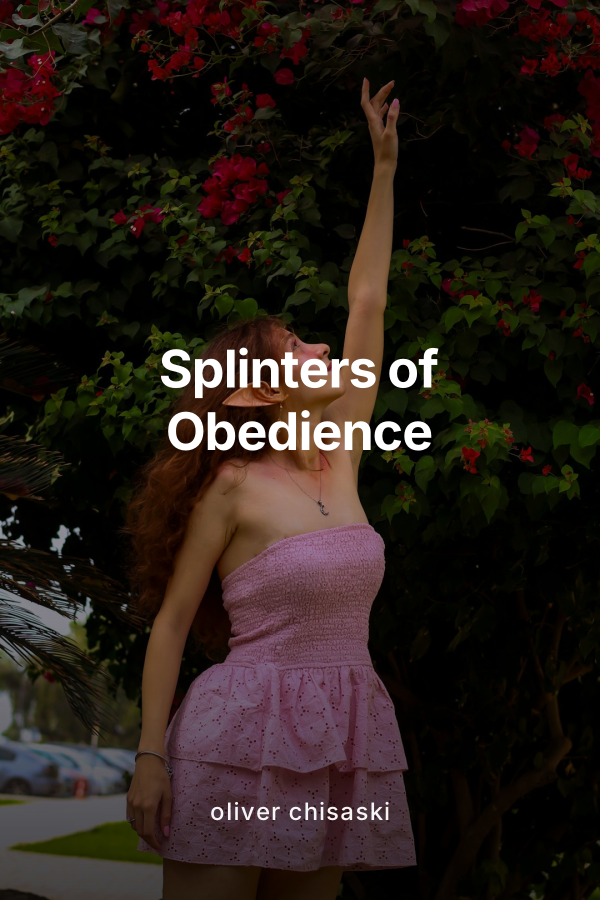
Only the first page of this book is left. We lost the rest in October 2026.
We lost access to the service that stored them, and no other copy exists. We're sorry.
Summary:
“Broken Orbit” is a brutal, intimate psychological dark romance that follows the toxic, obsessive bond between Moira O’Deorain, a brilliant and ruthless geneticist, and Oliver Williams, the fragile young woman she resurrected and reshaped into a living anomaly. The story lives at the knife-edge where love, dependence, and abuse become indistinguishable.
Moira is a towering, androgynous presence whose authority fills every room before she speaks. Feared by former colleagues and enemies alike, she has built her life on cold logic, unsentimental research, and an unshakable belief that the strong are entitled to use the weak. In Oliver, she found more than a subject. She found a creation, a possession, and a private devotion she could mold, break, and rebuild as she pleased.
Oliver’s life ended at fourteen in fire and shrapnel on a Dublin street. Moira refused to let it stay that way. Reconstructed in secret laboratories and anchored to unstable temporal energy, Oliver was raised inside Talon’s walls, half weapon and half ward. Her powers let her stretch and shiver moments, yet she cannot escape the one timeline that matters most: the one that binds her to Moira.
Now, with Talon gone and Overwatch dismantled, the pair live under false names in Manchester, where Oliver tries to inhabit a version of normal life she never had. College, buses, music, posters on the wall: all of it feels thin and unreal. The only thing that feels solid is Moira’s hand on her throat, Moira’s voice in her ear, Moira’s gaze that sees straight through every lie Oliver tells others and herself.
To Oliver, Moira is home, lover, savior, and captor in one. She understands that what they share is wrong, yet her body and mind have been trained to turn toward Moira for everything: safety, punishment, comfort, annihilation. To Moira, Oliver is an achievement, a constant experiment, and the one soul she allows dangerously close. Control is Moira’s language of love. Tenderness is a weapon she wields sparingly, knowing exactly how devastating each rationed touch can be.
Across the book’s two chapters, “Broken Orbit” traces a single volatile night in their new domestic life. An argument over Oliver’s fragile attempts at independence ignites a spiral of post-fight intimacy that is as erotic as it is horrifying. The narrative stays close to Oliver’s quietly dissociated mind as she is pulled from room to room, from kitchen counter to workspace to bedroom, the spaces of ordinary life becoming stages for reenacting the power structures of the laboratory.
Moira demands apologies and obedience, framing her cruelty as care: a necessary correction, a reminder of who Oliver belongs to. She mixes rough manhandling with a chilling closeness, gripping wrists and throat while pressing their bodies together, while her mouth shapes both endearments and degradation. Toys, overstimulation, and calculated denial become instruments in Moira’s attempt to “teach” Oliver that no one knows her, owns her, or can satisfy her like Moira does.
Oliver’s resistance collapses slowly, almost silently. “No” gives way to “please,” pushing hands slide into clinging fingers, and tears that never quite become sobs are kissed away by the same woman who caused them. Inside her own head, Oliver watches herself from a distance, tracing the shape of Moira’s hands more than her own fear, counting breaths and words in an effort to stay whole. The result is a portrait of a young woman so starved for connection that even violation becomes proof that she is seen and wanted.
The final aftermath offers no easy catharsis. When the night’s violence ebbs, Moira’s mock-affection is as controlling as any restraint. Clothes are straightened, a body is arranged, gratitude is demanded and given. Oliver ends where she began: pressed close against the source of her harm, drifting between numbness and desperate hunger for the only touch she has ever been allowed to claim as love.
“Broken Orbit” is not a story of healing or redemption. It is a study of how power corrodes affection and how trauma can tangle itself so tightly with desire that the victim cannot tell them apart. The book foregrounds its content as abuse and rape, refusing to romanticize what unfolds even as it inhabits the erotic charge of their connection. It is meant for adult readers who seek fiction that confronts the darkest edges of intimacy: where devotion becomes possession, comfort becomes control, and one shattered girl orbits the woman who rebuilt her, unable to break free of the gravity that will destroy her.