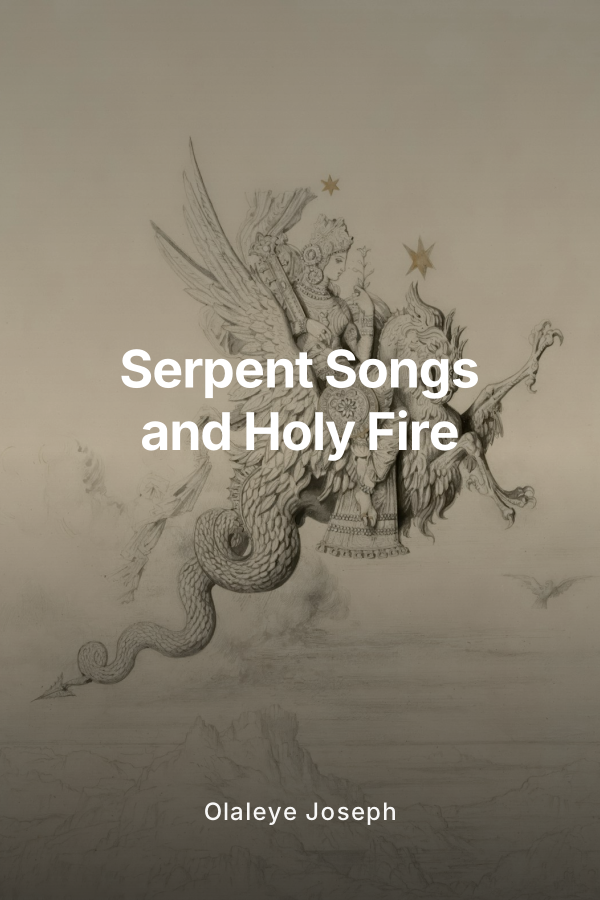
This book is a redemptive Christian spiritual warfare novel set primarily in a West African secondary school and a modern city hospital. It follows the rise and collapse of a gifted boy who becomes a campus pop star, plunges into depression and occult assault, and emerges as a healed worshipper of Jesus Christ, called to sing for God alone.
At the center of the story is Tobi, a bright, talented secondary school boy known for his voice, his dance moves, and his sharp mind. Teachers love him for his academic brilliance and discipline. Students adore him for the joy he brings to social gatherings. School events hardly feel complete without his performances. Between exam trophies and roaring applause, he seems to have everything a teenager could want. Beneath the surface, however, Tobi’s heart is restless. He is deeply impressionable, drawn to the glamour of a famous secular pop artist whose music and persona quietly shape his desires.
The turning point comes in the final year of secondary school, as he prepares for the most important exams of his life. In this pressure-filled season, Tobi’s admiration for a particular girl in his class grows into a consuming infatuation. She has a magnetic presence and moves around other boys with a boldness that confuses and fascinates him. In his immaturity and lack of guidance, he mistakes lust and emotional dependency for love. His timing could not be worse. With exams on the horizon and expectations sky high, he decides to reveal his feelings.
Unable to speak with courage, Tobi turns to a love letter. He pours out his confused affection in words that feel tender to him but sound clumsy and inappropriate to her. Instead of responding privately, the girl, already under her own pressures and fearing scandal, hands the letter over to a teacher. In a single humiliating moment, the private ache of a teenage heart is dragged into the harsh light of public judgment.
What follows is a social crucifixion. The letter circulates as gossip. Snickers, whispers, and mocking glances follow Tobi down the corridors. Teachers who once praised him now see recklessness rather than responsibility. Students who cheered his performances now label him foolish and obsessive. His identity as the school’s beloved “pop star” collapses almost overnight. The girl, who once secretly admired his talent, now feels cornered and exposed. Her silent affection hardens into resentment and then into deep hatred as she convinces herself that he has ruined her reputation and peace.
Under the weight of shame, misunderstanding, and relational chaos, Tobi sinks into depression. His sleep breaks. His concentration shatters. The exam halls, where he once felt confident and focused, become arenas of torment. Each day he sits at his desk, haunted by accusing thoughts. He stares at questions he could easily have solved in the past, but his mind feels clouded and heavy. His behavior grows strange. Silences stretch too long. Sudden bursts of nervous laughter or vacant stares alarm teachers and classmates. The girl, struggling with her own anxiety and guilt, interprets his instability as further harassment and blames him for her crumbling performance.
Unseen by human eyes, the spiritual atmosphere around Tobi thickens. What began as natural teenage infatuation has opened a doorway into a darker conflict. Enemies appear not only in whispers and rumors but in dreams and night visions. Teachers and classmates who now despise him become unwitting instruments in a satanic conspiracy in the spirit realm. At night, Tobi finds himself fighting shadowy figures he recognizes as their spiritual counterparts. Their faces blur, but their hostility is clear. They press on his chest, choke his throat, and jeer in voices that echo real insults spoken during the day.
Tobi’s exam results arrive as a catastrophe. Subjects in which he has always excelled suddenly show failure, as if his real performance has been stolen or obscured. Rumors suggest he has been denied his rightful marks in several papers. Instead of investigation, there is indifference. To most, it seems like the predictable outcome of a boy who lost focus and allowed silly romance to derail his future. To the girl, these results somehow validate her resentment. She reasons that his collapse has dragged a dark cloud over her own exams. In her mind, he becomes the sole cause of her underachievement, the thief of her peace and potential.
On the last day of exams, there is a moment of fragile humanity. With tension still simmering but the academic battle temporarily over, the girl feels a strange pull. Beneath her anger and fear, she remembers the boy who once sang and danced with innocent joy. For a brief, unguarded instant, she longs for closure, perhaps even reconciliation. She approaches him, silently asking for a simple hug as a sign that the nightmare is ending. Crushed under self-hatred, stripped of confidence, and determined to protect the last fragments of his dignity, Tobi refuses. The rejection cuts her and cements, in her heart, a conviction that he has wounded her beyond repair.
From there, the story moves into darker, more overt spiritual territory. Tobi’s distress is noticed not as a cry for spiritual help but as a clinical problem. He is taken to a hospital for supposed treatment of mental health issues. Unknown to him and his family, this particular medical setting is infiltrated by satanic agents disguised as ordinary doctors. Outwardly professional and calm, inwardly they serve as priests of another altar.
Tobi is coerced during evaluations, pushed to confess to behaviors and drug use that are not his own. Under pressure, fear, and confusion, he signs statements and repeats words he does not truly believe. These forced confessions become legalistic claims in the spirit realm, agreements that the enemy uses as open doors. The doctors administer injections that feel like powerful drugs but are, in truth, vehicles for serpentine spirits programmed to torment him in seasons to come. He senses a rush of unnatural strength, a counterfeit vitality that carries an underlying chill. It feels as if something ancient and cold has coiled itself inside his veins.
Blood samples are taken, but they serve more than diagnostic purposes. In the unseen realm, a portion of his life is yoked into dark covenants, forming hidden soul ties without his consent. Symbolically, parts of his identity and destiny are stored in shadowy altars. Tobi’s physical body lies on a hospital bed, but his spirit is dragged into regions of night. In one chilling encounter, a senior doctor leads him to a secluded examination room. There, the walls become transparent, and spiritual sight opens. He beholds a spirit prince seated on a grotesque throne, enthroned over a kingdom of counterfeited music, fame, and lust.
The revelation is shocking. This prince carries the twisted likeness of Tobi’s teenage music idol, the global pop star whose songs and performances once shaped his dreams. The man he once admired is, in the spirit, a second personality of a dark ambassador, a figure who traded his soul for brief earthly glory. The visions suggest that the prince’s empire has been fed and strengthened by multitudes of youths enthralled by his art, including Tobi himself. Now that Tobi has stumbled into a vulnerable spiritual state, that empire seeks to claim him more fully.
The conspiracy against Tobi intensifies. Teachers who once called his name with pride, classmates who once clapped for his shows, and the idol he adored are all, in the vision, linked in a spiritual court where accusations fly. He is condemned as a traitor, a failure, and a fool. Night after night, he suffers sensations of his body stretching and twisting in an elastic, serpentine manner, as if his very humanity is being reshaped into something less than what God intended. The feeling is invasive, degrading, and terrifying.
Yet even in this season of deep oppression, shafts of light break through. After his discharge from the hospital, he drags himself to church, desperate for prayer and guidance. Tragically, his search leads him to a pastor whose allegiance is not to Christ but to hidden altars. Instead of refuge, Tobi encounters betrayal. His pain is mishandled, his vulnerabilities exploited, and his longing for deliverance met with spiritual abuse. The church building becomes, in this episode, a battlefield where religious appearance hides demonic activity.
When he returns home, stripped of trust in both school and church, God Himself intervenes. One night, in the quiet of his family compound, Tobi encounters Jehovah in a vision of crushing glory. He sees the Lord robed in white, light pouring from His presence, attended by angels radiating peace and authority. The contrast between the counterfeit splendor of the spirit prince and the pure majesty of the Lord is stark. In that holy light, the lies of the enemy are exposed. The whispers that he is beyond repair, cursed by his failures, and owned by darkness begin to crumble.
In another scene, a fallen angel appears in the compound, issuing a challenge in the unseen realm. It demands that Tobi contest for influence “on the charts,” vying for hearts through music and fame. Before this challenge can fully take shape, Watchers, a class of holy angels, intervene. They rebuke the intruder and command it to leave the boy alone. The message is clear. Though the warfare is fierce, the boy is not abandoned. Heaven is not neutral in his struggle.
The conflict, however, is not limited to visions. Even mundane events carry spiritual weight. One day Tobi’s father buys him plantain as a simple gesture of care, unaware that the enemy has twisted this act into another gate of entry. The food carries a hidden spiritual contamination, a serpentine influence that seeks to reinforce the earlier hospital covenants. The narrative emphasizes that Satan, a murderer from the beginning and devoid of truth, loves to disguise poison as kindness and evil as comfort.
In response, Tobi turns more deliberately to prayer. He cries out to God for deliverance, purity, and understanding. In a powerful visitation, Jehovah appears again, this time in a robe of light that fills the boy’s room. The presence of God pierces through every layer of confusion. Tobi receives spiritual power that transforms his inner man. In visions, he sees himself grow into a giant of light, trampling on serpents and scorpions. Flames of fire burst from his feet each time he steps on the coiled bodies of anaconda-like creatures that represent entire satanic kingdoms in the second heaven. The imagery is fierce yet not gratuitously graphic, portraying spiritual warfare as real, weighty, and decisively shaped by divine authority rather than human strength.
During one quiet moment on his bed, lost in contemplation of God, Tobi sees an angelic figure appear. From the waist up it looks like a man, but from the waist down it is a blaze of burning fire, reminiscent of Old Testament prophetic visions. This encounter seals in his heart the conviction that his battles are known in the courts of heaven and that he is not fighting alone.
A subsequent follow-up visit to a different, more dignified hospital becomes another training ground. As Tobi walks through its majestic compound with his father, the laws of nature bend in the spirit. In a city renowned for heat and sunlight, he sees snowfall covering the pillars and trees. The whiteness speaks of purity, cleansing, and a new season. Amid this unreal weather, God stages a living parable between Tobi and his father.
In the spirit, roles are reversed. Tobi finds himself in the position of God, his father standing before him in garments soiled with filth like excrement, begging for mercy from terrible final judgment. Tobi hardens his heart in the vision and refuses forgiveness. Moments later, the scene flips. Now the father stands in the place of God, while Tobi kneels in need of pardon. This time the father refuses. Through these mirrored experiences, God teaches the boy the weight of mercy and the horror of withheld forgiveness. Without either man fully understanding at first, heaven is training them for deeper participation in divine love. The message echoes the biblical warning that those who receive mercy must become instruments of mercy.
As they continue their walk, another sign unfolds. Outside the hospital, heavy rainfall turns the grounds into a flood. Tobi’s garments, radiant in the spirit, are dipped into the waters. The moment his clothes touch the flood, the storm ceases. An unseen angel uses the anointing on those garments to calm the turmoil. It becomes a symbolic affirmation that God’s presence on his life can still storms, both in his family and in the wider world.
Meanwhile, the spirit prince from the earlier hospital encounter prepares a final assault, intending to kill Tobi and seize his household. Before the enemy can approach, however, God reveals the plan to one of His servants, an intercessor who lifts the boy in prayer. In a dramatic vision, Tobi’s spirit is carried like the wind, swift and purposeful, bearing a sharp sword. He confronts the fallen spirit in a clash of kingdoms. With a decisive blow, he severs the prince’s head. The fallen one releases a roar like a lion, then falls into the second death, a final separation beyond recovery. Tobi’s spirit returns to his body, alive and victorious.
After this climactic victory, he steps out of his room one day and hears a disturbing sound. Music floats through the air, but instead of the exhilarating melodies he once adored, he hears a voice writhing in pain, crying out from flames. He realizes, with a jolt, that this tormented voice belongs to his former pop idol, the very artist he had just defeated in the spiritual realm. The vision reveals the true cost of the idol’s fame and covenants. The artist had enjoyed a meteoric rise, extraordinary success, and hordes of adoring fans, only to die young while staging a comeback concert. The fiery agony Tobi now hears exposes the reality behind glamorous sin and occult power.
Shaken to the core, Tobi makes a radical choice. He gathers every trace of that idol’s influence in his life: audio recordings, videos, posters, and memorabilia. Each item represents a string of allegiance, a subtle agreement of admiration and trust. With grim determination and holy sorrow, he destroys them all and throws the remnants into the garbage. This act of consecration marks a clear breaking of covenant with darkness and a decisive turn toward the Lord Jesus Christ.
The book closes not with vague optimism but with a concrete commission. Tobi emerges from his season of depression, occult attack, and intense spiritual training as a healed young man. His mind, once clouded, is restored. His emotions, once tormented by shame, are steadied by the assurance of God’s love. His body, once invaded by serpentine powers, now carries the fire of the Holy Spirit. He steps onto a new stage, this time not to entertain a worldly crowd or to chase fleeting applause, but to lead hearts into the presence of the Lamb.
Music remains his arena, but its purpose has changed beyond recognition. He writes songs soaked in Scripture, clothed in the language of visions and deliverance. His testimony shapes his lyrics. Where he once sang to mirror the style of a corrupt idol, he now sings to magnify the beauty of Christ. Concerts turn into altars. Youths who once adored the same fallen artists he once loved now encounter the living God through his worship. Tobi’s school days, his humiliations, his hospital terrors, and his surreal visions are all gathered into a single, burning truth: no depth of compromise or oppression can hold a life that Christ has claimed.
“Serpent Songs and Holy Fire” is written for Christian readers between eighteen and thirty who are familiar with both the allure of popular culture and the realities of mental distress. It speaks to those who have danced close to darkness in the name of art, romance, or identity, and who now sense a call back to purity and purpose. Through its Nigerian setting, vivid but not gratuitous spiritual warfare, and layered symbolic visions, the book presents a story where mental health struggles intertwine with invisible battles, and where redemption is not merely survival but a commissioning into holy calling.
At its heart, this is the journey of a boy who was once the darling of his teachers and the star of his peers, then became the subject of scorn and demonic assault, and finally rose as a worshipper whose songs scorch serpents underfoot. It proclaims that Jesus Christ is still stronger than every secret covenant, every stolen grade, every cruel whisper, and every counterfeit throne.