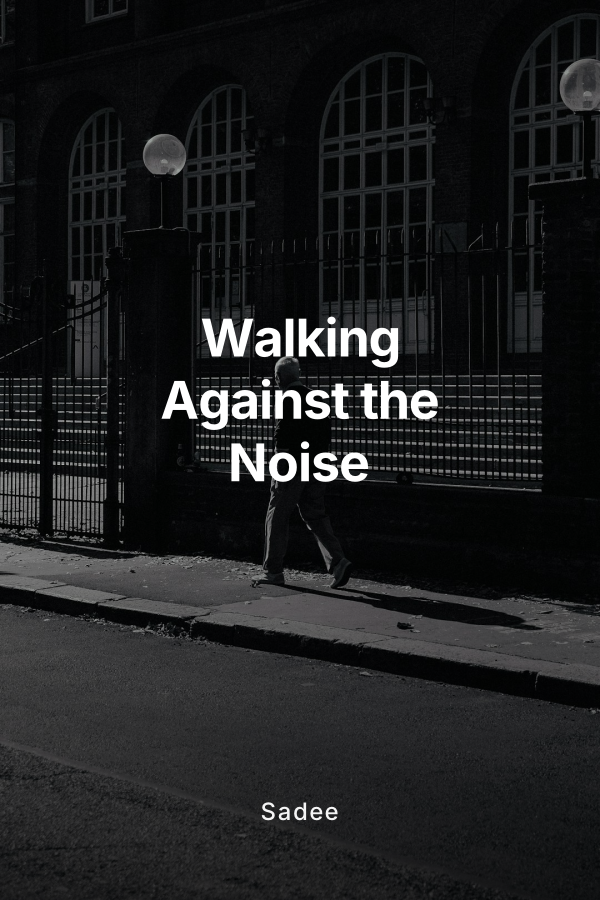
This book follows a single intense day in the life of Dennis, a British boy with severe non verbal athetoid cerebral palsy who is also deaf, drools constantly, makes strange involuntary noises, and often seems detached from the world around him . His family, worn down by fear, shame, and ignorance, have grown to resent his existence. They talk over him, around him, and sometimes about him, but never to him as if he were fully there. The story is told through the eyes of an unnamed first person narrator who steps into this hostile ordinary world and dares to treat Dennis as someone worth asking questions, worth waiting for, worth believing in.
Across five chapters, the narrator slowly uncovers the hidden intelligence and emotional life trapped behind Dennis’s involuntary movements and lack of speech. The narrator’s questions are simple at first, almost clumsy attempts to reach across an invisible wall. Instead of assuming that Dennis is unaware, the narrator learns to read the small shifts of his eyes, the rhythm of his noises, the tilt of his head, and the uneven stillness that passes for concentration. A private language begins to form in the spaces everyone else has already given up on.
As the narrator spends time at Dennis’s home, the cruelty and discomfort of his environment become impossible to ignore. The family’s hatred is not cartoon villainy but a slow, familiar kind of rejection rooted in disappointment, social stigma, and grief they never learned to name. Ordinary routines drip with contempt: plates slammed on tables, impatient sighs during personal care, jokes made just out of Dennis’s line of sight, the studied indifference to his drool and his spasms. The narrator becomes a quiet witness to these scenes and, through reflective commentary, exposes how easily a disabled child can be turned into a problem instead of a person.
The pivot of the book occurs when the narrator brings Dennis a walker, an adaptive aid that no one in his family has ever seriously considered for him. Whether out of disbelief in his abilities or sheer neglect, they have accepted the idea that Dennis will always remain limp and static, an object to be moved rather than someone who might move himself. The narrator, however, insists on trying. What follows is a raw, slow, painstaking process where each tiny shift of weight, each tense swallow, each strained breath becomes a significant act of defiance against the story everyone else has already written for Dennis.
When Dennis finally stands and takes steps with the walker, the moment is not clean or triumphant. It is shaking, drooling, uneven, and loud with his involuntary noises. Yet in that jagged effort there is unmistakable will. The narrator frames his movement not as a miracle cure but as proof that Dennis has always had a body that wanted more than the small corner of space he had been confined to. The walk outside is described with sensory attention in reverse: not what Dennis sees and hears in a traditional sense, but how the world presses against his skin, his balance, his breath. The outside air becomes a shocking presence, a reminder that he belongs to a world larger than four walls of resentment.
The story reaches its sharpest emotional peak when Dennis collapses into a seizure outdoors. Two strangers notice him and, instead of concern, respond with mocking laughter and cruel imitation of his noises and movements . The narrator is caught between urgent physical care for Dennis and a rising fury at the casual cruelty that echoes so perfectly the contempt inside Dennis’s home. This scene is not softened. The reader is forced to confront how quickly a disabled body in distress can become someone else’s entertainment, how suffering is translated into a spectacle when a life has been systematically stripped of dignity.
Yet the book refuses to end on a single note of despair. While the seizure and mockery mark a devastating climax, the narrator’s internal response becomes a quiet act of resistance. In the aftermath, while Dennis lies exhausted and recovering, the narrator speaks to him directly, in the same questioning, respectful tone carried throughout the book. They name what happened, not as Dennis’s failure, but as the world’s failure to see him. They describe the walker, the brief steps, and even the seizure as evidence of a body that tried, a person who reached beyond what others imagined possible. In doing so, the narrator keeps Dennis from being reduced to a moment of collapse.
Across its five chapters, the book weaves together present tense narrative, internal monologue from the narrator, and vivid sensory descriptions of Dennis’s movements and environment. It avoids sentimentality and inspirational clichés, instead focusing on the uncomfortable, often ugly truths of living with severe disability in a family and society that do not want to understand. The narrative voice remains intimate and self critical, acknowledging mistakes, awkward questions, and moments of doubt where the narrator wonders whether they are helping Dennis or simply imposing their own need to feel like a savior.
Central themes include the difference between awareness and how it looks from the outside, the ease with which disabled people are written off as less than human, and the quiet, radical power of asking someone questions even when they cannot answer in conventional ways. Dennis’s apparent unawareness is repeatedly challenged by tiny responses that suggest understanding beneath the surface: the way his noises change slightly when mocked, the way his body leans almost imperceptibly toward the door when the walker is mentioned, the way his eyes fix on the narrator just a second longer when asked a question addressed to him and not about him.
The book also examines the narrator’s moral responsibility. It explores the complexity of stepping into someone else’s suffering: the risk of misreading consent when someone cannot give words, the danger of offering help that could cause physical harm, the guilt of leaving at the end of the day while Dennis remains with his hostile family. The seizure incident crystallizes these tensions. The narrator must live with the knowledge that the attempt to help Dennis walk contributed to a medical crisis, even as they believe that denying him that chance would have been another form of cruelty.
Walking Against the Noise is aimed at readers who can handle emotionally challenging material and who are willing to sit with discomfort instead of easy resolutions. It is not a clinical exploration of cerebral palsy or deafness, though it deals concretely with their physical realities. Nor is it a simple tale of inspiration. It is a human story about care, miscare, effort, and the thin line between protection and neglect. The reader is left with lingering questions rather than clear lessons: What does it mean to see someone as fully human when they cannot speak or signal in familiar ways? What counts as progress when every movement is a battle? How do we measure the worth of a life that our culture has trained us to ignore?
By the end of the summary arc, Dennis’s external situation has not miraculously improved. His family’s hostility remains largely unchanged, and the broader world is still quick to mock what it does not understand. The narrator cannot save him in a neat, narrative way. Yet something irreversible has shifted. Dennis has walked, however briefly. Someone has asked him questions and waited for answers that did not come in words. Someone has witnessed his body’s effort and refused to translate that effort into pity or entertainment.
The closing tone is sober, tender, and quietly defiant. The narrator recognizes that they cannot rewrite Dennis’s life in a single day or a single act with a walker. What they can do, and what the book itself attempts to do, is to carve out a space in which Dennis is no longer an object defined by drool, noise, and supposed unawareness, but a person whose struggle to stand and move, whose collapse and recovery, speak volumes about the violence of indifference and the power of being truly seen.