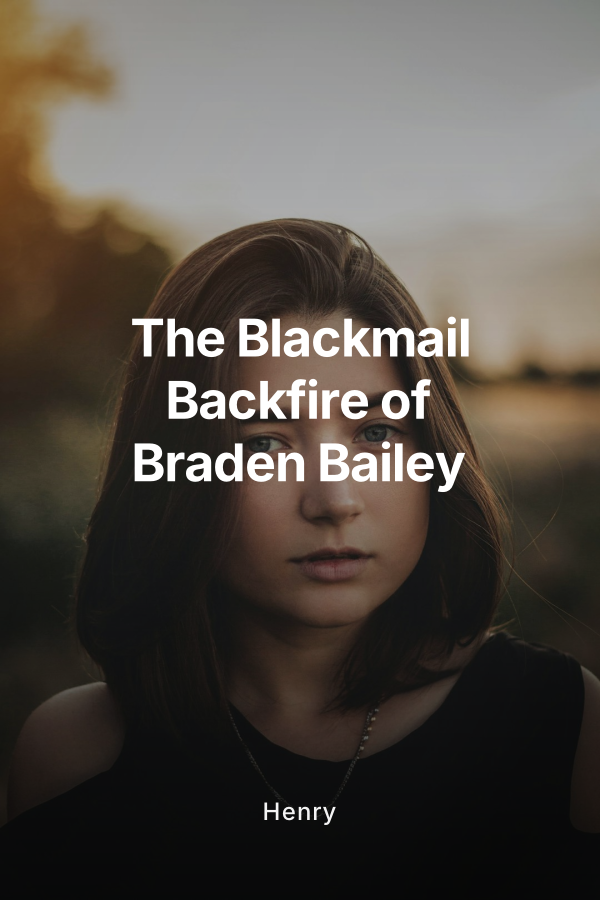
Braden Bailey thinks he is about to become a legend. At Cedar Ridge High, where every minor embarrassment becomes a meme before lunch, Braden stumbles onto what he believes is the ultimate social cheat code: a set of private photos that Emily Marcotte accidentally sent to him instead of her actual crush. Convinced this is his shortcut to popularity, power, and maybe finally sitting at the “cool” table, Braden decides to blackmail her.
From the very first chapter, it is obvious that Braden has seriously overestimated both his intelligence and his grasp on reality. His “evil mastermind” plans involve color‑coded charts, a villainous inner monologue that keeps getting interrupted by his mom yelling about laundry, and an attempt to practice “intimidating eye contact” in the bathroom mirror that just makes him look constipated. He is not a smooth criminal. He is a walking disaster with Wi‑Fi.
Emily Marcotte, on the other hand, is not the panicked victim he imagined. She is sharp, sarcastic, and way too used to surviving Cedar Ridge’s daily chaos. After a moment of shock and anger, she decides that if Braden wants to turn this into a game, she will not just play; she will rewrite the rules. Instead of crumbling, she begins engineering a slow, gleefully absurd counterattack that Braden is far too oblivious to see coming.
What starts as a dumb, creepy blackmail attempt explodes into a school‑wide circus. Braden’s efforts to threaten Emily turn into a chain reaction of mix‑ups, lies, and bad improvising. He fakes screenshots that get obviously exposed. He invents a bogus hacker group that supposedly backs him, then has to keep pretending they exist when people start asking for help with their own drama. A rumor about “The Phantom of the Phone” sweeps through the halls, and somehow Braden finds himself accidentally running an underground “tech support” ring he never meant to create.
Every attempt he makes to keep control only makes everything worse. Teachers misinterpret his frantic whispering in the hall as some kind of inspirational peer‑counseling. The vice principal turns one of his near‑confessions into a mandatory “digital responsibility” assembly, complete with cringeworthy role‑playing skits and an unhinged slideshow. One of Braden’s friends thinks the whole mess is guerrilla performance art and starts filming his breakdown like it is a documentary. A bizarre chain of events involving the school mascot, a projector, and a crashed pep rally nearly exposes him multiple times, but he keeps stumbling out of trouble by dumb luck.
Meanwhile, Emily quietly pulls strings. She plays along just enough to keep Braden confident and sloppy, while planting traps for him everywhere. She recruits friends who specialize in gossip, editing, school politics, and pure chaos. Together they build a sprawling social Rube Goldberg machine of revenge, where one rumor leads to another, each prank escalates the last, and Braden never realizes the pattern until it is far too late. By the time he starts to suspect a setup, he has already lied to his parents, panicked at a guidance counselor, and accidentally confessed to more than one person while trying to confess to no one.
The fallout grows bigger and stranger. Braden ends up in the principal’s office trying to talk his way out of something the principal does not even fully understand. His parents, dragged into the mess, misinterpret half of it and become bizarrely, publicly overprotective at exactly the wrong moments. A local PTA group picks up fragments of the rumor mill and starts a crusade about “teen phone culture” that only pours more attention and chaos onto Cedar Ridge. Braden watches the story of his own terrible decisions balloon into something that barely resembles the truth anymore, but still points directly back to him.
Underneath the non‑stop absurdity, the story never forgets that what Braden did is wrong. His blackmail attempt is treated as creepy, selfish, and harmful, even as the narrative leans into ridiculous humor to keep the tone wild and energetic. As Emily’s plan matures, the imbalance between them starts to flip: he began with the power, but by the middle of the book it is obvious that he is the one dangling over the edge while Emily holds the scissors.
The climax arrives when Emily finally decides it is time for Braden to face the exact humiliation he has been dangling over her head. In an outrageous, over‑the‑top finale that ties together the fake hacker group, the digital responsibility assembly, and the now‑viral legend of “The Phantom of the Phone,” Emily and her allies orchestrate the ultimate reversal. In one chaotic burst of perfectly timed misdirection, tech sabotage, and social theater, the school’s attention shifts completely.
Braden, the would‑be blackmailer, becomes the main character of his own nightmare.
The private images that end up leaked at school are not Emily’s. They are Braden’s.
The final joke of the entire book is that the boy who tried to control someone else with her most private photos has his own embarrassing, ridiculous, poorly posed pictures blasted across the very social channels he thought he could manipulate. The leak is not graphic in a realistic, grim way; it is presented as absurd and humiliating. Angles are awful, facial expressions are ridiculous, and the school’s reaction is less “trauma” and more “how did he think this looked good?” The irony is brutal, cartoonish, and played for maximum comedic shock.
As Braden’s photos spread, the school’s meme factories go into overdrive. His poses become reaction images, posters, stickers, and an infinite stream of jokes he cannot escape. For once, everyone else is in on the joke while he is simply the punchline. Emily, instead of being destroyed by his threats, walks away with her reputation intact and her confidence sharpened, surrounded by friends who helped her flip the script. Braden is forced to confront, in the most humiliating way possible, the reality that people are not trophies, that privacy actually matters, and that actions have consequences even in a world that feels like a non‑stop joke.
The book ends in the tone it carried all along: fast, loud, and outrageous. Braden’s downfall is comedic, not tragic. He is left red‑faced, overdramatic, and still a little oblivious, but undeniably changed. Emily’s victory is not about cruelty; it is about reclaiming control in a way that fits the ridiculous world they live in. Cedar Ridge High simply moves on to its next scandal, but the legend of the kid who tried to blackmail a girl and ended up with his own pics leaked becomes a permanent part of school mythology.
“The Blackmail Backfire of Braden Bailey” is an over‑the‑top, no‑subtlety, laugh‑first high school comedy that takes a very real kind of awful behavior and drags it through the mud of consequences, memes, and absurdity. It is not here to moralize quietly. It is here to let readers howl at the sheer stupidity of Braden’s choices, cheer as Emily takes back power with style, and leave with the unmistakable message that if you treat people like leverage, do not be surprised when the joke, in the end, is on you.