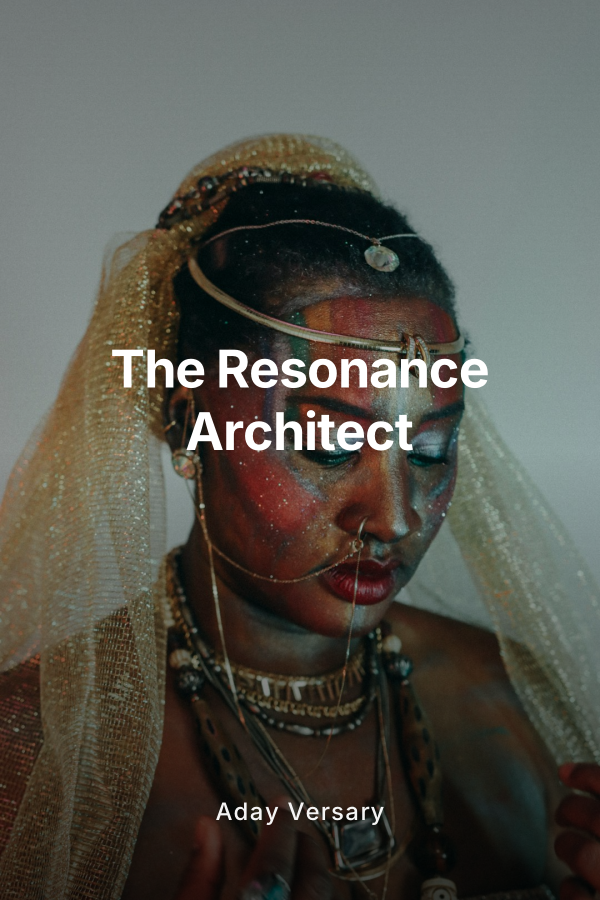
Chapter One: The Architect of the Mud
Victoria Oso has spent her life trying to stay invisible. At Lotus High, she is the girl people tease, the girl who knows too much about water levels, the girl who would rather measure a creek than fight for a seat at the lunch table. But beneath her quiet surface is a mind built for patterns, structure, and survival. She lives with her cousin Marcus, who has taken care of her since childhood and understands her grief better than most adults ever could. Her mother’s final instruction, “Always look for the builders,” still echoes in her mind, and it shapes the way she sees the world. When she watches a beaver named Barnaby hauling branches through the creek with precise, intelligent purpose, she does not see a rodent. She sees an engineer, a living answer to the chaos in her life. Then Barnaby approaches her, drops a glowing branch at her feet, and everything changes. The branch hums with recognition, as if it has been waiting for her all along. That moment becomes the spark that pulls Victoria out of invisibility and into a hidden system of resonance, architecture, and impossible inheritance.
Chapter Two: The Amber Chord
Victoria brings the glowing branch home in secret, where Marcus reacts with his usual blend of sarcasm and instinctive protectiveness. Their banter keeps the scene grounded, but the mood shifts when the branch begins to sing with a note no machine should make. Marcus reveals that their mother once spoke of the creek singing again, and the story suddenly becomes larger, older, and more unsettling. Then the owl appears at the window, enormous and red-eyed, watching Victoria as if it knows her name. The sight confirms that the branch is not a random oddity but a signal, and that someone or something has begun to pay attention. This chapter deepens the emotional bond between Victoria and Marcus while also planting the first real sense that the creek is tied to a hidden history neither of them fully understands. The branch is no longer just a strange object. It is a call to the Builders.
Chapter Three: The Eyes in the Bleachers
At school, Victoria discovers that whatever is happening to her cannot stay hidden for long. Chloe, the school’s reigning cruelty machine, corners her in the hallway and tries to turn her into a joke. But Victoria is not the same girl she was yesterday. When the owl appears in the bleachers and the branch answers with a ringing vibration, the school feels the shift before Victoria fully understands it herself. The experience is part humiliation, part awakening. Chloe’s fear proves that Victoria is becoming someone the social order cannot easily categorize. That matters because the story is not just about magic. It is about a girl stepping out of social erasure and into visible power. The chapter ends with a crucial emotional beat: Victoria realizes she is no longer invisible, and that realization is both terrifying and liberating.
Chapter Four: 3D Printers and Bass Drops
In Advanced Robotics, Victoria finally finds a place where her mind makes sense. The room is full of broken parts, discarded filament, and failed attempts, which feels to her like a perfect language. She uses the glowing branch to coax the scrap into motion, and the materials begin assembling themselves into a sleek, elegant armor design. The scene works because it reflects Victoria’s worldview: broken things are not worthless, they are unfinished. The armor is not war gear. It is survival made visible, a protective form shaped like the river itself. This is one of the story’s strongest identity beats because it fuses Victoria’s grief, intelligence, and instinct into one physical creation. It also expands the worldbuilding by suggesting that the branch responds to people who understand structure, resonance, and repair. The Builders are not just a local myth. They are a system of perception, and Victoria is finally learning how to read it.
Chapter Five: The Corridors of Midnight
This is where the story opens up. A midnight-blue feather leads Victoria and Marcus into the abandoned archives wing of Lotus High, a place that feels half forgotten and half preserved by design. Inside, they meet Silas, a tall, owl-shifting figure with a voice like stone dragged through water. He tells Victoria that the dam at the creek is not really a dam at all. It is a seal. He says her mother learned to hear the frequencies, her father helped draw the first lines, and Barnaby is waiting for her at the creek. The chapter combines eerie atmosphere with precise lore, and it works as the doorway into the larger mythology. Silas feels ancient and exact at the same time, like a curator of a system older than the school, older than the creek, maybe older than the town itself. He offers Victoria a diamond-cut glass piece that hums in her hands, and the story moves from mystery into mission. The pacing slows here in the right way, letting the reader feel the dust, the silence, and the weight of inheritance before the next descent into the creek.
Chapter Six: The Midnight Masonry
At the creek, the story turns fully uncanny. The water is trembling instead of flowing, and the dam feels wrong in a way Victoria can sense before she can explain it. Barnaby arrives like a foreman on a job site, and Victoria steps into the creek to help repair the breach. When the branch and diamond glass resonate together, the creek blooms into blueprints of light. Geometry fills the air. Supports, load paths, angles, and structural patterns appear as if the world itself is offering a schematic. Victoria rebuilds the dam with the beavers in synchronized motion while a shadow called the Silence advances from the trees, a faceless void that absorbs sound and pressure alike. Then Victoria sees her mother in the water, mirrored in the same motions, and the emotional meaning of the scene deepens. This is not just restoration. It is lineage. It is inheritance becoming action. The dam is repaired, but the victory is uneasy, because Silas watches from above, counting, not celebrating. That detail matters. It implies that the rescue was only one move in a much older plan.
Chapter Seven: The Resonance of the Hallway
Victoria returns to school changed, and now the social world reacts to her power. Chloe mocks the creek incident in front of everyone, but Victoria does not shrink. She uses the pendant’s resonance to expose the emotional architecture of the cafeteria itself, revealing the space as it could be if it were built for gathering instead of cruelty. This chapter is important because it shows Victoria’s power becoming moral rather than just mystical. She is not interested in dominating people. She is interested in redesigning spaces and expectations. Silas appears again, this time in a subtler, almost parental way, and plants the idea that Victoria’s father drew the first lines of something much larger. That line carries both comfort and unease. It makes Silas seem helpful, but not necessarily trustworthy. The story keeps tightening its mystery without rushing the reveal.
Chapter Eight: The Master’s Ink
The archives come alive when Victoria and Marcus return with equipment. An old map of Lotus Creek changes under the branch’s glow, revealing new lines, notes, and a signature from her father, A. Oso. Silas explains that Victoria’s father was the Lead Architect, and that when the seal weakened, he bound himself to the keystone to prevent collapse. The map then transforms again, forming the design for armor that can move through raw frequency. This chapter is where the ancient and the scientific merge most clearly. The lore feels old, almost ritualistic, yet the mechanics are precise and methodical. That combination gives the world weight. When the Silence returns and the room darkens, the threat feels inevitable rather than random. Victoria responds with a builder’s logic: if the old structure is failing, she will rebuild it. This is the emotional and thematic hinge of the story. She is no longer just discovering power. She is choosing what to do with it.
Chapter Nine: The Cobalt Construct
This is the scene that needs the most breathing room, and the story supports that need. In the archives, the Silence swallows sound while Victoria reaches into a pile of blue filament, carbon panels, and copper coils. The armor does not just appear. It assembles itself because the materials recognize the resonance in her, and because her memories are feeding it. Her mother reading by the window, Marcus teaching her to solder, Barnaby hauling branches, all of it becomes part of the machine. The Grey Wolf Construct forms around her in layers: cobalt plates, copper channels, carbon fiber ribs, and sapphire pulses racing through every seam. Slowing this moment down makes the armor feel intentional and sacred, not like a quick power-up. It becomes a crafted transformation, a masterpiece born from grief, memory, and design. The scene also builds suspicion around Silas, who says the suit needs memory, and then watches with a smile that does not feel friendly. That hesitation matters. It keeps his betrayal from feeling sudden later.
Chapter Ten: The Curator’s Cold Truth
By the time Victoria and Marcus reach the creek again, the storm is beginning to erase the sky. The stakes are bigger now, but the emotional center remains intimate. Silas reveals the terrible truth: Victoria’s father is not just trapped, he is the current anchor of the system, and Silas wants Victoria to replace him. This is where the betrayal lands, but it lands better because the story has already been seeding his layered motives. He was never just a messenger. He was a curator of an older architecture, protecting a structure that demanded sacrifice. Victoria’s shock turns into clarity, and her response is pure builder logic. If the system is broken, she will not preserve it out of habit. She will redesign it. Marcus’s role here is essential. He is no longer only the witty cousin. He is the steady human support holding the line while Victoria makes the impossible choice. The scene earns its intensity because the emotional cost has been allowed to build.
Chapter Eleven: The Architect’s Revolution
The final battle is not just a fight. It is a philosophical act. Silas tries to force Victoria into the water, arguing that one life can be traded to preserve the many. Victoria rejects the premise completely. She does not accept architecture as cages, nor duty as obedience to dead systems. When the battery overloads and power surges through the Grey Wolf Construct, the moment needs space to feel like a crucible. That is where the story’s emotional and symbolic payoff lives. Victoria does not merely free her father. She rewrites the rift itself, turning a sealed wound into a door. The dam transforms from mud and pressure into glass and copper light. Her father returns. Silas dissolves. The creek runs clear. In the epilogue, the repaired world is no longer held together by sacrifice and silence. It is held together by choice, shared labor, and the understanding that nothing strong is built alone. The old architecture has fallen. The future has been redesigned.
Overall, The Resonance Architect is a young adult fantasy about grief, hidden inheritance, and the courage to rebuild what other people insist must stay broken. It blends eerie creekside mystery, school hallway tension, and science flavored magic into a story that feels both intimate and expansive. The emotional core is Victoria’s transformation from overlooked girl to visionary builder, with Marcus, Barnaby, and even the frightening Silas shaping the path toward that becoming. The result is a story about listening for structure beneath the noise, and about learning that the most radical thing you can do is redesign the world instead of obeying its failures.