Marianna Blackthorn arrives at Hogwarts already sharpened like a blade. Her father is a trusted lieutenant of Voldemort and has spent her childhood forging her into a weapon for the coming Second Wizarding War. Her mother is long dead under suspicious circumstances, and in their decaying ancestral home Marianna has learned to live with pain, secrecy, and a rare, terrifyingly precise magical power she can switch on at will. She does not stumble into darkness by accident. She has been marched toward it since birth.
From her first night in Slytherin, Marianna is the girl other students whisper about. Spells obey her with uncanny obedience. Her reading strays to the margins of the curriculum, hovering near forbidden topics. Professors sense it too. Detentions, stern warnings, and near expulsions bring her name repeatedly before the staff table. Yet in every confrontation, Professor McGonagall catches a glint of something beneath the menace, and Dumbledore quietly agrees. Both are afraid of the damage Marianna could inflict, yet neither is willing to concede that she is already lost.
Inside Slytherin, Marianna grows into the dark heart of a small, fiercely loyal group of boys who orbit her like rough, laughing satellites. They tease and bicker and swagger through the castle corridors, a loose tangle of ambition and mischief that most students avoid. They call themselves her bodyguards, half in jest, though everyone knows she does not need them. In truth, she is the one always stepping forward when trouble appears. When tempers flare and wands rise, Marianna is the one who takes the hit, shoulders the curse, and forces her power to the surface, efficient and lethal, to end the threat.
Among the boys, one becomes more than a friend. Mattheo, sharp with sarcasm and quicker with his wand than is strictly healthy, hides a softness no one else is allowed to see. Ruthless in a duel, icy toward those who cross him, he is quietly, fiercely gentle with Marianna. He watches the way she flinches from sudden movement and rare touch, the way she shrugs off cuts and bruises with a bored “It is nothing,” and he begins to fear that the deepest wounds are the ones she will never admit.
The darkness that clings to Marianna is not, however, of her own choosing. Each summer, she returns to a home that is less a sanctuary than a private torture chamber. Her father punishes disobedience with curses designed to leave no evidence where polite eyes will look, yet they etch fine lines of agony into her bones. Voldemort himself takes an interest in her progress, demanding a Dark Mark she refuses to accept. That refusal brings consequences. Pain becomes a constant companion, not merely from spells but from the relentless psychological pressure of being told she was born to serve.
Back at Hogwarts, the truth begins to leak in. A Ministry raid on her family estate uncovers fragments of horror that cannot be easily dismissed, and buried reports find their way to Dumbledore’s desk. At the same time, scraps of gossip drift through pure-blood networks and reach the ears of another dark family’s child, who passes them along in whispers to a staff member. Madam Pomfrey notices injuries that do not fit schoolyard accidents or Quidditch mishaps. The story forms slowly, piece by piece, never quite neat, always partially denied by its only true witness.
Marianna offers nothing. She sits through questioning with bored eyes and an expression that borders on contempt. She does not plead, does not explain, does not correct the wildest assumptions. She is too tired, and perhaps too proud, to fight for the charity of people who already half-believe her guilty. Let them think what they like. She will not bend herself into an apology just to be seen as something other than her father’s daughter. The staff must decide what to do with a girl who can stride into a corridor duel and end it in two spells, yet return to her dormitory limping from wounds she refuses to name.
As years pass, the tension around Marianna only tightens. McGonagall argues that she is a student before she is a danger, that the cruelty she shows is in defense, never in sport. Others disagree. Slytherin’s reputation, already poisoned by Dark families, is not improved by a witch who stares down hex-happy boys until they drop their wands. Classroom incidents escalate, rules are broken in more elaborate ways, and Marianna’s disciplinary record becomes a stack of parchment that would have expelled any other student outright. Only Dumbledore’s calm insistence on second chances and McGonagall’s stubborn belief keep her at Hogwarts.
Within her world of stone corridors and flickering torches, Marianna lives on a knife-edge between predator and protector. She wanders the castle at odd hours, drawn to out-of-bounds towers and hidden passageways like a creature who cannot bear to be caged. When she finds bullies at work, she intervenes not with lectures but with controlled, clinical force. A jinx that leaves a tormentor whimpering on the floor. A charm that twists a cruel taunt back against the speaker with twice the sting. She never draws it out, never toys with her victims. Quick, decisive, terrifying. She acts as if her magic is a scalpel, not a whip.
The rare softness in her appears in flashes. A first-year who trips over her own robes in the corridor and braces for mockery instead finds a cool hand offering to pull her up. An owl with a broken wing is repaired in a silent corner of the Owlery with no witnesses except a baffled bird. In late-night study sessions, when her boys have finally run out of energy and sprawled across couches in a tangle of limbs and books, Marianna curls near them like someone who does not know how to relax, but is learning. Mattheo sees each of these moments and keeps them tucked away like talismans that prove she is more than the weapon her father made.
The war outside Hogwarts thickens like a storm cloud on the horizon. Death Eaters rise, disappear, and rise again. Marianna’s father moves ever closer to Voldemort’s inner circle, which further complicates her presence at school. Some students whisper that she is a spy, feeding information back to the Dark Lord. Others are convinced she is a ticking curse that will explode in the Great Hall one day. The staff’s fear grows, yet so does their understanding. Every new report and bruise drives home the same truth. Whatever else she may be, Marianna is not safe at home, and whatever darkness she carries, it is not entirely self-chosen.
Inside the dungeon common room, the Slytherin boys change too. Their jokes gain an edge, their banter hides unease. They realize that if the war continues on its present course, Marianna will be pushed to the front lines. Some urge her on with grim pride, eager to see their friend become something legendary. Others cannot shake the vision of her lying broken on a battlefield. Mattheo is divided against himself, pulled between awe at her power and terror of what it might cost her. He loves the way she faces danger without blinking, but he lies awake some nights thinking of curses that even she might not deflect.
Although she insists she does not care about being misunderstood, Marianna’s choices begin to shift almost imperceptibly. She is not interested in redemption speeches or grand reconciliations. Instead, she makes smaller, quieter decisions. She disables a cruel hex rather than refine it. She “loses” a cursed object meant for a Death Eater ally. She feeds a sliver of information to the Order’s side entirely by accident, or so she claims. Each step seems minor, but together they form a path that leads away from her father and the future he designed for her.
The story’s emotional heart beats strongest in the unspoken spaces. The way McGonagall’s voice tightens when Marianna walks into her office with fresh marks. The way Dumbledore asks questions that sound philosophical but are really quiet invitations to choose a different life. The way Mattheo’s hand trembles for a second before he slips it into hers in an empty classroom after another owl from home arrives. There is no sentimental transformation, no sudden revelation that strips away all her flaws. Instead, Marianna inches, grudging and bruised, toward a new truth. She can be her father’s child without becoming his copy.
All threads converge in the final, catastrophic days of the Second Wizarding War, when Hogwarts becomes a battlefield. Marianna stands on the stone floors she once crossed as a bored student and feels the castle itself shudder under curses. Her rare powers, honed and sharpened, make her a natural focus of the fighting. Both sides look toward her, some with hope, others with calculation. She could swing the war’s outcome. For once, the choice is entirely hers.
Her father comes to the castle with the Death Eaters, no longer just a shadow in her past but a living, snarling embodiment of everything she has tried to outgrow. Sparks fly, spells collide, and the Great Hall and its courtyards become spaces of brutal, fast-moving violence. Painful curses crack through the din, bodies fall, and the air fills with the raw, overwhelming scent of fear and burning stone. Marianna’s participation is not theoretical any more. She moves from engagement to engagement, protecting friends, students, and even strangers, her precision magic cutting through chaos with frightening clarity.
The ultimate confrontation is split in two. First, Dumbledore faces her father in a duel that has been building for years. Marianna watches as the man who terrorized her, who tried to bind her to Voldemort’s service, meets a wizard who chose to believe she was more than a reflection of him. The fight is ferocious and unforgiving. When it ends with her father’s death, relief and grief crash over her at once. The world seems both safer and emptier. She has wanted this, feared it, and imagined it in a hundred ways, yet the reality still leaves her shaken to her core.
There is no time to break. Voldemort is still alive, still tearing into Hogwarts with cold, merciless intent. In the ruined shadows of the castle she once resented and then learned, reluctantly, to love, Marianna steps forward. She has become something neither her father nor Voldemort ever fully understood. Not a servant. Not a simple hero. A girl forged in horror who can choose how to wield the power it left behind. The duel between her and Voldemort is the culmination of every lesson, every cruelty, every small act of kindness she has given or received. It is brutal, swift, and edged with the same terrifying efficiency that has always set her apart.
Victory comes at a cost. When Voldemort falls, Marianna is still standing, but barely. Her body is ravaged by curses, her magic burned down nearly to the wick. She is battered, bleeding, and half-conscious when the world around her collapses into a blur of noise and color. Hands lift her, voices shout, and in the midst of it, one presence anchors her. Sirius, who once saw her as a dangerous Slytherin girl on the wrong side of too many rumors, now carries her away from the wreckage with a determination that brooks no argument. He refuses to let another child be consumed by a dark legacy.
She wakes in his old family house, a place filled with ghosts and grudges, slowly being turned into something like a home. Recovery is not a neat, upward line. Marianna startles at footsteps in the hall, recoils from wands drawn too quickly, and must learn that raised voices do not always lead to curses. Sirius responds with sharp humor and unexpected patience, chipping away at her defenses with banter and quiet acts of care. Other members of the “good side” drift through the house, some wary, some curious, most unsure how to handle the girl who ended Voldemort and carries the blood of a Death Eater.
Through slow days and restless nights, Marianna begins to understand what it means to be more than a weapon. The war is over, but the habits it carved into her remain. She does not suddenly become open or gentle. She still shrugs away attempts to put her on a pedestal, refuses interviews, ignores those who call her a hero. She prefers the company of a few people who have seen both her worst and her best. Mattheo, bruised and alive, becomes a constant presence, torn between pride in what she has done and fear of what it still costs her. He and Sirius form an unlikely alliance in protecting her from the more intrusive side of peace.
In the end, the book follows Marianna beyond the final battle into a life that is complicated, compromised, and real. She does not retreat entirely from the world, nor does she step into the spotlight with a smile and a speech. Instead, she searches for work that fits her strange set of talents and hard-won ethics, perhaps delving into curse-breaking or the dismantling of lingering dark structures left in Voldemort’s wake. She continues to defend those who cannot defend themselves, still taking the blows when necessary, but now with a clearer understanding of her own worth.
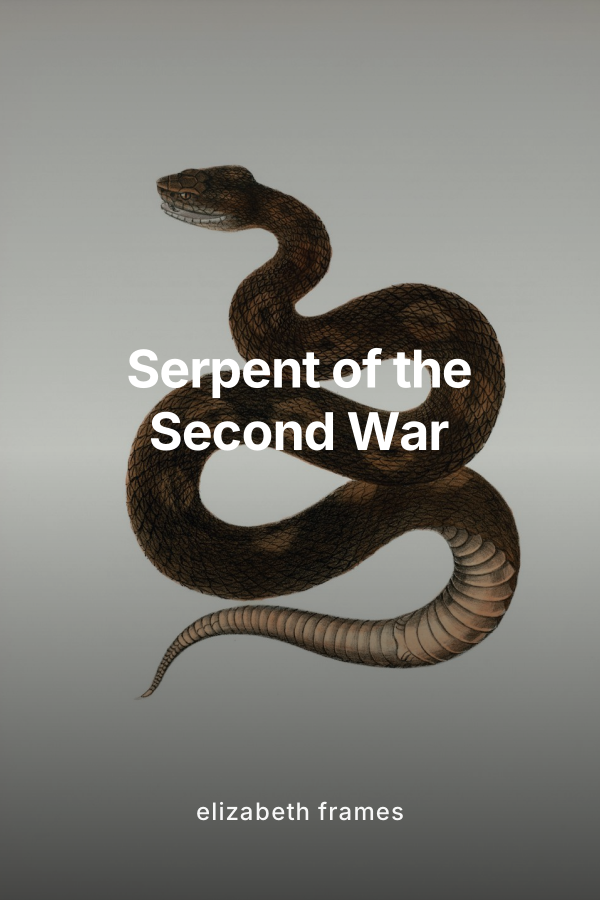
“Serpent of the Second War” is a story that lingers in the grey spaces between villainy and heroism. It explores painful magic and psychological abuse without reveling in gore, focusing instead on the way trauma bends a life without fully defining it. Marianna’s journey from feared Slytherin girl to Voldemort’s destroyer is not a clean redemption arc, but a slow, often reluctant assertion of self. Surrounded by teachers who fear and believe in her, friends who joke and bleed by her side, and a makeshift family that teaches her she is more than the sum of her scars, Marianna proves something quietly radical. Being born in darkness does not mean you are bound to live there forever.