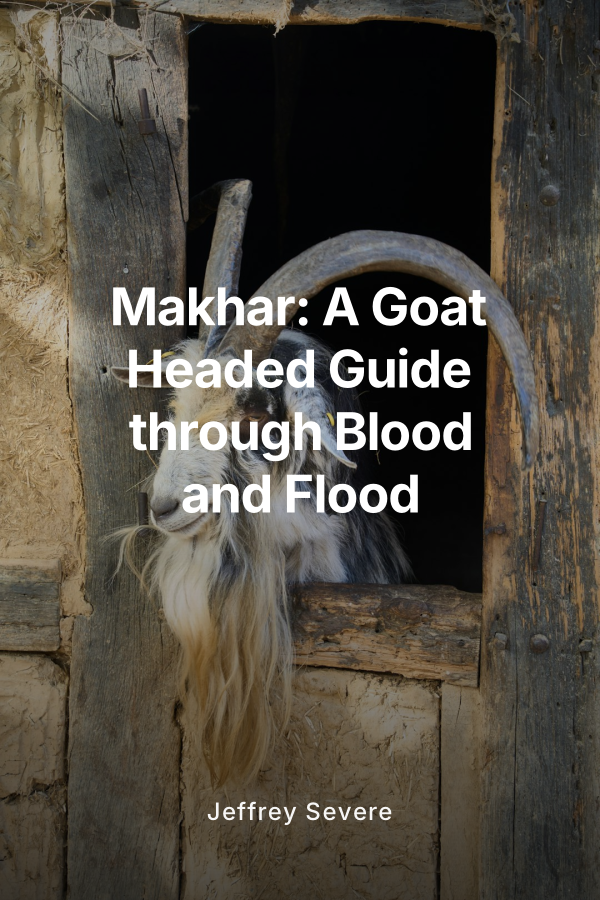
Alan is twelve, abandoned, and carrying a secret that could drown the world. The only thing that stands between him and the brutal wilderness that wants to break him is a towering figure with the head of a goat, a body like a man, and a mouth that knows only one word: “Makhar.” In this adult grimdark horror tale, their journey through swamps and forests toward a distant cult fortress peels back the skin of the natural world to expose rot, cruelty, and the thin, quivering line between protection and sacrifice.
The story follows Alan from the moment his abandonment leaves him half feral with fear, soaking in the sounds of the wild and the echo of a prophecy he should never have heard. Somewhere in his fractured memory sits a vision of a world drowned in filthy water, cities and forests alike choked under a rising, blood tinged tide. This prophecy is not written down in any book and not chanted in any temple. It lives only in Alan’s mind, and for that reason alone, a hidden blood cult wants him captured and delivered alive. They are a clan that drinks devotion out of veins, cultists who believe that the world must be broken in order to be remade.
Into this terror steps the goat headed man. His very presence bends the logic of the forest. His horns are long and scarred. His fleece is matted, caked with old blood and the grime of travel. His eyes hold a dim, strange intelligence that never quite resolves into anything human. He never explains himself. He never offers comfort. He gives Alan only one word to cling to in the overwhelming silence: “Makhar.” It becomes both his name and his answer to all questions, a sound that can mean “follow,” “hide,” “stop,” “remember,” or “obey,” depending on the way it rumbles out of his throat.
On the surface, the book is a relentless trek through treacherous nature. Swamps try to swallow Alan whole. Forests teem with insects that burrow into the skin, with roots that knot like fingers around his ankles, with branches that snap like bones in the dark. The path the goat headed man chooses is never the easy one. He guides Alan through putrid bogs where corpses bloat beneath the waterline, along cliffs where the wind slices like knives, and through abandoned villages where something worse than starvation has hollowed out the houses. Every stretch of land carries traces of the blood clan’s influence, from strange symbols carved into trees to animal carcasses arranged in ritual patterns, hinting that the cult’s reach radiates far beyond its isolated fortress.
As the pair travels deeper into this hostile wild, their relationship forms the core of the narrative. Alan begins as a terrified child, too young for the knowledge lodged in his mind and too desperate to survive on his own. The goat headed man is his unlikely guardian, a creature that could crush him without effort yet instead shelters him with a brutal efficiency. He shields Alan from predators, tears apart things that emerge from the dark water, and confronts human threats without hesitation. Every act of protection is soaked in gore. Bodies are broken in ways that are impossible to ignore. Limbs snap, skulls are crushed, and the raw brutality of survival is never softened. This is not heroism as Alan has ever imagined it. It is closer to butchery.
Yet, in that butchery lies a twisted form of care. Alan learns to read meaning into the creature’s one word. “Makhar” becomes the rhythm of their march, the beat that keeps him moving when his legs fail. Over time, he realizes that the goat headed man is not a mindless beast. There are patterns in the way he chooses which lives to spare and which to end. There is intent in the silence between his grunted syllables. Although the creature never explains why he is leading Alan to the blood clan’s fortress, his constant vigilance suggests a bond that is more than obligation.
As the pair move through the wilderness, the prophecy of the flooded world begins to gnaw at Alan. The memories of how he learned it float up in fragments, like flotsam on a rising tide. He remembers whispers in the night, a voice that was not his own describing water chewing through foundations, swallowing hills, and washing away every boundary that humans have ever drawn. Whether these images came from a dying adult, a forbidden tale, or something older and larger than both is left unclear, sharpening the story’s unease. Alan knows, with a certainty that terrifies him, that the cultists in the fortress believe his knowledge will either usher in this drowning or prevent it.
The emotional horror of the book blooms from this uncertainty. Alan is not just running from physical danger. He is trapped in a moral landscape as treacherous as the swamps he crosses. If he clings to the prophecy, is he helping destroy the world, or is he the only one who can avert the flood? If he lets the knowledge rot in his mind, does the rising water come faster? If he gives in to the blood clan’s demands, will they use him as a sacrificial map, a living key that unlocks the catastrophe they crave?
Along the way, Alan meets other remnants of humanity. Peasants hiding in shacks at the forest’s edge, hunters who have seen too much, scavengers who trawl through abandoned settlements and strip them of anything that might keep them alive one more week. Their reactions to the goat headed man and to Alan range from terrified avoidance to violent hostility. To some, the goat headed figure is a monster that needs to be driven away. To others, he is a half remembered omen from rural legend, proof that old stories about nature’s vengeance might be truer than anyone wanted to believe. Each encounter underscores the world’s decay and the thinness of the line separating human cruelty from inhuman savagery.
The blood clan itself remains largely out of sight throughout the journey, yet their presence saturates the story. Symbols of their faith cling to tree trunks and stones. Strange, rust colored fetishes hang above paths, dripping in the rain. Slaughter sites suggest ritual bloodletting rather than random violence. Birds go silent near certain clearings, and the air tastes metallic. Alan hears rumors that the cultists believe only blood can bargain with the forces that guide the world’s waters. They think drowning is not an accident of weather but the result of a failed pact. If they can find the one who carries the full prophecy, they can rewrite that pact in their favor.
This looming threat magnifies Alan’s dependence on the goat headed man. For all the horror his protector unleashes, the alternative is worse. Alone, Alan would vanish into the swamp or be dragged screaming to the fort by cultists who see him only as a resource. With the creature, he has at least one being who treats his survival as a priority, even if that care is expressed through shattered bones and rivers of spilled blood. Their companionship is bleak and wordless, built on shared danger rather than affection. Still, in the grimmest moments, when Alan’s body shakes from exhaustion and cold, the shape of the goat headed figure at his side becomes the closest thing he has to comfort.
The book leans into graphic horror to explore this bond. Night attacks turn into slaughter scenes where the goat headed man fights with unrestrained savagery. The world does not look away from torn flesh or mangled bodies. The violence is not stylized spectacle but a constant reminder of what it costs to keep moving. Alan cannot pretend that survival is clean. He cannot deceive himself that he is untouched by the ruin around him, because each time Makhar acts in his defense, blood stains his path.
Underneath the gore, the story also examines what it means for a child to hold knowledge that adults are willing to kill for. Alan is too young to be burdened with global catastrophe, yet he is never allowed to be just a child. The prophecy marks him as a piece on a board he never chose to play on. The goat headed man’s presence makes this unbearable role slightly less lonely, but it also forces Alan to confront the possibility that he is a tool in someone else’s plan. Is Makhar truly guiding him to safety, or only delivering him to the cult that has been hunting him? Is the creature resisting the blood clan, working for them, or serving some older and stranger master that neither boy nor cult fully understands?
Mystery coils thicker as the fortress draws nearer. The land begins to change, the swamps becoming strangely orderly, like veins channeling travelers toward the castle whether they wish to go or not. Trees appear in unnaturally straight lines, carved with sigils that pulse in Alan’s peripheral vision. The water level in streams and ponds shifts unpredictably. Sometimes the banks are dry and cracked. Other times, water laps hungrily at paths that were dry only hours before. The prophecy’s imagery starts to bleed into reality, and Alan cannot tell where his memories end and the world’s future begins.
Throughout, the goat headed man remains a puzzle. He never reveals whether he fears the cult, despises them, or obeys them. Sometimes his posture stiffens at signs of the blood clan’s presence, as if preparing for conflict. Other times he leads Alan straight through territories marked with their symbols, showing no hesitation. Each utterance of “Makhar” can feel like reassurance, warning, or threat. The book carefully avoids a clear answer, allowing readers to project their own fears into that silence.
By the time the fortress finally comes into sight, Alan has been reshaped by the journey. He is still only twelve, but the landscape has carved him into something leaner and harder. The constant presence of death, the intimate awareness of gore and decay, and the suffocating knowledge of the coming flood have stripped away the last remnants of innocence. He has learned to move quietly, to read danger in the way the forest holds its breath, and to understand that mercy is rarely free.
The closing movement of the book is all build up with no release, deliberately withholding the answers the reader most wants. The fortress, a dark mass of stone and old blood, rises from a low, marshy plain. Its walls are stained and uneven, as if generations of ritual have soaked into the rock. Alan senses something inside that vibrates in tune with the prophecy in his head, as though the castle itself is a vessel waiting to be filled with his secret. At the same time, he sees how the surrounding land bears scars of earlier flooding. High water lines mark trees and stones. Abandoned watchtowers loom partially submerged in stagnant pools.
As Alan and the goat headed man stand before the fort’s outer gate, the book’s tension reaches its peak. The air smells like rust and wet soil. In the distance, indistinct figures move along the walls, their robes dragging, their faces hidden. Their voices do not yet reach Alan’s ears, but he knows they are chanting something for him, words that will try to pry open his mind and spill the prophecy out where they can grasp it. The goat headed man, silent as ever, steps slightly ahead of the boy, positioning himself between Alan and the looming structure.
The summary closes on the image of that approach. The gate is closed but not barred, as if waiting. Alan tastes the metallic hint of storm on the air and imagines, for a heartbeat, the world already underwater. His heart races. Every part of his journey through the forests and swamps has been leading to this point. The creature beside him gives a final, low utterance of “Makhar,” a sound thick with meanings the boy still cannot fully untangle. Whether it is a promise, a warning, or a farewell remains unclear as the scene freezes on the brink of revelation.
Makhar: A Goat Headed Guide through Blood and Flood is a story of companionship forged in horror, of a child crushed beneath the weight of apocalyptic knowledge, and of a nature that has turned hostile under the influence of human fanaticism. It offers no comfort and few answers, instead guiding readers step by step through the muck and carnage to the threshold of a blood soaked fortress, then leaving them standing there beside Alan and his monstrous guardian, waiting for whatever comes next.