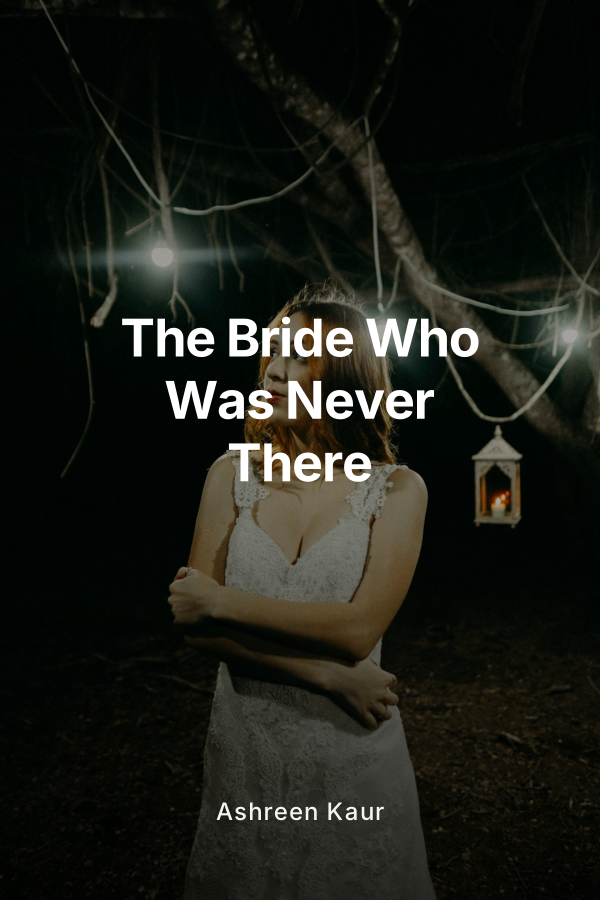
Chapter 1: The Road to Manali
They were six in total, but they never moved like six separate people. They moved like a unit built from years of inside jokes, silent loyalty, petty fights, shared secrets, and the kind of friendship that only survives when everyone is equally unserious and equally devoted. Two girls, best friends since school, both sharp-tongued, stylish, and impossible to intimidate. Two boys, best friends since forever, always trying to outdo each other, always pretending they were the smarter one, always failing whenever the girls rolled their eyes at them. And then there was the pair nobody could quite define without sounding obvious, the boy who belonged most naturally with one girl, the other boy who seemed permanently orbiting the other, each connection layered with humor, tension, and the easy chemistry of people who had spent years learning how to read each other’s moods without speaking.
When the invitation arrived, none of them expected anything unusual. A school friend was getting married in Manali, and the group decided to attend together, partly because they genuinely cared and partly because a mountain wedding sounded like the kind of cinematic escape they wanted. They joked about the trip for days, argued over outfits, and made predictions about which cousin would cry first and which one would flirt at the reception. The girls planned the looks. The boys pretended not to care and cared the most. The entire journey felt like the beginning of a glamorous, harmless adventure.
Manali welcomed them with cold air, pine-scented roads, and the kind of fog that made the hills look half imagined. By the time they reached the venue, the atmosphere was almost absurdly beautiful. The wedding was staged like a polished Bollywood dream, all marigold arches, glowing lanterns, carved wooden decor, and sweeping mountain views that seemed too perfect to be real. Everyone in the group changed into Indian attire, and the result was almost unreal. Silk, embroidery, rich color, and the visual kind of elegance that turned even an ordinary glance into something cinematic. They looked better than the bride and groom, and everyone knew it.
That should have been funny. Instead, it became uncomfortable.
The wedding guests kept staring at them as if the six of them did not belong there, or worse, as if they had arrived at the wrong event. The school friend, the groom, greeted them too warmly, too quickly, with a smile that held a strain he was trying desperately to hide. He kept saying everything was under control. He kept insisting they must enjoy themselves. Yet his eyes never settled, and every answer came with the faint panic of someone rehearsing a lie.
The bride had not yet been seen.
That alone would have been strange, but what made it worse was the way people spoke about her. No one described her directly. They used soft, evasive language. Some called her shy. Some said she was unwell. Some said mountain weddings made people nervous. But every explanation felt flimsy, like paper held up against storm wind. The group noticed small things first. Doors locked from the outside. Servants who refused eye contact. Elders who spoke in low voices and stopped whenever someone approached. A strange scent drifting through the corridor at night, something floral and rotting at once. And underneath it all, the sense that the entire wedding was not a celebration but a carefully decorated enclosure.
The first real crack appeared when one of the girls found a room at the back of the property with old family photographs hidden inside a trunk. The pictures showed generations of the groom’s family standing in the same courtyard, but one face kept returning in different eras, a woman in white, always blurred at the edges, always slightly wrong. In some photos she stood behind the bride. In others she stood where the bride should have been. In the oldest picture, the family matriarch had her hand on that woman’s shoulder as if presenting her, not mourning her.
The boys laughed when the girls brought it up. Then they saw the photographs themselves.
The mood changed from playful curiosity to instinctive caution. Still, nobody wanted to be the one to ruin a wedding. They told themselves they were overthinking. They told themselves old families had strange traditions. They told themselves the groom was under stress. Yet the night deepened, and the wedding became less of a venue and more of a sealed story, one that had already begun long before they arrived.
By dinner, the groom finally admitted enough to make the truth breathe. His family had been expecting the wedding for years, but not because of love. The marriage was meant to complete a debt passed through generations, a debt connected to an ancestral promise made in the mountains after a disappearance no one in the family ever discussed openly. A woman from their line had vanished during a winter ritual. In the years that followed, the family began seeing her in mirrors, hearing footsteps in locked rooms, and suffering deaths that always looked accidental until the pattern became too precise to ignore. To survive, his ancestors had made a bargain. Every few decades, a wedding would be arranged not to unite two people, but to bind the curse to one body long enough for the family to remain safe.
The bride, he said, was chosen to receive the curse.
The group thought he had lost his mind.
Then he confessed the part that made their skin go cold. There was no bride.
The woman everyone had been preparing for was not a person at all. She was a construct, an identity built from ritual, suggestion, and the family’s collective fear. Some said the original bride died years ago. Some said she was never alive in the first place. Some said the mountain had taken her shape and learned how to wear it. What mattered was that the family had continued the wedding to keep the ritual intact. They had invited guests to witness normalcy, because normalcy was part of the spell.
And now the spell was weakening.
Chapter 2: The Wedding Trap
Once the truth surfaced, nothing in the venue looked harmless anymore.
The bride’s chamber had no mirrors. The windows were covered from the outside. The clothes laid out for her were untouched, as if prepared for someone who could not decide whether to exist. The elders began moving through the house with a terrible urgency, and the servants avoided each other like prisoners. One of the boys discovered a hidden passage behind a prayer room that led to a sealed lower chamber carved into the mountain rock. Inside were ritual markings, old brass bowls blackened by use, and the remains of offerings too recent to belong to history. The air there felt charged, oppressive, intimate in the wrong way, as if the walls knew the names of the people standing in front of them.
The real horror was psychological before it was supernatural. The group began doubting their own senses. One girl swore she heard her name whispered from inside a locked cupboard. One boy saw the bride’s reflection crossing a hallway when no one was there. Another friend found mud on his shoes after sleeping indoors. They started questioning whether the wedding was trapping them physically or reshaping them mentally, making them complicit before they understood the rules.
The groom’s behavior worsened. He was not simply frightened. He was hiding something personal, and that something soon turned out to be betrayal. He had known much more than he admitted. He had invited them because the family had insisted that certain outsiders be present. “Witnesses,” they called them. The family believed strangers carried clean energy, enough to stabilize the ritual. But the groom also knew one of the six had been singled out from the beginning. A sacrifice was needed to complete the transfer and seal the curse into the mountain forever. He had planned to use his friends as shields, hoping the curse would choose someone else.
That confession detonated the group.
The friendship dynamic that had been light and funny now became painfully human. The girls exploded in anger, calling him every name they could think of. The boys nearly fought him. But beneath the rage there was still loyalty, and that made the betrayal cut harder. They had come together, they argued together, and now they would have to survive together. Fear sharpened their bonds instead of breaking them. The boy who always joked became fiercely protective. The girl who teased everyone turned cold and strategic. The quieter pair, the one with the most unspoken chemistry, started moving as if they had each already decided the other would not die under their watch.
The final ritual was scheduled for midnight in the courtyard, though by then it was clear the courtyard was only the surface. Below it lay the real stage of the curse, a chamber where the family had been gathering for generations whenever fear demanded ceremony. The wedding guests had been subtly isolated, their phones dead, their vehicles blocked, their routes watched. The mountain itself seemed to conspire with the house, and the fog outside thickened into a wall.
When the procession began, the bride appeared at last.
She was beautiful in the way a dream can be beautiful right before it turns wrong. Her face was veiled. Her posture was perfect. Her voice, when she spoke, sounded distant, almost rehearsed. Yet when one of the girls looked closely, she saw what gave the lie away. The bride did not blink like a living person should. Her wrists bore faint marks as if she had been bound recently. And when the veil shifted, the face underneath seemed to hesitate between features, as though the body had not finished deciding who it belonged to.
The group understood then that the bride was the curse given form.
Not a woman. Not a bride. A vessel.
The family’s dark secret had been older and crueler than anyone expected. Long ago, an ancestor had hidden a daughter’s death during a snowstorm and used a ritual to preserve the family line. The mountain never forgave the lie. It took the dead girl’s grief, her rage, and the family’s guilt and turned them into something that fed on weddings, vows, and bloodline obedience. Every generation since then had fed it a little more, pretending it was protection, calling it tradition, and using marriage as camouflage for sacrifice.
Now the curse wanted the final debt paid.
The ritual demanded the life of a loyal outsider, someone whose death would be witnessed by people who loved them. That grief would anchor the curse permanently. The family had chosen one of the six, not because of weakness, but because friendship made the offering more powerful. Love was the fuel. Betrayal was the blade.
What followed was chaos.
The friends ran, fought, and split and found each other again. One was nearly dragged into the lower chamber. Another pulled them back. One friend was injured protecting the others. One had the chance to escape and returned anyway. The emotional core of the story no longer lived in the house or the mountain or the curse. It lived in the repeated choice to stay when leaving would have been easier. Every argument earlier in the trip now paid off as history. Every joke became a shield against panic. Every small act of protection mattered. They had spent years building a friendship that could survive bad moods and ego. Now it had to survive a supernatural trap designed to turn affection into sacrifice.
The final confrontation unfolded in the ritual chamber beneath the venue, where the walls were lined with symbols, photographs, and offerings from decades of weddings. The bride stood at the center, no longer pretending to be human. Her voice deepened into something layered, as if several women were speaking at once. The groom’s family begged, prayed, and broke apart. The room filled with the revelation that the bride had never been invited. She had been constructed from the family’s guilt and the mountain’s memory, assembled to force the curse into a body that could endure it.
But the group refused the logic of the ritual.
They destroyed the offering circle. They broke the ceremonial bindings. They rejected the family’s demand for an outsider sacrifice. One friend used the family’s own records to expose the original lie, naming the dead daughter, naming the hidden crime, and forcing the elders to confront the truth they had buried under generations of ceremony. Another led the others through the hidden passage while the chamber collapsed into panic. One of them almost died holding the door shut. Another saved that person at the last second, and the moment felt earned, not decorative, because every bond in the story had been tested long before the climax.
The curse, denied its sacrifice, turned on its creators.
The bride’s face fractured into grief, rage, and something almost human. The mountain thundered. The wedding hall above began to split with panic as guests finally realized the celebration had been a trap. The family members who had fed the lie were forced to face the thing they had made. In that final horror, the bride was neither fully spirit nor fully body. She was the shape of a wound, and the only way to end her power was to stop treating her like a bride at all.
The friends survived not because they were stronger than the curse, but because they remained themselves when the ritual tried to reduce them into roles. They mocked fear, protected each other, and chose loyalty over escape. In the end, the wedding collapsed into silence, the bride dissolved into mountain fog, and the family’s secret was buried no longer. The curse did not disappear cleanly. It was broken, but not erased. Something ancient still watched from the dark above the pines, waiting for another lie, another wedding, another family willing to dress guilt as love.
And when the six friends finally left Manali at dawn, exhausted and shaken, they no longer looked like people who had attended a wedding.
They looked like people who had survived one.