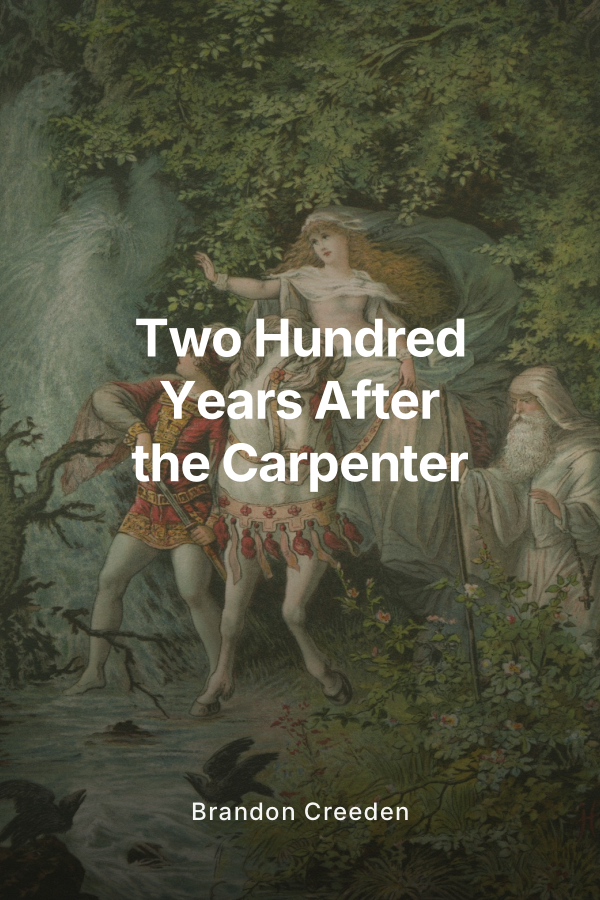
Only the first page of this book is left. We lost the rest in October 2026.
We lost access to the service that stored them, and no other copy exists. We're sorry.
Two Hundred Years After the Carpenter is a work of contemporary magical realism about grief, digital isolation, and the slow, stubborn miracle of a family learning to listen again. At its heart is the Harrow family, whose home has gone from a place of warmth and overlapping voices to a house full of cold blue light and unsaid words after the death of Mira Harrow’s mother. Screens glow in every room, but no one really sees one another anymore. It is into this dim, humming silence that a small wooden box quietly enters their lives.
The story begins in a Goodwill on Highway 27, where twelve year old June Harrow discovers the box wrapped in a faded cloth and half hidden behind a cracked ceramic rooster. The box is carved with an iris, a moth, and a flame, and when June first touches it, it feels unmistakably warm, as if it were alive. She carries it home to a house that has forgotten how to listen: Mira scrolling numbly through articles she never finishes, Caleb answering emails behind a half closed office door, and fifteen year old Rowan drowning in his earbuds and his phone, while June drifts through the rooms as the only one fully present to the ache in the walls.
At first, the box does nothing that anyone but June can feel. It simply sits on the coffee table, absorbing the harsh, disconnected noise of electronics and the heavy silence beneath it. June senses its attention before she understands it, sitting near it at night and whispering small tentative words, the way one sits with someone who is grieving. Her quiet “Hi” becomes the first real interruption in the family’s numb routine, a tiny seed of change beneath the surface of their days. The house itself seems to respond: screens flicker, the hum of devices softens, and something old and patient presses closer.
The first visible shift comes during an otherwise unremarkable Tuesday evening, when the background hum of electronics falters and Rowan, almost against his will, asks, “What’s that thing made of?” For the first time since the funeral, all four Harrows gather around the same object, their hands testing the impossible warmth of the cloth wrapped box. June struggles to give language to what she feels and finally says it is warm the way a hand grows warm when held for a long time. The family stands together in a shared, fragile stillness that is less about the box and more about remembering how to be in the same moment. The box remains closed, yet it has quietly done its first work: it has drawn their attention into one place.
That night, the dreams begin. June dreams of a lamplit workshop and a man carving with reverent care, whispering, “It’s for her.” Rowan dreams of a feverish boy at dusk clutching something alive pressed to his chest. Mira dreams of her mother’s strong hands tracing the grain of an unfamiliar wooden box, gently telling her she does not have to hold everything alone. None of them speak of these dreams in the morning, but all of them behave just slightly differently: Rowan leaves his earbuds out at breakfast, Mira makes coffee without reaching for her phone, and Caleb lingers in the doorway, hungry for a connection he cannot yet name. The box has begun to open not with hinges, but with echoes.
When the box finally opens, it does so in a house filled with ordinary gray rain and habitual distraction. The cloth ripples on its own, the lid lifts, and inside the family finds a single line on a yellowed piece of paper: “Grief is not meant to be carried alone.” The sentence is simple, but it collapses the distance between them. Each Harrow meets the words in a different way: Mira sees the admonition her mother never quite had the chance to give; Caleb feels his solitary burden loosen; Rowan realizes someone has finally named the weight he has been hiding; June understands that the box is listening to what they have not been able to say. The message does not heal them, but it opens the first honest space in which healing could begin.
From here, the book follows the Harrows through a series of small but decisive moments, each one deepening their relationship with the box, with their house, and with one another. The box becomes a quiet presence at the center of the living room, drawing them back, not through spectacle, but through shared attention. As Mira finds herself sitting near it just to breathe without a screen in her hand, Caleb begins leaving his office door open, June lingers with a growing sense of responsibility and wonder, and Rowan drifts downstairs more often, sitting on the rug in its orbit. The house, once filled with noise without voices, begins to hum with a more human kind of sound: footsteps, clinking dishes, overlapping breaths.
The story does not flinch from the breaking point it knows must come. When Rowan’s phone buzzes with yet another cruel message from school, the family’s unspoken tensions burst into the open. Rowan lashes out, accusing Mira of hiding in her phone and Caleb of hiding in his office, insisting that they are all pretending to be fine while he feels himself disappearing. His confession tears through the brittle calm that has kept them emotionally apart. In the raw aftermath, tears finally fall where they can be witnessed, apologies are spoken where they can be heard, and the family clings to one another as though they might otherwise come undone. The box does not move, but the air around it warms as if it had been waiting for this honest storm. Honesty, the narrative insists, is where healing always begins.
In the second opening, the box offers not words but a single wooden shaving, curled and impossibly warm, a tangible memory of a carpenter’s loving labor centuries earlier. June understands it as a symbol that healing is made, not granted — carved together, shaving by shaving, through shared work and truth. As the shaving rests on the mantel in a small dish that once held her grandmother’s loose change, the house begins to orient itself around this delicate relic of intention. The family start to experience overlapping visions: a workshop lit by lamplight, a woman humming, a child wrapped in blankets, a house at dusk leaning against the horizon, a voice insisting, You’re not alone. These echoes are less about revealing a precise past than about impressing a pattern on the present: care, craftsmanship, endurance, and the refusal to abandon those who suffer.
As the box draws their inner lives closer, each Harrow is invited into a private reckoning. Rowan spends a sleepless night on the rug, confessing to the box that he feels himself vanishing and does not know how to tell anyone without making things worse. In answer, the wood warms beneath his hand, and for the first time in months, he feels held enough to sleep. Mira is given a merciful dream in which her mother, whole and strong again, teaches her that strength is not silence but the courage to be seen in her grief. Caleb, whose entire identity has been built on being the steady one, sits with the box and finally admits his fear that he is failing them all. The memory of his mother in law’s voice returns: strength is knowing when to let someone hold you. In each of these quiet crises, the box does not fix their pain; it steadies them while they learn the language they need to bring that pain into the open.
One of the novel’s most hauntingly beautiful sequences occurs the night the house itself “listens.” All four Harrows sit around the box as it seems to bend the air, layering their living room with the ghostly images of the carpenter’s world: the workshop, the field, the boy, the humming woman, and the whispered assurance that they are not alone. The vision is not proof to be argued over; it is an invitation to understand that their grief rests inside a longer story of making, mending, and carrying one another. When the images fade, they are left with a startling, shared certainty that the box is real in the only way that matters: it is a vessel for an old intention that has reached them across two centuries to teach them how to remain together.
The book’s final act is as understated as the rest of its magic. One dawn, June discovers a message hidden in the grain of the lid itself, letters only visible when the light strikes at a precise angle: “Listen to what is left behind.” The sentence reframes everything the box has done. It is not asking them to seek answers in some unreachable past; it is telling them to attend to what remains: each other, their house, their memories, their ordinary days. When the box opens one last time, it offers a final inscription carved into the bright wood at its base: “What you keep is what you share.” The Harrows understand, at last, that the box was never about the wonders it contained. It was about teaching them that whatever love, honesty, and presence they manage to keep alive between them must be given away if it is to mean anything.
The closing chapters follow the family after the box’s work is done. They place it in an old cedar chest “like laying a story to sleep,” and they do not open it again. Spring arrives in incremental changes: Mira cooking because she wants to, not because she must; Caleb closing his laptop earlier and leaving his office door open; Rowan finding that the cruel messages from school have less power now that he no longer faces them alone; June feeling that she is no longer the only one holding the fragile threads of the household together. The house, once merely a container for their separate silences, becomes an active participant in their shared life again — warm, alive, and capable of holding them even without the box at its center.
Two Hundred Years After the Carpenter is ultimately a novel about the holiness of small shifts: a phone set aside during dinner, a door left ajar, a walk around the block, a sentence finally spoken aloud. Its magic is quiet and domestic, threaded through blue light and nightlights rather than through grand spells. The box functions not as an object of power to be mastered, but as a finite presence whose very limits force the Harrows to claim their own agency. When it finally grows cold and remains so, they discover that the real transformation has taken place not in the wood, but in their willingness to listen to what is left behind.
When readers close this book, they are left with an image of the Harrows on their porch, watching fireflies rise into a soft summer night, the house glowing behind them, alive and listening. They have not undone their loss. They have not returned to who they were before. Instead, they have learned to carry grief together, to let their home be a place of honest sound again, and to understand that what you keep — the love, the stories, the patient work of showing up — is what you are called to share.