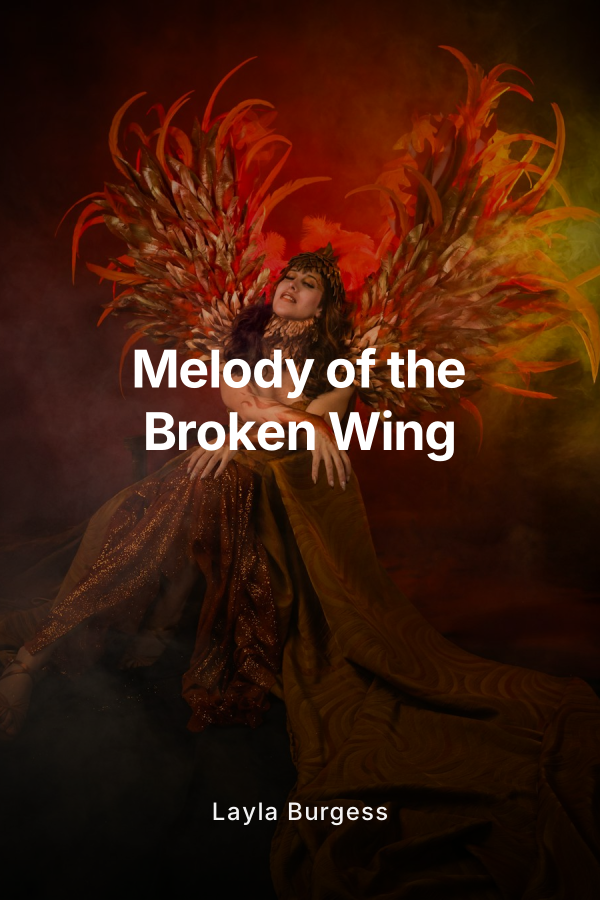
This book is an intimate, alternating‑POV character study about a wounded, nonhuman weapon who has never been treated as a person, and the ordinary man who insists on keeping him, caring for him, and teaching him how to live in peace. It draws emotional DNA from caretaking, touch‑starved recovery, and nonsexual hurt/comfort dynamics seen in stories where a deeply traumatized fighter is taken into a gentle home and allowed to rest, while remaining firmly its own tale of a blind, bat‑winged hybrid and the human who becomes his safe place.
At its core, Melody of the Broken Wing is about healing without pretending that the damage was ever small. There are nightmares, flashbacks, and old scars that ache in the cold. There is self‑hatred, dehumanization, and the conviction that a “tool” who can no longer be useful deserves to be discarded. Yet threaded through every dark moment is the stubborn, transformative insistence of one person who refuses to treat that tool as anything less than cherished.
The story opens in a lifeless winter garden, in a shed that smells of old wood and fertilizer. Jason, a quiet, lonely man with a small house and a careful life, goes out to fetch a trowel and instead finds a nightmare on his floor. The creature is curled in a defensive knot, wings torn and bent, side bleeding from a clean, blade‑cut wound. His hands end in sharp claws. His hair is matted. His face is a map of old injuries, crowned by eyelids crudely sewn shut. He looks like something designed to frighten, and like something the world has already tried very hard to throw away.
Jason’s first instinct is to panic. His second is to help.
The opening chapter follows Jason’s point of view as he hauls the too‑light body into his house, cleaning blood from torn skin and shredded membrane, stabilizing a wound that should have killed. He improvises medical care: warm water instead of cold hosing, careful bandages instead of restraints, blankets and hot water bottles instead of chains. The creature never wakes. Jason has no name for him and no idea what he is, only the steady reminder of thin ribs under his hands and the unnatural, stitched‑shut blindness that makes his throat tighten.
When the hybrid finally wakes, the narrative shifts into his head.
He calls himself a weapon, not a man. He has no ready name for himself, and no category for what Jason is. His first awareness is pain, then softness where there should be hard floors, then an unfamiliar scent that is not disinfectant or blood. He cannot see. The last thing he remembers clearly is battle, orders, the weight of a gun in his hands, and the certainty that if he failed, he would be punished and then discarded.
Sound is everything to him. He echolocates reflexively, sending out small, high clicks to map the room and the body leaning over him. There is no metal table, no bright surgical glare, no restraints biting into his wrists. Just warmth, slow breathing, and a voice that says its name is Jason.
His instincts, honed by years of conditioning, do something automatic and terrifying: they choose. A weapon must have a Master. Without a Master, there is no purpose, no structure, no way to predict what will hurt and what will keep him alive. So he latches onto Jason with the ferocity of a dying thing. In his thoughts, Jason becomes Master long before Jason understands what the word means.
Mikhael is the name Jason gives him, something soft and human to place against the ragged inhumanity of his wings and scars. Mikhael accepts it with quiet bewilderment. He accepts many things this way: food that is not rationed by threat, medicines offered without cost, blankets tucked around him by hands that never strike.
But inside, the contempt for himself runs deep.
Mikhael has been taught that a weapon who cannot perform is garbage. Every scar is proof of failure. His empty eye sockets are not badges of survival, but visible, shameful flaws. He is sure his body is repulsive, especially the stitched mess where his eyes used to be and the mangled joint of one ruined wing. He eats too fast, gulping food as if Jason will snatch it away. He forces himself to sit upright when every nerve shouts for rest, because tools do not deserve ease.
The book traces, in patient detail, how that belief system collides with Jason’s unwavering kindness.
Early chapters stay mostly within the walls of Jason’s house. Jason establishes firm, simple routines that feel, to Mikhael, like a set of nonlethal orders: when to eat, when to take medicine, when to call Jason if he needs help standing or if his wings ache. It is a scaffolding designed for safety. Jason feeds him regularly. He checks the wound on Mikhael’s side. He painstakingly tends the torn membranes of those strange batlike wings, smoothing soothing ointment along rips and setting splints where bone has fractured.
For Mikhael, every gentle touch is a crisis.
The narrative from his perspective is fragmented, sensory‑heavy, and haunted. The slide of a warm cloth along his flank can become, for a few heartbeats, the bite of antiseptic and the snap of gloved fingers. A hand near his stitched eyes summons blurred, larger‑than‑life figures and harsh voices that never softened. Nightmares pull him back into laboratories and training grounds where experimentation blurs into punishment and “maintenance” is just a sterile word for pain. The book treats these memories as real but unreliable, leaning into disjointed imagery rather than graphic detail: metallic echoes, faceless technicians, the press of restraints, the roar of gunfire and the humming silence after.
Jason learns, slowly, how to ground him.
We watch Jason’s POV as he sits on the edge of the bed during Mikhael’s first major flashback, doing all the wrong things at first, then finding what works. He speaks quietly, repeating that there will be no punishment, that Mikhael is in his bed, in his house, not in any facility. He rests a steady hand between Mikhael’s shoulder blades and keeps it there while Mikhael shakes and sobs against him, frozen in the expectation of blows that never fall. He stays. He keeps staying. The book returns to this scene later, echoing it when both of them are more practiced at survival.
As Mikhael stabilizes physically, the story turns its attention to slower forms of care.
Bathing becomes a recurring motif, a way to hold his vulnerability up to the light without cruelty. Jason offers help with practical embarrassment, expecting refusal. Mikhael accepts with the stiff obedience of something resigned to humiliation. Instead of being scrubbed harshly or left to fend for himself on damaged limbs, he is guided in and out of the tub with painstaking gentleness, supported whenever his ruined leg threatens to buckle.
Wing care is treated with the same reverence. Jason learns how to clean between the fine bones, how to bandage tears without tugging at sensitive membranes. Mikhael, trembling, lets those hands close around his flightless wings and learns, over time, that this does not lead to having them broken further.
One of the most charged sequences involves his scars.
Jason asks, eventually, if he can see what was done to Mikhael’s eyes. Mikhael braces himself for disgust. He expects Jason to flinch, to pity him loudly or to mask horror with politeness. When the bandages come away and Jason only breathes in, then whispers “I am so sorry they hurt you like this,” it shatters something in Mikhael that the Empire never managed to reach.
From Jason’s POV, touching the marred skin around those stitches is an act of fierce protectiveness: he wants to know every wound so he can work out how to ease it. From Mikhael’s, the feather‑light cream on his scars is unbearable mercy. No one has ever touched him there for any reason but to cause pain. Feeling Jason’s fingers move carefully along each uneven ridge without hurting him teaches Mikhael, in a way words never could, that he is being handled as something precious.
The Master–pet dynamic crystallizes in these scenes.
Mikhael calls Jason “Master” almost from the beginning, half in fear, half in reflex. Jason, at first, sidesteps it, assuming it is just an artifact of trauma. But as he begins to understand what “Master” means to Mikhael, he realizes that rejecting the term outright would strip Mikhael of the fragile sense of structure he has. Instead, he chooses to inhabit it differently.
In a quiet, pivotal conversation, Jason asks what a Master is supposed to be. Mikhael’s answers are bleak: one who owns, orders, punishes, discards. Jason listens, and then makes his own vow. If being Master is the only role Mikhael’s instincts can recognize, he will claim it, but on his terms. He tells Mikhael directly that he will keep him, that he wants him, that there will be no punishment and no abandonment, not for mistakes, not for clumsiness, not for nightmares. Mikhael can stay, always, and if he ever chooses to leave, Jason will not cage him.
To Mikhael, this is inconceivable.
The book lingers in his inner world as he tries to reconcile the old equation of “owned equals hurt” with this new reality where “owned” seems to mean fed, warmed, and held through panic attacks. He is pet‑like in his needs, seeking touch more than a typical human, gravitating toward Jason’s side without quite admitting it. He builds himself a nest of blankets at the foot of Jason’s bed and curls up there, wings wrapped around his body, sleeping better within earshot of his Master’s breathing than he ever has alone.
Music becomes their shared language.
Early on, Jason notices that Mikhael’s fingers tap invisible patterns on every surface. When he asks, Mikhael admits that he remembers piano pieces in his head and misses the feel of keys. Inspired by caretaker narratives where background music helps a traumatized character relax, Jason starts leaving soft piano tracks playing in the house, watching the way Mikhael’s whole body eases at the first notes.
As Mikhael gains strength, Jason buys a real piano and has it delivered with bureaucratic fuss and private excitement. Those chapters blend Jason’s anticipation with Mikhael’s stunned silence when his sensitive hearing catches the first test chords. Sitting Mikhael at the bench, guiding his hands to the keys, and then stepping back to listen as Mikhael recreates complex pieces from memory, is one of the book’s brightest points. For Mikhael, the piano is the one place where he has always felt competent, something whole. For Jason, it is proof that Mikhael’s value has nothing to do with combat capability.
Everyday life quietly rearranges itself around these rituals: shared meals Mikhael no longer bolts through, evenings with Jason reading while Mikhael plays, lazy mornings where Mikhael’s echolocation clicks trace the outline of Jason’s movements in the kitchen and reassure him that Master has not vanished.
The outside world intrudes only once in a serious way, when the police arrive.
A neighbor, unsettled by glimpses of wings or by the shadow moving behind drawn curtains, reports an unregistered hybrid on the property. The knock at the door freezes Mikhael in place. He retreats to his nest, shaking, convinced that this is the moment everything ends. From Jason’s POV, the scene on the doorstep is a careful dance of calm body language and clipped explanations. Unknown to Mikhael, Jason has already filed all necessary papers to register him and secure his legal presence in the house. He wanted Mikhael to have protections without feeling pressured into signing anything.
The police check the records, find everything in order, and leave.
What matters, though, is not the swift resolution, but Mikhael’s reaction afterward.
The book devotes a long, emotionally dense stretch to their ensuing conversation. Mikhael spirals, certain that once Jason realizes how much trouble he brings, he will be sent away. Jason sits with him on the floor by the nest, speaking slowly, answering every frightened question. He explains the registration, how he did it early not to control Mikhael but to protect him, how it means that no one can legally remove him from the house against his will. He repeats, again and again, that he wants Mikhael there, that he arranged everything with the firm intention of keeping him safe for as long as Mikhael chooses to stay.
This is where Mikhael breaks.
He cries openly in Jason’s arms, not from physical pain or fear, but from the crushing revelation that someone planned ahead on his behalf, not as a handler securing an asset, but as a man making sure his companion cannot be stolen or erased. The Master he now serves will not throw him away. He might leave, if he truly wishes, but he will never again be discarded like malfunctioning equipment.
From this point on, the healing is still halting, but the trajectory is clear.
Mikhael begins to test the boundaries Jason has set. He asks, in stumbling words, for specific things: for music, for Jason’s hand on his neck when a nightmare lingers, for permission to sleep on the bed instead of in his nest after a particularly bad flashback. Jason always says yes, and always adds some variation of “you can ask me for what you need.” That encouragement, repeated over the course of the book, gradually rewires Mikhael’s understanding of need itself.
His pet‑like traits become sources of quiet joy instead of shame. He curls on the couch with his head in Jason’s lap while Jason absently strokes the uninjured parts of his wings. He orients to Jason’s voice in any room, the subtle shifts in tone becoming a safety signal. He still startles at sharp sounds, but recovers faster, grounding himself in the rhythm of Jason’s heart or the familiar pattern of a piano piece.
The final chapter brings all of this growth into a single, understated domestic scene.
Jason has had a hard call with his brother, frustration snapping his tone short. In the past, any raised voice would have sent Mikhael cringing to the floor, bracing for impact, or frozen in place waiting for commands. This time, when he accidentally drops a plate or spills something, Jason’s barked “Not again” hits him like a physical blow. There is a long, suspended moment where old conditioning surges, every instinct screaming at him to apologize, to offer himself for punishment, to make himself as small and quiet as possible.
Instead, the reader stays in Mikhael’s head as he takes a breath.
He listens not just to the volume of Jason’s voice, but to its content, to the heartbeat behind it. He realizes, with a kind of fragile wonder, that the anger is not aimed at him like a weapon. It is residue from the phone call, from some human problem that has nothing to do with his usefulness. He remembers every time Jason has promised no punishment, no abandonment. He remembers the registration papers, the piano, the nights Jason has stayed awake just to keep a hand on his back while he slept.
And he asks, quietly, “Master, are you angry with me, or with the call?”
Jason stops cold. Shame washes through him as he sees what that moment almost became. He apologizes for snapping, clarifies that he is angry with his brother, not with Mikhael, and his shoulders slump with relief when Mikhael nods instead of flinching away. They clean the spill together, Jason’s hands steady, Mikhael’s claws careful around broken pieces. Later, in the evening, Mikhael curls against Jason on the couch of his own accord, wings draped over both of them like a shared blanket, and Jason remarks aloud how proud he is that Mikhael could ask that question instead of defaulting to fear.
The book ends with music.
Mikhael, settled at the piano, chooses a piece not because it is expected, but because he wants to play it. Jason, from his chair, asks him what the melody feels like. Mikhael searches for words and says it feels like lying in a warm nest, hearing his Master breathe, knowing the door is locked from the inside to keep danger out, not to keep him in. It feels like the space between one heartbeat and the next where he knows that even if he makes a mistake, he will not be thrown away.
Jason listens, eyes closed, letting the notes and the quiet admission wash over him. The narrative closes on this shared awareness: Mikhael is not healed, not entirely, and may never be as the world defines it. The scars remain. The nightmares may return. But he has learned to distinguish gratitude from desperate earning, tenderness from exploitation, and ownership from abuse. He has a Master who truly keeps him, a home where his nest is not a symptom of brokenness but a valid way to feel safe, and a life where he can be both weapon and person, both pet and partner in the small, ordinary work of living.
Melody of the Broken Wing is, ultimately, a story about the kinds of love that are built in routines rather than declarations: the meal waiting at the same time every day, the light left on for a blind creature to orient by habit, the papers quietly filed to keep a hybrid from being dragged away. It is about what happens when someone who has only ever known themselves as an object is given the time and space to believe they are wanted, not for what they can do, but for who they are when they are allowed to rest.