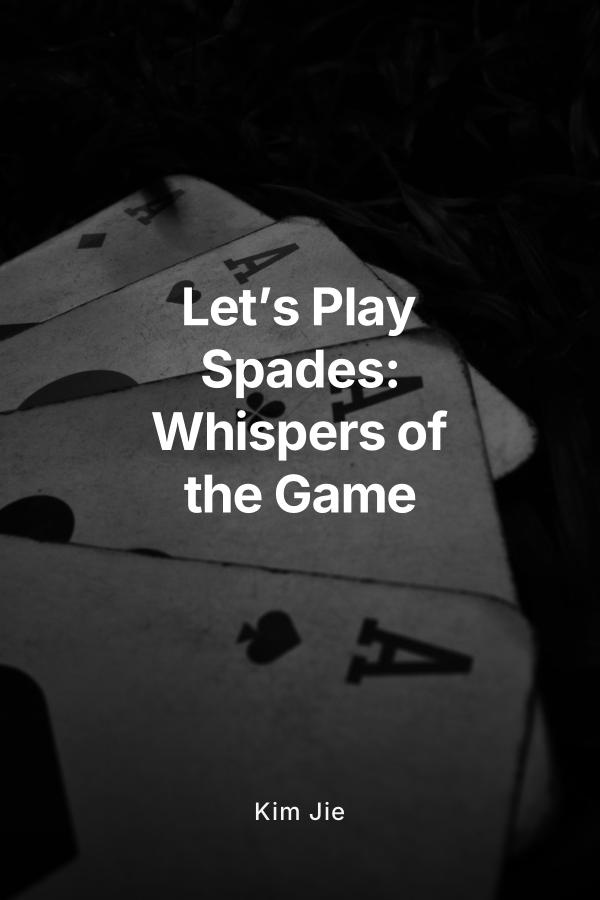
Only the first page of this book is left. We lost the rest in October 2026.
We lost access to the service that stored them, and no other copy exists. We're sorry.
At first glance, it is just cards on a table, four players, two partners facing each other, and a neighborhood game that feels like any other. Isaiah is the quiet strategist who reads the room before he plays a card. Marcus is all energy, trash talk, and instinct, the kind of partner who can win big or crash hard depending on the night. Across from them sit veterans like Mr. Lewis and Ms. Evelyn, older players who treat Spades as more than pastime, more than numbers, something closer to a language about who you are and how you move when it counts.
The opening chapter of this two chapter book sets the tone inside one living room, on one night that changes everything. Isaiah and Marcus step into a routine game that slowly reveals its true weight. Every trick, every hesitation, every missed cut starts to feel like a lesson. Isaiah reads tempo and intent in the smallest plays. Marcus feels the swing of confidence that rises when a risky bid works and crashes when it falls short. Together they learn that Spades is not just about having the right cards in your hand. It is about trust between partners, control of emotion, the courage to commit, and the humility to adjust when your partner slips.
Their near perfect run against Mr. Lewis and Ms. Evelyn ends just short of a flawless victory. The older pair break the streak at exactly the right moment and remind the younger team that knowledge and timing always cost something. Isaiah sees how close he and Marcus came to greatness, and how small the gap between “almost” and “earned” really is. Marcus feels both the thrill and the sting of realizing that skill without discipline still leaves you exposed. That closing hand does more than decide a score. It opens Isaiah’s eyes to a higher level of the game, one he has only sensed but never seen.
Then an envelope arrives at Isaiah’s door with a single word on it: Spades. The timing is too sharp to be coincidence. No return address, no instructions, just an invitation that feels like recognition. Somewhere, someone has been watching their table, measuring their choices, and judging whether they belong. The chapter ends on a simple choice that is not simple at all. Marcus is not sure they are ready. Isaiah understands that readiness will not be decided in theory. If they want to find that higher level, they will have to sit at a different kind of table.
The second chapter widens the lens beyond Isaiah’s living room. Word travels slowly but with purpose. Across the city and beyond, players who live and breathe Spades find identical envelopes waiting in their mailboxes, on desks, and under doors. In offices, basements, corner stores, and kitchens, the same word appears, and the same quiet question follows: Why me?
Danielle studies her envelope like a coded message, convinced that precision means intention. Her partner David shrugs, but he cannot ignore how often her instincts about people and patterns prove right. Henry sits with his unopened envelope and claims he already knows what it says. Nia does not believe him until she tears it open and sees what should not be possible. At a loud basement table, Dre, Malik, Jamal, and Eli argue over bids and missed plays until they realize all of them have been invited. In another corner of the city, Luis and his crew of Sofia, Carlos, and Mateo track their mistakes and small victories through long, talk filled nights. Each group thinks their games are local and small, yet all of them have been seen.
Across these scenes, the book explores not only who can play, but who can be trusted. One partner cuts their own teammate and stares at the fallout. Another overcorrects and plays scared, proof that fear at the table is as dangerous as arrogance. A quiet perfect cut in a single hand becomes the moment Carlos begins to feel what true timing is. Every envelope is a test, but the test is not just about technical skill. It is about how a player responds to pressure, how they treat the people beside them, and what they do after they lose.
As the chapter moves toward the underground tournament, players prepare in their own ways. Isaiah and Marcus camp out at the barbershop, replaying mistakes and learning that their real opponent is miscommunication between them. Danielle charts odds and patterns, trying to build foresight instead of relying on luck. Henry teaches Nia subtle signals and rhythm while noticing how quickly she absorbs the unwritten rules. Luis manages chaos at a noisy table, seeing how tension between partners reveals more than any perfect hand.
The unmarked building where the invited players finally gather becomes a quiet arena for everything they have learned. Tables line the room like a field of chessboards. The early rounds are fast and sharp. Some overbid and are covered by partners who refuse to let them fall. Others fall apart because ego does not know how to listen. Renegs freeze whole tables and turn into live lessons about attention and responsibility. A near Boston electrifies the room, reminding everyone just how high the ceiling really is.
Isaiah and Marcus fight through their own missteps, finding new trust in real time. Henry and Nia operate like a single mind. Danielle uses disruption as a strategy, breaking opponents’ comfort. Luis and his crew ride the edge between loud personality and focused execution. Yet in the end, a quiet, almost invisible team takes the entire tournament. No flare, no talk, just relentless precision and perfect bids. Their victory reframes everything. The night is not about showmanship. It is about honoring the game itself.
The book’s closing movement lingers not on trophies but on what stays with the players afterward. Marcus confronts the difference between talking like a champion and preparing like one. Isaiah recognizes that his gift for reading others only matters if he also learns to be read by his partner. Luis and Sofia accept that the next tournament will come, but only if they use this loss as fuel rather than excuse. Henry and Nia see how the game mirrors every relationship where signals can be missed and trust can be broken or rebuilt. Eli understands that chasing a perfect record means less than learning from a flawed one.
This two chapter story is built for readers from early teens to adults who love competition, community, and the quiet mental battles that live behind every move in a game. It balances the thrill of underground tournaments with the warmth of neighborhood tables and the introspection that comes when a simple deck of cards exposes who you are under pressure. Spades here is not a gimmick or a backdrop. It is the central language through which characters face ego, loyalty, fear, patience, and respect.
By the final page, the envelopes have done their work. The players are sharper, not just at counting books or protecting bids, but at reading people and owning their choices. The tournament crowns a winner, yet the deeper victory belongs to everyone who sat down and learned. Somewhere unseen, the organizers who sent the invitations watch in quiet satisfaction. The game has been honored, the culture of the table has been protected, and a new chapter in the legacy of Spades has begun. The story closes with the sense that another invitation will arrive one day, that another generation will gather around a table and discover for themselves that this is never just a game.