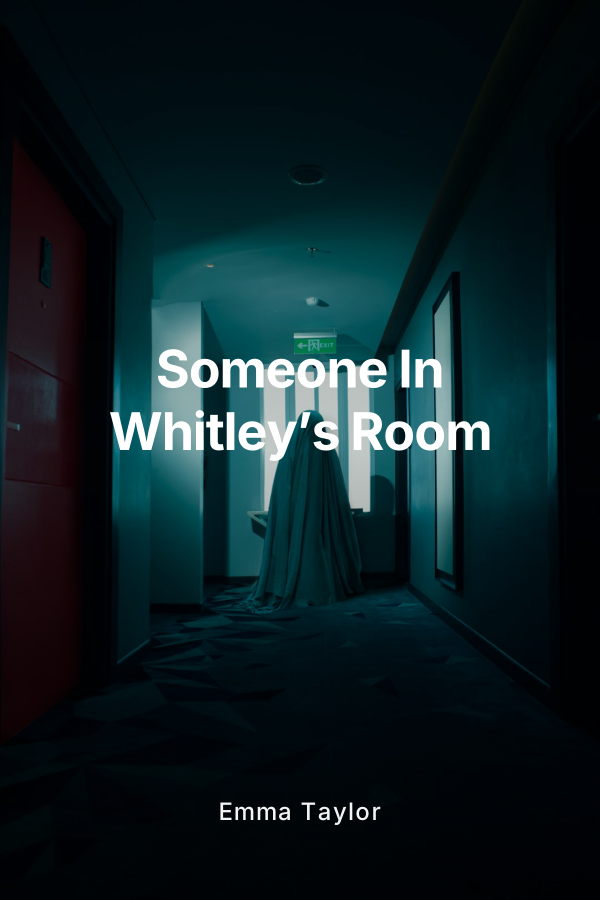
In a quiet, middle class cul de sac that looks perfectly safe from the outside, thirty five year old Sarah is trying to stitch together a life for herself and her six year old daughter, Whitley, after a brutal divorce. There is a restraining order against her volatile ex husband, whose temper and cruelty still haunt Sarah’s sleep, but on paper she is finally free. The house is small but tidy, the neighborhood watch signs are reassuring, and the worst sound at night should be sprinklers ticking in nearby yards.
Then Whitley starts talking about her new friend.
Willy is, at first, exactly what a desperate, overworked mother wants an imaginary friend to be. According to Whitley, he makes her laugh when Sarah is at her most exhausted, he knows how to calm her nightmares, and he tells her where lost toys have rolled beneath furniture. Whitley chatters about him at breakfast and sets an extra place at the table. Willy likes the blue cup. Willy hates carrots. Willy sits in the dark corner of Whitley’s room where the night light does not quite reach.
Sarah dismisses him as a symptom of loneliness and upheaval. The first third of the book lingers in these uneasy days of adjustment. The tone is domestic and almost ordinary, but a slow, sour dread coils beneath every scene. The house feels a little too quiet whenever Whitley is not filling it with her voice. Shadows seem to linger a little too long at the edge of the hallway. When Sarah wakes at 2 a.m., heart pounding from some half remembered nightmare, she feels watched, as if a pair of eyes is studying her from just beyond the doorway, from the slit of Whitley’s room across the hall, or from the low dark space beneath her bed.
Physical evidence begins to replace harmless fantasy. Whitley’s drawings, tacked to the fridge and scattered across the coffee table, change. Simple stick figures slowly gain a third shape that grows more detailed each day. At first Willy is only a tall, dark smear at the edge of crayon houses. Soon he is a looming figure with too many jagged teeth and long, snipping fingers. In some pages, Willy stands between a smaller figure and a much larger one whose face is slashed out with frantic black strokes. In others, Willy is drawn bending over shapes that are nothing but red.
Sarah finds her kitchen knives misplaced and lined up with unnatural precision on the floor beside Whitley’s bed, their handles touching the carpet as though presented in offering. Whitley insists that she did not move them. Willy did. Willy wanted to keep her safe. Willy is very good at keeping little girls safe.
Around the midpoint, the outside world presses in. Sarah spots her ex husband lurking in his car at the far end of the street, watching the house. The restraining order feels like a joke when she sees the familiar silhouette behind the windshield, the glow of his cigarette. The police come once, check the paperwork, promise to swing by the neighborhood more often. Nothing changes. The car returns. At the same time, Sarah begins to notice news reports flickering in the background, stories about a long vanished serial killer whose unsolved crimes centered on this part of town decades ago. The details are never spelled out in full, but brief mentions of victims dismembered in their homes and of a monster who loved to watch his prey sleep echo in the rhythm of Whitley’s bedtime stories.
The imaginary friend grows less imaginary. Whitley says things in a voice that does not belong in a six year old’s throat, her words too cold and knowing. She repeats gruesome details of deaths she could never have heard from television or adults. Sometimes, when Sarah stands in Whitley’s doorway late at night, watching over the small rise and fall of her daughter’s chest, the little girl’s eyes open already aimed at her, shining and unblinking in the dark, and a low male chuckle leaks out before Whitley’s familiar tone returns. Willy does not like it when Mommy stares at us while we sleep, she says.
Chapter One concludes with several escalating shocks that wrench the story from psychological unease into overt horror. Sarah awakes one night to find Whitley sitting cross legged on the floor of the master bedroom, drawing in the weak light that spills from the hallway. Every picture is the same scene of the bed from above, a woman-shaped lump under the covers, and a long armed man standing at the bedside with his head tilted down. In the last drawing, the man is no longer standing. He is leaning closer, until his mouth is at the sleeping woman’s ear.
In a final, jarring moment of the first chapter, Sarah glimpses Willy not in her imagination but in the warped reflection of the dark television screen. While she stands rigid in the living room, the blank screen shows a thin man crouched just behind the couch, hands inches from her shoulders, his skull-like face pressed close to the back of her head, smiling. When she whirls around, the room is empty, except for the smell of old pennies and earth.
Chapter Two shifts into a relentless, suffocating siege. The house becomes a trap, its comforting walls now a cage holding Sarah, Whitley, and the invisible predator that claims to be her child’s protector. Phone lines crackle and fail, the nearest neighbors are conveniently away, and the night stretches on without relief. Sarah realizes, slowly and with rising horror, that Willy is not a harmless figment or even a conventional haunting. He is the spirit of a human predator, a serial killer who took pleasure in stalking families, especially those with young children, and he has found a new way to keep doing what he loves.
Yet Willy is not entirely free. He is devoted to Whitley in his own grotesque way. He has chosen her as his special girl, and there are lines he will not cross if they would cause her true distress. He can be bargained with. He can even be turned.
When Sarah’s ex husband finally breaks the restraining order and forces his way closer to the house, the story accelerates into its climax. He pounds at the door in the middle of the night, his slurred threats and drunken pleas seeping through the thin wood. As he prowls around the property, rattling windows and trying back entrances, the already fragile safety of the home crumbles. Sarah is cornered between two monsters, one of blood and one of spirit, and the only weapon she has is the strange loyalty of her daughter’s invisible friend.
The clever survival twist unfolds in a nerve shattering sequence of manipulation and terror. In whispers by Whitley’s bed, with the shadow of a man moving outside the window, Sarah proposes a new game to Willy through her daughter. She does not beg Willy to spare them. Instead, she offers him something better. The ex is, in her words, a bad man who hurts little girls and their mommies. He is the kind of prey that Willy has always enjoyed most. She pulls every painful memory to the surface, describing the ex husband’s cruelties, his hands, his voice, the sound of his boots in the hallway. Whitley, half innocent and half inhabited by her friend, repeats these descriptions in that wrong voice into the darkness of her room.
Willy listens.
What follows is a slow, graphic torment staged entirely within the walls of the suburban home. The ex, lured inside by a suddenly unlocked door and by the sight of his sleeping child at the top of the stairs, finds himself ensnared in a nightmare. Lights fail one by one. Doors that were open are closed and locked behind him without sound. Voices guide him into rooms that smell of rot. He is stripped of the power he once held over Sarah and reduced to a screaming, stumbling animal as something unseen cuts, breaks, and rearranges him at a leisurely pace.
The book does not flinch from visceral detail in these scenes, lingering on the grotesque intimacy of each wound, the way the ex’s bravado dissolves into raw, animal terror as he realizes that there is a presence in the room with him that enjoys his suffering more than he ever enjoyed inflicting pain on others. His end is not merciful. By the time the police eventually respond to the cacophony, there is almost nothing left that resembles a human body, and no rational explanation for how such ruin could have been inflicted in such a short time by a single person.
Yet even as Sarah survives and the immediate earthly threat is eliminated, the victory is tainted. The final pages are a fast, chaotic blur of sirens, screaming, flickering lights, and conflicting testimonies. Neighbors swear they heard two male voices in the house when there should only have been one intruder. An officer glimpses a tall, pale man at an upstairs window that should have been empty. Whitley, carried out wrapped in a blanket, turns her head over her mother’s shoulder and smiles at something only she can see in the far corner of the yard.
The story cuts off in an abrupt, breath stealing final beat. Back inside the now empty house, in the dark of Whitley’s room, her drawings sway slightly on the wall in a breeze that should not exist. On the last page of her sketchbook, left open on the floor, there is a fresh crayon picture that no one remembers her making. It shows the house from across the street, every window dark except one upstairs, where a tall black shape stands and watches a sleeping woman in a neighboring bed.
The last image before the narrative slams to black is of Sarah jolting awake in her new bedroom weeks later, convinced that someone is standing at the foot of the mattress. She cannot see anything in the dark, but she feels breath on her face and hears Whitley’s small, sleepy voice drifting from down the hall.
It is not safe for Mommy to sleep without Willy watching, the voice murmurs.
The book ends there, severed mid heartbeat, leaving the reader with the shuddering realization that the bargain was never about simple survival. Willy has a new family now, a new game, and he is very patient.