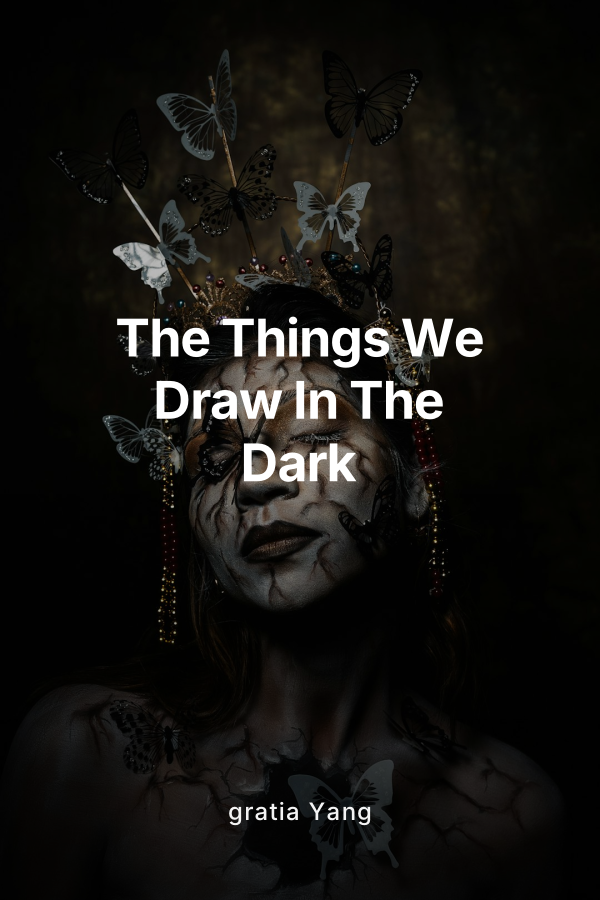
In a concrete ocean of a city, Hanamori High School rises like any other building of glass and steel. Bright banners. Shiny floors. Smiling teachers. But every corridor hums with something wrong, a quiet frequency just under hearing, like the moment before a scream.
Into this world steps Aiko Sato, a new transfer student from a remote countryside village, carrying one suitcase, one worn sketchbook, and a past she will not talk about. Back home, the night never felt empty to her. Shapes moved in the treeline. Whispers rode the wind. Everyone else said she had an overactive imagination. Her parents called it a phase. But Aiko knows better. She draws what she sees to keep it contained.
At Hanamori High, she tries to blend in. Wrong shoes. Wrong accent. Wrong everything. The city kids watch her with sharp eyes and sharper smiles. They call her “Farm Girl” under their breath. They mock her quietness. But they are careful, too. Careful not to walk down certain halls alone. Careful not to stay late in the art room. Careful, most of all, around the mirrors.
Because Aiko is not the first one to see things here.
THE SETUP: A SCHOOL THAT BREEDS MONSTERS
The story unfolds in a fast, compressed timeline over several weeks, every day more suffocating than the last. Hanamori High is the kind of place that looks safe from the outside. Guidance posters. Anti-bullying campaigns. Grinning club photos. Underneath, fear festers. Rumors slip through the student body: a girl who vanished from the rooftop. A boy who started talking to a blank wall and would not stop until they took him away. An art teacher who “transferred” mid-semester without saying goodbye.
The official record is clean. No incidents. No deaths. No supernatural events. But the halls remember.
The monsters in this book are not traditional ghosts or demons. They are imaginary shapes at first. Things only teenagers see at the corner of their vision. Shadows with too many joints. Smiles without faces. Figures that cannot exist in daylight. They begin as private fears given form, then twist into something shared and lethal.
For years, students have scribbled their fears into the margins of notebooks, onto desks, over bathroom stalls. Someone, long ago, discovered that when enough students believe in the same nightmare, it gains weight. Teeth. Claws. And this school, packed with hormonal terror and quiet despair, has become a factory for such things.
Aiko, with her rare ability to see what others refuse to admit, is stepping into a nest.
THE PROTAGONIST: A GIRL WHO DRAWS WHAT SHOULDN’T EXIST
At the center of the story stands Aiko, withdrawn and observant, her mind split between survival and surrender. She has always seen things other people miss. In the countryside, black figures would watch her from the rice fields, tall as telephone poles, bending closer when she cried. She learned early that drawing them made them clear, gave them fixed shapes, and for a while, that made them weaker. Contained.
Her last year in the village ended in a tragedy she will not speak of. A friend. A late walk. A shadow that should not have touched the earth. Now her family has dragged her to the city, hoping a new environment will heal what they call her “delusions.” At Hanamori, Aiko tries to deny what she sees. She refuses to open her sketchbook in public. She avoids windows after sunset. She tells herself that everything strange is just stress.
But the school will not let her rest.
On the first day, she finds a crude chalk drawing on the back wall of her classroom, half-erased. Long limbs. No face. A familiar shape. No one admits to drawing it. That night, she dreams of it standing by the blackboard, head brushing the ceiling, spilling a black dust that chokes the desks.
In the morning, there is real dust in her shoes.
EARLY HORROR: WHEN IMAGINATION BLEEDS
The horror in the first chapter is slow, creeping, almost gentle. Tiny details go wrong. Reflections do not match movements. A shadow in a photograph has one limb too many. A doodle on a math worksheet shifts position when no one is looking.
Aiko’s first ally, if he can be called that, is Kenta, a loud, restless boy who hides his fear behind jokes. He sits near her in class, notices how she stares too long at empty corners, and teases her until he sees the look in her eyes when she is truly terrified.
He shows her the school’s rumor notebook, hidden in the back of the library, filled with handwritten stories passed down for years. In its pages, she reads about “The Thing At The Stairwell Landing,” “The Girl In The Third-Floor Bathroom Stall,” and “The Crowd With No Faces In Classroom 2-B.” The entries are written like pranks, dares for first-years. But some are scratched out violently. Others are smeared, as if written by a shaking hand.
Aiko feels her heart pound as she recognizes shapes she has drawn since childhood. The same strange joints. The same wrong angles. Someone else has seen them here. Many someones.
The imaginary monsters are incubating in this shared fear, and something inside the school is helping them hatch.
ESCALATION: WHEN MONSTERS BECOME A LANGUAGE
The book’s tension spikes when the monsters stop being personal hallucinations and start behaving like a coordinated force. Students begin reporting the same nightmares. They wake up with identical ink smears on their hands, as if they have been drawing all night. Art projects turn grotesque without anyone remembering making them.
The monsters themselves are not fixed creatures but evolving manifestations of specific teenage terrors:
-
A tall, jointed thing that crawls across ceilings, feeding on the shame of those bullied until they fall silent. It can only be seen in the gaps of flickering fluorescent lights.
-
A creature made of torn exam papers and red correction marks, whispering failure into ears during tests, squeezing hearts until students pass out trying to be perfect.
-
A swarm of thin, shadow-children that gather behind anyone who feels invisible, growing clearer with every ignored cry, threatening to pull the victim out of reality and into their rank, wordless crowd.
These are not distant monsters. They are woven into daily school life. They sit in the back row. They crouch beneath the lab tables. They nest inside lockers that slam on their own.
At first, only a handful of sensitive students seem affected. Then, one day, a classroom full of teenagers simultaneously sees the same thing: a pale figure standing in the doorway, eyes stitched shut, mouthing soundless words. Their screams become the spark that finally gives it physical presence. A teacher tries to pull a student away from the door and feels fingers grab back from nowhere, leaving bruises shaped like threads.
From that moment, the school cannot pretend nothing is wrong. Yet the administration insists on silence. Many students begin to question their sanity. Others lean into the thrill, sharing photos, daring each other to look longer, feed the phenomena. The boundary between imagination and reality tears just a little more every day.
Aiko realizes, with dawning horror, that her drawings are no longer just coping tools. Every time she sketches what she sees, the monsters gain definition, clarity, new ways to exist. She is helping them evolve.
THE SECRET HISTORY OF HANAMORI HIGH
As the danger grows, Aiko, Kenta, and a small circle of outcast classmates dig into the school’s past. They find references to an abandoned art therapy program run in the old, sealed-off wing. Years ago, a counselor had encouraged troubled students to externalize their fears on paper, promising that “giving your horror a face makes it weaker.”
Students created their own personal demons in charcoal and paint, then hung the work all over a basement hallway. Something terrible followed.
Officially, it was a fire. A tragic accident that closed the wing and resulted in a quiet wave of transfers. Unofficially, survivors tell a different story in hushed bits: drawings peeling off the walls and walking into the dark, a low humming sound under the floor, a student who disappeared into her own mural. No bodies were found. The wing was bricked over, and the administration started a new tradition of pretending.
But trauma does not vanish when buried. It seeps upward. It stains the new building above it. It infects the new generation, waiting for a catalyst.
Aiko is that catalyst. She is sensitive enough to see early, stubborn enough to investigate, and gifted enough as an artist to give the shapeless things a body.
By mid-book, she discovers that the imaginary monsters are not random. They are fragments of that old art, starved for attention for years, now feeding on the exploding anxieties of current students. Every cruel rumour, every panic over exams, every secret self-hatred is fuel. The school has become a closed ecosystem of fear.
PERSONAL STAKES: A PAST THAT WILL NOT STAY BURIED
The supernatural horror tightens its grip as it collides with Aiko’s buried guilt. Flashbacks reveal that the countryside tragedy involved a monster very similar to the ones now stalking Hanamori. A friend named Mio had believed in Aiko’s drawings completely, telling her, “If you can draw them, they must be real.”
One night, they tested that belief at an abandoned shrine. Aiko drew what she saw. Mio looked too long. Something stepped through. The next morning, villagers found Aiko alone, sketchbook soaked on the ground, pages blank, the friend gone without a trace.
Aiko’s parents insisted it was a runaway incident. Aiko remembers the imprint of too many fingers on Mio’s wrist as she was pulled into the treeline.
Now, as Hanamori’s monsters grow bolder, they begin to mimic faces from Aiko’s past. A tall thing in the stairwell suddenly bends down with Mio’s smile. A whisper in the hallway uses her voice. Aiko realizes that the entities are not just feeding on fear; they are learning from memories, stealing identities from anyone who cannot let go.
This makes the horror deeply personal. The school is not merely haunted; it is wearing the ghosts of Aiko’s own failures like a mask. If she cannot distinguish between what is her guilt and what is truly out there, she will break.
TIGHTENING THE NET: NO SAFE PLACES LEFT
The second half of the story becomes a series of escalating, claustrophobic set pieces inside the school. Fire drills, club meetings, exams: every normal routine becomes an ambush point.
-
During an art class, students are told to “draw your fear.” The unspoken rules of the school are broken. As paper fills with shaky sketches, the room temperature drops. The teacher’s shadow gains horns. Drawings slide off desks and cling to walls, watching. When a boy accidentally splashes black ink across his own face in the drawing, his nose starts to bleed in real life.
-
In the gym, a school assembly about “mental wellness” turns nightmarish when the mascot costume in the corner starts moving without anyone inside. Its stitched-on smile stretches wider, its eyes buckle inward, and it begins to walk the bleachers, sitting beside students whose hearts are already close to snapping. Anywhere it sits, the kid beside it begins to feel crushing, inexplicable despair, some pushed to the brink of self-harm.
-
The library, once a refuge, becomes a trap. Text on the pages rearranges into threats. Margins sprout handwritten messages in a child’s clumsy script, begging Aiko personally to “draw me again” and “finish what you started.” Shelves seem to shift while no one looks, funneling students into narrow dead ends where something waits on the ceiling.
By this point, the monsters are visible to entire classes at once. The administration clamps down, locking doors, banning phones, calling everything a “group psychological episode.” Parents receive scripted reassurances. No one mentions the bruises and burns students wake up with, or the new, empty desks in homerooms.
Aiko understands that if the school continues to deny the reality of what is happening, the monsters will escalate until there is nothing left to feed on. The building will become a dead shell full of moving things that used to be teenagers.
THE CENTRAL DILEMMA: TO DRAW OR TO LET DIE
The core of the plot tightens around a brutal trade-off. Aiko discovers, through exhausted trial and error, that when she draws a monster with enough precision, she can trap some of its presence on the page, weakening it in the physical environment. But the cost is high. Once trapped, the creature becomes clearer in her mind. It can talk to her. Bargain. Threaten.
If she refuses to draw, the entities roam free, slaughtering her classmates in subtle, deniable ways: “accidents” on stairwells, breakdowns that end in a single step off the rooftop edge, disappearances that no one quite remembers the details of.
If she continues to draw, she concentrates the horror inside herself. The pages of her sketchbook throb with invisible weight. The images whisper when closed. Sleep becomes impossible. Her sense of self dissolves.
The book’s tension stems from this impossible choice. Aiko is essentially asked to become the living prison for a school’s accumulated nightmares, or stand by while the building devours its children.
Kenta and the others try to help. One girl, Rina, stops self-harming only when she starts feeding her pain into a specific creature, a slumped, eyeless thing that sits by her desk and absorbs her worst thoughts. But the more she relies on it, the more it controls her, until she cannot make a decision without looking to it first. Aiko sees what will happen if they accept the monsters as coping mechanisms. The school will remain standing, but no one inside will be truly human.
THE BRICKED WING: ROOT OF THE CURSE
The climax of the book’s summary centers on the sealed old wing. Through whispered maps, midnight explorations, and breaking more than a few rules, Aiko’s group finds the bricked doorway which once led to the art therapy corridor. Every adult insists it does not exist. Every blueprint pretends that space is solid concrete. Yet at night, muffled scratching and the rustle of paper can be heard on the other side.
When the emotional pressure reaches a breaking point, they open it.
Behind the bricks lies a hallway preserved like a tomb. Charred edges on student paintings. Melted crayons. Smears that look too much like fingernails clawing at the walls. At the far end hangs a single surviving canvas, completely black except for the faint outline of a girl’s figure stepping through.
The air is thick as syrup. Shadows here do not follow light. The group’s breath comes out in visible curls, no matter the season.
It becomes clear that the origin of the crisis was not simply scared teenagers but a deliberate experiment. The old counselor had wanted to prove that fear could be turned into something manageable, even useful. By turning individual terrors into shared myths, he hoped to teach students that monsters could be named and thus controlled. Instead, he created a collective deity of dread, a multi-faced thing born from a hundred paintings and a thousand secrets.
That entity never died in the fire. It slept. Waiting for a new artist strong enough to revive it.
Aiko feels it wake the moment she steps inside that old wing. Her sketches, all the creatures she has drawn since childhood, were tributaries feeding into this black ocean without her knowledge. The monsters roaming the school are only fragments, scouting bodies. The true horror is a formless core that wants one thing: for everyone in Hanamori to believe in it completely.
ENDGAME: FACING THE UNSPEAKABLE
The final stretch of the book (to be told across two tightly wound chapters) will follow Aiko and her allies as they confront the central entity. The summary points towards an ending that is not clean or heroic but brutally costly.
The entity, shifting and unstable, uses illusions to break them. It appears as beloved relatives, favorite teachers, lost friends. It offers bargains: let it stay, let it feed slowly and discreetly, and it will remove pain, erase memories, make parents proud, make grades perfect. A painless school, if they simply stop resisting.
Many students would accept such a pact. Aiko cannot. She has seen what denial did back in her village. She knows that any comfort offered by a monster is a leash in disguise.
She realizes that the only real weapon she has is precisely the one that caused so much harm: her drawing. But this time, she must reverse the rules. Instead of giving form to fear, she must draw what the school and its students have always refused to look at directly. Not the monsters, but the truths that birthed them. Bullying. Abuse. Impossible expectations. Abandonment.
The book hints at a desperate plan. On the day of a major school event, Aiko will cover the walls with a single, enormous mural painted in a frenzy: not of the creatures, but of the students’ real faces, their raw pain, their hidden despair. By forcing everyone to confront what they have turned away from, she hopes to starve the entity of its favorite food: secrecy.
The entity fights back, twisting the mural, trying to replace faces with its own variations. The building becomes a war zone of hallucinations and shifting space. Staircases lead back on themselves. Doors open onto scenes of worst fears. The monsters, sensing their food source threatened, tear through classrooms.
The story drives toward a conclusion where Aiko, barely holding onto sanity, steps into her own mural as a final act, entering the psychic battlefield between imagination and truth. She risks dissolving entirely to create one last drawing from the inside: a portrait of the entity as it truly is, stripped of borrowed shapes, reduced to its pathetic core. A hungry, formless need.
Whether she survives is left knife-edged and uncertain in tone. What is clear is that Hanamori High will not walk away unchanged.
THEMES AND AFTERMATH
Beneath the jump scares and relentless tension, the book digs into several themes:
- The way institutions prefer pretty lies to messy truths, even when those lies breed horror.
- How teenage imagination can be both a lifeline and a weapon against itself.
- The terrible cost of one person trying to carry everyone’s nightmares alone.
The ending of the summary promises a resolution that is more haunting than comforting. The monsters are not neatly banished. Some drawings cannot be burned. Some students will always see too much. But there is a shift. The school begins, haltingly, to talk. To acknowledge. To look directly at what hurts.
In that thin strip of honesty, the monsters lose their perfect grip. They recede, not into oblivion, but into a manageable distance, where they can no longer slaughter in the dark.
Aiko, whether present or remembered, becomes a whispered legend: the countryside girl who came to the city and taught Hanamori High a brutal lesson. That imagination, when suffocated, will find a way to breathe, even if it has to grow teeth.
“The Things We Draw In The Dark” stands as a fast, nerve-fraying supernatural thriller about a high school where imaginary monsters are real enough to kill, and one girl’s desperate race to turn her cursed gift into the only weapon that might save them all.