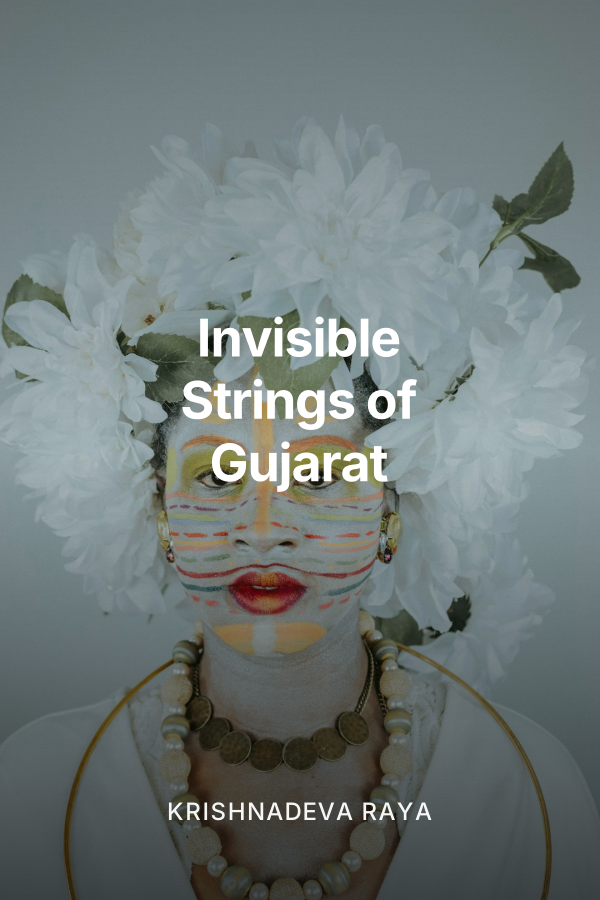
This book is a historical fantasy of politics, commerce, and guerrilla warfare set in princely Gujarat between 1852 and 1898. It follows three orphaned prodigies who grow into the secret heart of the resistance against the British Raj and then traces the destiny of their six children, split between thrones and shadows. The tone blends intimate, character‑driven drama with intricate plotting, secret alliances, and a quietly magical sense that history itself is listening.
At its core stand three rulers whose weapons are utterly different. Mahima of Baroda fights with law, treaties, and the cold power of paperwork. Kiran of Rajpipla holds the forests with guerrilla tactics and carefully calibrated terror. Megha of Bhavnagar wields gold, ships, and markets. Their story begins as three separate origin tales shaped by the same looming catastrophe: British annexation and the Great Rebellion of 1857.
Born in 1852, Mahima comes into the world in the shadow of Nazarbaug Palace, a child of court ministers who traffic in secrets while Lord Dalhousie’s Doctrine of Lapse hangs over every princely state. When cholera takes her parents, the Gaekwad Maharaja adopts her into the King’s Crib. Growing up on his lap as he reads feuding letters from rebels and British officials, she learns that survival is a matter of double speech and careful silences. By eight, she is the “Keeper of Secrets,” a girl who knows that the wrong word can end a kingdom.
Far to the east in the rugged hills of Rajpipla, Kiran is born in a monsoon night laced with musket fire and lightning. He survives a hunting‑camp tragedy and is taken by a superstitious queen into the Zenana, then out into the forests with the Bhil tribes during the uprisings of 1857. There he becomes a “Hidden Blade” child: tracking, hunting, memorizing every British patrol route. Rajpipla remains partially unconquered, a buffer of wild hills where Company law does not quite hold, and Kiran grows up believing that trees, not treaties, are the true walls of a kingdom.
On the western coast, Megha is born into a wealthy merchant family in Bhavnagar, where the air tastes of salt and spice. When pirates destroy her family fleet and drown her parents, fishermen find her afloat on a crate of silk. The young prince adopts the “ocean’s child” as a living symbol of mercy and independence. Raised within the treasury wing instead of the nursery, she learns numbers before nursery rhymes. The Mutiny turns trade routes into battle lines and shows her a simple lesson: kings fight for territory, but merchants own the supply lines. By eight, she is the “Silver Tongue” who can haggle with sailors in three languages.
By 1860 the East India Company has fallen and Queen Victoria rules India. The three children grow apart in different worlds. Mahima sits in Baroda’s court surrounded by coded letters and bribed officials. Kiran moves between forest caves and hidden valleys, his playmates Bhil hunters rather than princes. Megha navigates docks and counting‑houses, watching her adoptive prince quietly profit from chaos. Each becomes a specialist in one axis of power: diplomacy, survival, or commerce.
Their first meeting in 1864 is not a matter of destiny but of politics. On the edge of the Great Rann of Kutch, under a British ban on assemblies, the rulers of Baroda, Rajpipla, and Bhavnagar secretly celebrate Makar Sankranti. Their twelve‑year‑old wards drift away from the tense negotiation tent and climb an old watchtower to watch forbidden kites. There, the story reveals its central metaphor: the sky full of silent kites as a map of an occupied nation.
Mahima does not see play. She watches the glass‑coated strings and the absence of shouted victory calls, reading in the silence the fear of nearby British patrols. The kites become, to her, blueprints for future resistance: invisible strings instead of swords. Kiran sees birds on leashes and feels only restless anger at captivity. Smelling the wind, he predicts a sandstorm that will blind cavalry and quietly charts escape routes. Megha weighs the material of each kite like inventory, calculating profit margins and supply chains even in the sky. In a single scene, the narrative lays out their three lenses on the same landscape: politics, survival, and commerce.
At first they clash. Megha appraises a fallen black kite in terms of rupees. Kiran cuts the dangerous string as a matter of survival, not ownership. Mahima orders them to leave it undisturbed, thinking of British scouts and railway treaties. Their “verbal battle” showcases mutual contempt: the courtier’s icy disdain for smugglers and speculators, the forest prince’s scorn for courtiers and merchants, the trader’s irritation with idealists who ignore cost. Yet that same encounter plants the seeds of fascination. Each recognizes in the others a power they cannot wield themselves.
By 1868 they have grown into formidable young adults in their separate spheres. Mahima, now the Brain of Baroda, wields the pen as her weapon. She buries the court in petitions, counter‑petitions, and footnotes, playing British law against itself with almost scholastic ferocity. Kiran has become the Shield of Rajpipla, a half‑legendary figure among the Bhils who sabotages British survey parties without shedding enough blood to invite full reprisal. Megha, the Bank of Bhavnagar, navigates global crashes and war‑shaken markets, facing down bullying captains on the docks with perfect English and the credible threat of impounding their ships. The book lingers on these parallel coming‑of‑age vignettes to establish competence and loneliness together: three prodigies, each without true peers.
The real story ignites in 1873, when Dadabhai Naoroji arrives in Gujarat as Diwan of Baroda. Historically an early critic of economic exploitation, here he becomes something more: the architect who forges three scattered weapons into a single, unstable instrument. His presence is grounded in fact but shaded with a mentor’s almost mythic intuition. He teaches Mahima that the real war is not only about law but about ledgers. He gives Kiran a new target, the supply lines rather than the soldiers. He warns Megha that wealth locked in British banks is an illusion of safety. Then he disappears into the background, having sent each of them a single line about British rule as a “knife of sugar” and summoned them separately to the ruins of Dholavira.
In those ruins, a second, sharper meeting unfolds. They arrive expecting informants or ambushes, find only each other and a dusty courtyard, and are forced to argue. Mahima criticizes Kiran’s raids as primitive provocations that invite annexation. Kiran accuses Megha of feeding the very empire she claims to resent. Megha mocks Mahima’s devotion to laws written in London. Beneath the clash, however, something shifts. Mahima, used to men of ink, is startled by Kiran’s raw, maskless certainty. Megha, used to men of gold, is shaken by his immunity to her status and possessions. Kiran, long guarded, finds himself grudgingly reliant on Mahima’s maps and Megha’s ships for any hope of lasting defiance. The ruins scene becomes the crucible of their adult emotions: anger, grudging respect, and a dangerous pull that none of them name yet.
Naoroji, ever pragmatic, sees opportunity. The British are circling with a familiar playbook of “divide and rule.” Plans are afoot to marry Mahima into a compliant northern court, declare Kiran unfit to rule and absorb his forests, and seize Megha’s fleet through new maritime regulations. His answer is not another petition; it is a triple marriage the British will be reluctant to unravel. In a hidden temple above the Narmada waterfalls, witnessed only by Naoroji and the forest, Mahima and Megha marry Kiran in a Gandharva ceremony that binds three principalities into one unregistered alliance. To the outside world, it is a sober political merger. For the three of them, as the chapter about the wedding night makes clear, it is a personal catastrophe and deliverance at once.
Their union is described not as a romantic idyll but as the creation of a three‑headed organism. Mahima brings the Mind, Megha the Stomach that turns resources into action, Kiran the Spine that faces bullets and famine. In private, around the hearth of their forest lodge “Iron Nest,” the book dwells on scenes of exhausted intimacy: Mahima dropping legal dispatches and trembling that she has failed Baroda, Megha confessing the guilt of running famine grain for profit, Kiran kneeling before them and promising that their lives matter more than kings or markets. It is there, during a storm in 1874, that “the soul splitting” occurs, a semi‑mythic night when Kiran is said to divide his stillness and wildness between his two wives. The magic here is subtle and mostly symbolic, folded into the language of legend, so that readers can read it as prophecy or metaphor.
The consequences of that night ripple across Gujarat. In 1875 the Deccan Riots erupt as farmers burn debt bonds and challenge moneylenders. Both wives are six months pregnant, yet neither hides. Mahima, confined by her condition, fights in courtrooms and in print, funding legal defenses and secretly printing pamphlets that argue, using British law against itself, that destroying fraudulent debts is an act of correction, not crime. Megha ships food under the guise of luxury textiles, weaponizing her pregnant body at checkpoints to shame British officers into letting contraband grain pass. Kiran vanishes into the smoke and dust, making sure no firing line remains unshadowed by his archers. Together they turn what history recalls as scattered riots into the echo of a coordinated, if clandestine, second rebellion.
That November twin births transform their triangle into a dynasty of six. The solution they devise to survive British scrutiny is as ruthless as it is brilliant. Two children, Vikram in Baroda and Shubh in Bhavnagar, will live in the light as recognized heirs, molded by British tutors or ruthless trade. The other four, Vidya, Vivek, Shakti, and Chaya, will vanish into the Satpura forests with Kiran and be raised as “Guardians” instead of princes or princesses. The narrative here plays with a sun‑and‑moon motif: a public world of velvet suits and dockside contracts, and a shadow world of arrow‑catching, code‑breaking, poison‑mixing, and secret monthly visits from both mothers, who teach law, history, ledgers, and manipulation by firelight.
As the children grow, the book shifts tone into a generational spy saga. By the late 1880s, the Indian National Congress debates reform in public, but the real counterweight to colonial power in Gujarat is this hidden family network. Chaya infiltrates Baroda as a mute handmaiden, tasting food for poison and eavesdropping behind silk screens, unnoticed even by her own brother Vikram. Vivek becomes a lowly clerk in Bhavnagar’s treasury, quietly correcting books to build Shubh’s fortune without provoking British audits. Shakti, masked and mounted, raids tax carts along the ghats and re‑routes wealth to villages, earning ghost‑stories whispered by terrified officials. Vidya remains in the forest lodge, turning scattered reports into strategy. The parents age before their time as they juggle two parallel systems: official loyalties and the secret family state.
By the 1890s, history surges back in the form of plague. The Epidemic Diseases Act gives soldiers license to strip search women and burn homes, and the tacit truce between rulers and ruled dissolves. Mahima fights the law head‑on, contesting invasive searches and arguing, again, against the British using their own legal rhetoric. Megha smuggles scarce European medicines that colonial authorities hoard. Kiran transforms the forests into a vast quarantine refuge, protecting both tribals and city refugees. Their Iron Nest, once a sanctuary for planning and love, turns into an overcrowded field hospital. The cost is devastating. By November 1898, all three are worn out, their strength eroded by decades of double lives. Kiran, carrying a plague‑stricken child in his arms, finally contracts the disease himself.
The book’s final movement is not a triumphant revolution but a hard, luminous grief. Faced with Kiran’s imminent death, Mahima and Megha understand that the Soul Split cannot be reversed. Without the Spine, the Mind cannot stand upright and the Stomach cannot turn grief into useful fuel. Rather than retreat to their palaces and fade into ceremonial irrelevance, they choose a different ending, one that the summary hints at but leaves for the full text to reveal in emotional detail. The six children, scattered across courts, docks, forests, and temples, must step into both roles at once: swords and shields, rulers and ghosts, the inheritors of a secret kingdom stitched between princely titles and tribal clearings.
Invisible Strings of Gujarat, as a whole, uses the lives of Mahima, Kiran, Megha, and their children to reframe the familiar history of Gujarat’s princely states. The British appear not as faceless villains but as a heavy, pervasive system that must be tricked, starved, and misdirected rather than simply fought in open battle. The true battles are for information, for grain, for jurisdiction, and for the right to define whose lives are expendable. The story balances intimacy and scope: moonlit conversations in a forest lodge against the backdrop of famine trains, stock market crashes, poison plots, and legislative acts.
Throughout, kites and strings recur as an image of resistance. At twelve, the trio study glass‑coated strings as metaphors for invisible weapons. As adults they learn to stretch their own invisible lines between palace, port, and jungle, sending signals through ledgers, songs, and rumors rather than flags. Their love triangle subverts the usual tale of jealousy; it becomes instead a structure of mutual reinforcement, a quiet promise that none of them will be left alone to carry the weight of a country’s fear.
The book closes on a future that belongs to the Six. Two have grown up believing they are only children, unaware of the eyes in the galleries and the ledgers that have guarded them since birth. Four have grown up in the dark learning that their entire purpose is to keep the visible two alive. Somewhere beyond the page, they stand at a crossroads marked by plague pyres and railway tracks, with the British still entrenched and a new century approaching. Behind them lie the invisible strings their parents wove across Gujarat. Ahead lies the question that will drive their own saga: can an empire be undone not by a single rebellion, but by a family that has learned to live half in shadow and half in sun?