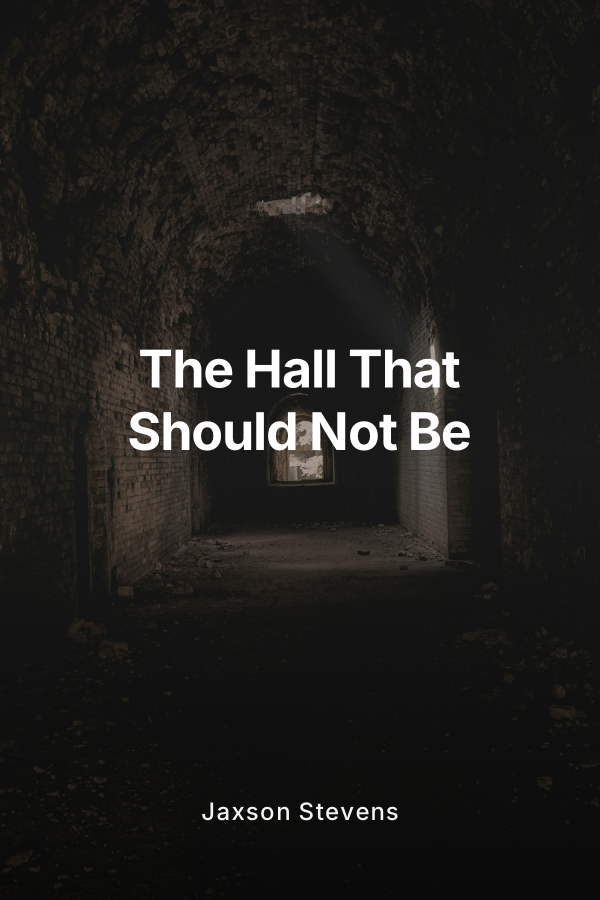
David is sixteen, restless, and used to being alone. He has no real friends, little contact with anyone who would notice if he vanished for a few hours, and a growing habit of wandering through forgotten places just to feel something sharper than boredom. That hunger for discovery leads him into an abandoned mall, a dead monument of shuttered storefronts, stale air, and silence so deep it feels staged. At first, the place is exactly what he expects: broken tiles, dark display windows, abandoned food courts, echoes. Then he sees something impossible. A hallway stretches out from the mall in a place where no hallway should exist, long and wide and purposeless, jutting from the architecture like a mistake in reality itself. It does not connect to any shop. It has no sign, no design, no reason to be there. That wrongness is exactly what pulls him in. Curiosity wins. It always does. The core concept centers on this impossible hallway and David’s choice to enter it, which becomes the point of no return
The moment David steps inside, the mall begins to change. At first the shifts are subtle enough to be denied. The lights flicker in rhythms that feel deliberate. Sounds travel the wrong way. A distant metallic clatter becomes a whisper near his ear. The hallway seems longer when he looks up than it did when he first entered. Then the glitches begin in earnest. Benches sink halfway into tile. A trash can protrudes from a wall as if the building tried and failed to swallow it. Storefront gates cut through display mannequins. Corners bend at impossible angles. Floors ripple with visual errors, and objects clip through one another as if the mall has become an unfinished simulation tearing open around him. These distortions are not decoration. They are the language of the place. As David pushes deeper, the mall becomes less like a building and more like a broken thought, a reality losing its ability to hold itself together. The summary builds suspense through these shifting halls, malformed spaces, weird sounds, and objects visibly embedded in walls and floors
What begins as exploration turns into entrapment. David tries to retrace his steps, only to find the route altered. Hallways shift. Escalators lead to levels that do not match the structure of the mall. Service corridors loop back into stores he has never entered. Familiar areas return in wrong combinations, like copied pieces pasted into the wrong places. Time also seems unstable. A distant announcement crackles over dead speakers, though the power should be gone. A food court clock jerks forward by hours in seconds. Somewhere water drips, but the sound arrives before the drop. The suspense comes not from immediate attack alone, but from the growing realization that the mall is actively preventing escape. Every attempt to impose logic only reveals more impossible architecture. David is not just lost in a building. He is trapped inside a place that has slipped free of normal space, where navigation, memory, and direction can no longer be trusted.
The first sign that he is not alone arrives through sound. Loud footsteps strike from somewhere beyond the dark, too heavy and too fast to belong to another explorer. Lights begin to flicker in violent bursts, illuminating the hallway in stuttering fragments. In each pulse of brightness, something seems closer. Then, in one hard flash, David sees it. A tall black mutated figure rounds a corner at a distance, its shape stretched and wrong, more silhouette than body until it moves. And when it moves, it moves like an animal. Fast. Jerking. Predatory. It is not shambling or ghostlike. It hunts. That changes the whole story. The mall stops being only a mystery and becomes a chase. From that point on, every wrong corridor is also a trap, every sound may be pursuit, and every flicker of light risks revealing the thing closing in. The entity’s defining traits in the concept are clear: black, mutated, first heralded by loud footsteps and flickering lights, then seen turning the corner, and hunting David with fast, animal-like aggression
The psychological core of the book is David’s loneliness. The horror works because the mall externalizes what he already feels inside. He is used to being unseen. Used to silence. Used to moving through life without strong connections. Inside the impossible mall, those private feelings become physical reality. The emptiness is total. There are almost no people, and the lack of human presence becomes more disturbing than any crowd. The few signs of life feel false, delayed, or abandoned mid-motion. David’s emotional isolation sharpens the suspense because there is no easy lifeline. No friend calling his phone. No one tracking his location. No immediate rescue. More importantly, the entity feels linked to the void inside him. It is not simply a monster in a building. It reads as the embodiment of his fear that emptiness is not absence at all, but a living thing waiting for him to notice it. The thriller element merges with surreal psychological dread as the hunt becomes both literal and symbolic, driving him through a collapsing maze that reflects his inner disconnection
As the pursuit intensifies, David begins to notice that the mall is not randomly broken. It responds. It anticipates. Routes seal off just before he reaches them. Dead ends form where exits should be. Reflections lag behind him in dark glass. Some spaces appear to mimic his memories, not accurately, but with corrupted details. This adds a second layer to the suspense: the possibility that the building, or the entity inside it, is learning him. The mutated figure never speaks, never explains, never becomes less frightening through overexposure. Instead, it remains partially obscured, glimpsed in fragments through static light, impossible distances, and sudden movement. The less clearly it is seen, the more oppressive it becomes. The narrative tension comes from constant pressure. David must keep moving, but movement leads him deeper into distortion. He wants answers, but attention itself seems to feed the place. His curiosity brought him into the hallway. Now that same instinct becomes dangerous, because every attempt to understand the mall risks drawing the hunter nearer.
The middle of the story escalates through a sequence of increasingly impossible set pieces. David runs through department stores that continue for far too long. He crawls under security gates that lead into entirely different sections than they should. He enters maintenance tunnels where the walls pulse with electrical hum, only to emerge somewhere above the atrium with no visible path between. Objects continue to clip into the environment in more grotesque ways, and the visual logic of the world breaks down. A row of vending machines is fused into plaster. A staircase descends halfway into the floor and keeps going. Ceiling lights hang through each other in dense tangles. At times the mall appears unfinished, like geometry failing to load. At others it looks overlaid with alternate versions of itself, multiple states occupying the same space. These scenes build a surreal rhythm of danger and disorientation, each one pushing David closer to panic while preserving the central mystery of what the hallway really opened into.
The entity’s hunt is relentless. It is not everywhere at once, but it is always near enough to matter. Sometimes David hears it charging behind him with impossible speed. Sometimes it stops just out of sight, forcing him to imagine its posture in the dark. Sometimes the only sign is a violent shake in nearby fixtures or a sharp pattern of footfalls that cuts off too suddenly. The best suspense in the summary lies in how the thing uses the mall’s instability. It seems adapted to this glitched environment in ways David is not. It slips through spaces that should be solid. It vanishes at one end of a corridor and appears at another. Whether this is due to supernatural ability or because the mall obeys it is left uncertain. The result is the same: David is prey inside a territory shaped for the predator. His only advantages are instinct, speed, and the desperate creativity that emerges under pressure.
As David struggles to survive, the story deepens its ambiguity. He starts to question whether the impossible hallway was always there waiting for him, or whether he was somehow meant to find it. He wonders whether the mall is transforming around him or revealing what it truly is beneath ordinary perception. The suspenseful mystery never collapses into a neat explanation. Instead, clues suggest multiple possibilities. The hallway may be a tear in reality. The entity may be a native inhabitant of this warped layer of space. The entire structure may be some broken overlap between the familiar world and something hostile beneath it. Yet the book summary emphasizes experience over explanation. The reader is drawn through dread, pursuit, and mounting unreality, not through exposition. This preserves the surreal psychological tone the concept calls for while keeping the threat vivid and immediate.
The climax forces David into a final run through the deepest distortion of the mall, where the environment nearly collapses into pure impossibility. Atriums open onto corridors that fold back above themselves. Store signs display shifting symbols. Floors and walls exchange roles. Sound arrives out of sequence. In this final section, David’s loneliness reaches its breaking point. To survive, he must reject the numb passivity that shaped his life before entering the mall. He cannot drift anymore. He cannot just observe. He must choose movement, risk, and self-preservation with full intent. The chase with the mutated entity becomes a brutal test of whether he can fight for his own existence in a world that has made him feel invisible. His escape is not framed as triumph in the heroic sense. It is raw, frightened, and incomplete. He gets out because he forces himself through one last impossible threshold as the mall and the entity converge behind him.
But escape is not clean. The ending preserves uncertainty exactly as requested. David returns to the outside world, yet the world does not feel fully restored. There is a lack of people, as if ordinary life has been quietly thinned out. Familiar spaces seem subtly wrong. Objects appear glitched, echoing the mall’s distortions. Something might sit a fraction too deep in a wall. A surface might clip strangely into the floor. A room may feel shaped incorrectly for a second too long. These are not dramatic revelations shouted aloud. They are quiet ruptures in normality. Small enough to doubt. Wrong enough to dread. David has escaped the building, but he may not have escaped what the building opened. The final emotional effect is unease rather than closure. The reader is left asking whether the impossible hallway changed him, followed him, or revealed that reality was always thinner than anyone knew. The intended ending is therefore both escape and uncertainty, with the world outside carrying the same lack of people and glitch-like visual wrongness as the mall itself
Overall, the book is a fast, suspense-driven surreal psychological thriller about a lonely teenage urban explorer whose curiosity leads him into an impossible hallway inside an abandoned mall, where shifting architecture, clipping objects, unnatural sounds, and a tall black mutated hunter turn exploration into a nightmare. Its power lies in the fusion of external chase and internal emptiness: the maze is terrifying on its own, but it becomes unforgettable because it reflects David’s isolation back at him in monstrous form. The summary promises a tense five-chapter novel driven by atmosphere, pursuit, warped reality, and a final unresolved question that lingers after the last page: if David really left, why does the world still look broken?