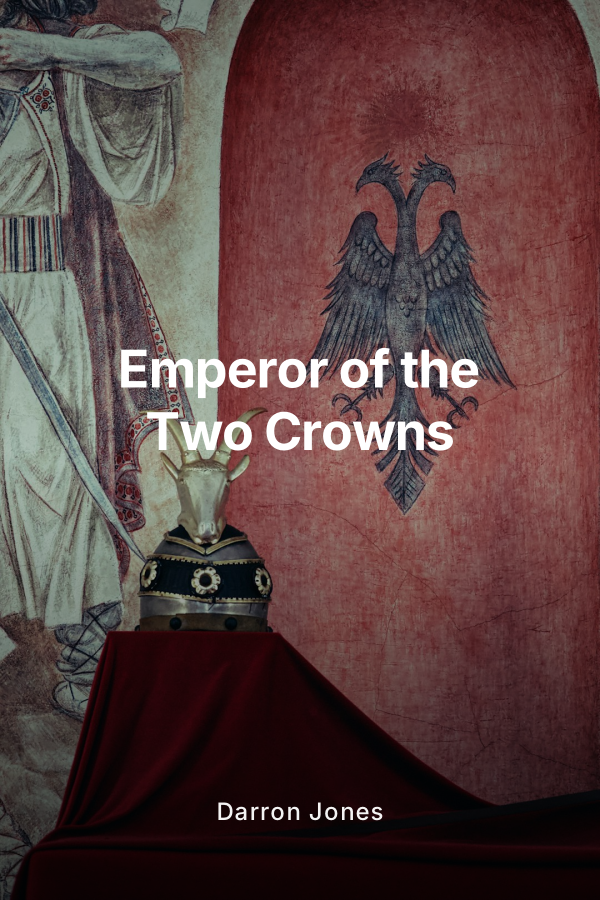
This book imagines a near future in which the quiet pressure of royal bloodlines, old treaties, and unresolved claims erupts into a new continental conflict. Drawing inspiration from the real constitutional roles of Charles III of the United Kingdom and Felipe VI of Spain, from the long history of British and Spanish monarchies, and from the enduring memory of dynastic unions that once reshaped Europe, it asks a simple but explosive question: what happens when three rival lines all believe they alone are entitled to wear the same crown?
Set in the year 2026, the story opens as Spain and the United Kingdom stand at a constitutional crossroads. In Madrid, Felipe VI, a modern, legally trained monarch who has spent his reign defending the integrity of the Spanish constitution, watches his approval ratings erode as an economic downturn and separatist aftershocks revive the language of historic grievances and forgotten royal grants. In London, Charles III, an older king with a lifetime of preparation behind him, balances his environmental convictions and his sense of duty against a restless public and a political class tempted to reinterpret the limits of a constitutional monarchy.
Into this fragile landscape bursts a discovery that should have remained buried in archives. An obscure medieval charter, nicknamed “the Grant of John,” is authenticated by historians working jointly in Seville and Cambridge. It purports to recognize a contingent right of succession linking the royal houses of Castile and England through a cadet branch that has never entirely died out. Legal scholars disagree about its present force, but the symbolism is enough. Commentators begin to speak, half seriously and half provocatively, of a “lost pan‑Atlantic crown” once envisioned when dynastic marriages were instruments of empire rather than ceremony.
Political actors weaponize this discovery. In Spain, hardline centralists argue that the charter proves Spain’s historic primacy in Western Christendom and revive the legacy of Isabella of Castile as a unifying figurehead, casting her as the spiritual mother of any renewed European throne. In the United Kingdom, constitutional traditionalists counter with the unbroken line of English and later British sovereigns, from the Saxon kings through the Norman, Plantagenet, Tudor, Stuart, Hanoverian, and Windsor houses, as evidence that only London has continuously borne the flame of legitimate monarchy.
The rhetoric escalates faster than anyone expects. What begins as archival controversy becomes a cultural battle, then a legal one, and finally a geopolitical crisis. Fringe parties in both countries promise to restore “the one true crown of Europe.” Old treaties are re‑read and re‑translated. Each side quietly encourages friendly jurists on the continent to publish opinions asserting that their respective monarch is, in theory, senior claimant to an undefined European dignity that never quite existed as law but always haunted the imagination of empires.
The core of the book, however, is not the aging kings but their heirs. On the British side stands William, raised under the unrelenting gaze of the public and shaped by the turbulent marriage and divorce of Charles and Diana, a childhood that taught him both the cruelty of exposure and the necessity of duty. On the Spanish side is Isabella, a fictionalized Borbón‑descended princess whose lineage threads back to Isabella of Castile through the Bourbon and Habsburg tangles, and who has been educated in law, diplomacy, and the delicate art of symbolic politics in a media saturated democracy.
As nationalist rhetoric stirs, legal disputes proliferate, and populist factions call for referendums on “the rightful king of Europe,” three competing theses emerge. One insists that Charles III alone, as head of the venerable Windsor line and sovereign of the United Kingdom, should be recognized as senior European monarch. A second argues that Felipe VI, as heir of centuries of Habsburg and Bourbon rule over a once global Spanish monarchy, has the stronger historic claim. The third radical thesis, advanced by ambitious politicians and opportunistic theorists, proposes that no existing monarch should lead a future Europe: the era of crowns must yield to an elected supranational presidency.
These arguments do not remain abstract. Diplomatic conferences stall as delegations insist on precedence. Symbolic gestures become loaded. A state visit postponed on health grounds is interpreted as a calculated slight; a speech about environmental stewardship is read as a veiled claim to moral leadership of Europe. Demonstrators in London and Madrid carry placards that echo the old cry “Not my king,” but now imbued with a new edge: not just rejection of a domestic monarch, but rejection of another country’s right to claim a shared future crown.
The “hundred‑year war” invoked in the book is not literally a continuous century of fighting, but a metaphorical arc the characters slowly realize they are stepping into. Historians in the narrative compare the emerging struggle to the protracted medieval rivalries over the crowns of France and England, warning that disputes over symbols can harden into generations of conflict. What begins with lawyers and pundits threatens to catalyze a sequence of constitutional crises, regional secessions, cyber conflicts, and proxy confrontations that, if not stopped, could entrench enmity for decades.
In this volatile context, both Charles III and Felipe VI confront the limits of their constitutional roles. The British monarch, who has pledged to uphold the constitutional principles at the heart of his nation and to act only on the advice of ministers, finds that those very ministers are tempted to bend the constitution under the guise of defending national dignity. The Spanish king, committed to transparency, national unity, and the rule of law, faces parties willing to twist the law they swore to uphold. Each man sees in the other a mirror of his own predicament.
The narrative traces a series of pivotal encounters between the two royal households. Officially, these meetings are framed as cultural exchanges or environmental summits, reflecting the real world priorities of Charles’s long standing environmental advocacy and Felipe’s interest in modernization and constitutional integrity. Unofficially, they are opportunities for quiet conversations about a problem neither can acknowledge publicly: how to stop their names from becoming battle cries.
At the same time, a younger generation moves in the shadows of palaces and parliaments. William carries the heavy awareness that, as heir to the British throne and symbol of continuity after the passing of Elizabeth II and the illness of his father, his every gesture is read as a signal of the monarchy’s future. Isabella, in Madrid, understands that her father’s legitimacy rests as much on moral authority and civic virtue as on dynastic blood. Both are, in different ways, grandchildren of turbulent twentieth century Europe, raised to believe that monarchy survives not by force but by restraint.
The book’s central dramatic move is to bring William and Isabella together, not as pawns in a crude dynastic arrangement, but as reluctant, self conscious agents trying to prevent disaster. They first encounter one another at a multilateral climate summit hosted on neutral ground, where their parents speak about environmental stewardship and the need to balance tradition with urgent action. The two heirs, both veterans of military training and charitable work, share a private sense that the world being described on stage no longer matches the one simmering outside the conference hall.
From there, the book follows two intertwined arcs. One is geopolitical: as rhetoric escalates, multiple European governments exploit the Anglo‑Spanish dispute to advance their own agendas. Some see an opportunity to weaken the influence of both monarchies and press for deeper republican integration. Others, nostalgic for imperial grandeur, flirt with the notion of a single crowned head of Europe. Each move intensifies the symbolic importance of William and Isabella.
The other arc is personal. William, shaped by the scars of media intrusion into his parents’ marriage, is at first deeply resistant to any whisper of a political union through matrimony. He fears repeating the mistakes of a previous generation, where personal unhappiness was sacrificed on the altar of public expectation. Isabella, fiercely intelligent and institutionally aware, is wary of becoming a twenty‑first century echo of earlier queens who were married off to solve male made crises. Both find in each other someone who refuses simple narratives.
As the crisis deepens, the notion that “only one king can sit on the throne of Europe” hardens among extremists. A network of minor political actors drafts plans that imagine the deposition of one monarch in favor of the other, or even competing coronations on continental soil. The specter of parallel symbolic thrones emerges, threatening to split Europe into camps aligned with London or Madrid. At the edge of this madness stands a quieter, more radical possibility: to refuse the logic of rivalry altogether.
The turning point of the book arrives when William and Isabella, with the reluctant blessing of their families, begin to explore a joint proposal. Instead of allowing the alleged “Grant of John” and the shared descent from Isabella of Castile to fuel a war of primacy, they aim to transform these fragments of history into the foundation of reconciliation. Their argument is bold. If the legal scholars insist that their bloodlines intersect in a web of old treaties and charters, then let that web be a bridge, not a battlefield.
They devise, with constitutional experts and cautious advisers, the outline of a new arrangement. The United Kingdom and Spain would retain their separate constitutions, parliaments, and national identities. No country would be annexed or subordinated. Yet through a carefully structured marriage, a shared charter, and a sequence of synchronized constitutional reforms approved by referendum, a symbolic “Crown of Europe” would be created. It would belong not to a single state but to a union of states that voluntarily recognize the same royal house as a unifying emblem of shared values, much as earlier personal unions once connected separate kingdoms without erasing them.
Underlying this vision is a principle both heirs insist upon. The new dignity must have its power strictly limited by law. It would not rule governments but serve as a living reminder that the quarrels of the past need not dictate the future, and that monarchies survive only by embodying service rather than domination. In this sense, the book treats monarchy less as an institution of command than as a stage on which societies rehearse their deepest arguments about identity, memory, and the proper relationship between power and conscience.
The final chapters of the book dramatize the fierce resistance this plan encounters. Hardliners in both countries denounce it as betrayal. Some British commentators portray William as abandoning a thousand years of sovereign independence; Spanish critics accuse Isabella of diluting a proud national tradition. Meanwhile, republicans argue that enshrining any new supranational crown, however symbolic, risks entrenching old hierarchies. The proposed union triggers fierce parliamentary debates, constitutional review, and a barrage of legal challenges.
Yet, parallel to these storms, a different current flows. Younger citizens across Europe, long skeptical of grand narratives, find themselves unexpectedly moved by the spectacle of two individuals refusing to weaponize their ancestry. Environmental groups recall the long standing advocacy of Charles III and the modernizing efforts of Felipe VI, and argue that if monarchy is to endure, it should be harnessed in support of transnational causes, not nationalist posturing.
The book culminates not in a grand imperial conquest but in a quietly radical ceremony. Rather than seizing a throne, William and Isabella stand together in a neutral European capital, surrounded by representatives from multiple nations, and accept a jointly drafted charter that limits their role to one of symbolic guardianship and intergenerational responsibility. The text affirms that no person holds Europe by right of blood alone, but that those who inherit a legacy of crowns bear an obligation to heal rather than deepen the fractures that history has left.
From that moment, they are acclaimed not as conquerors but as “Emperor and Empress of the Two Crowns,” a title that deliberately evokes and transforms the language of earlier empires. The British and Spanish thrones remain distinct. The imagined European dignity sits above them not as a superior jurisdiction, but as a shared reminder that power can be reconciliatory instead of rivalrous when it is bound tightly by law, transparency, and public consent.
The book closes with a forward glance. Neither Charles III nor Felipe VI lives to see the full consequences of this experiment, echoing the initial insight that the architects of a hundred year conflict would never live to witness its end. Their children, however, inherit a continent in which dynastic politics has been reimagined. The old question of “who will win” has been supplanted by a more demanding one: can inheritance, which once drove wars of succession, be disciplined into a tool for peace?
In blending political drama, intimate character study, and speculative constitutional imagination, Emperor of the Two Crowns invites readers of history, international relations, and royal biography to consider how deeply the stories told about crowns and bloodlines still shape modern Europe. It does not claim that monarchy is the future. Instead, it explores how, in a world that has tried repeatedly to move beyond thrones and banners, the way we choose to remember and reinterpret them may determine whether the twenty first century repeats the catastrophes of the past or cautiously rises above them.