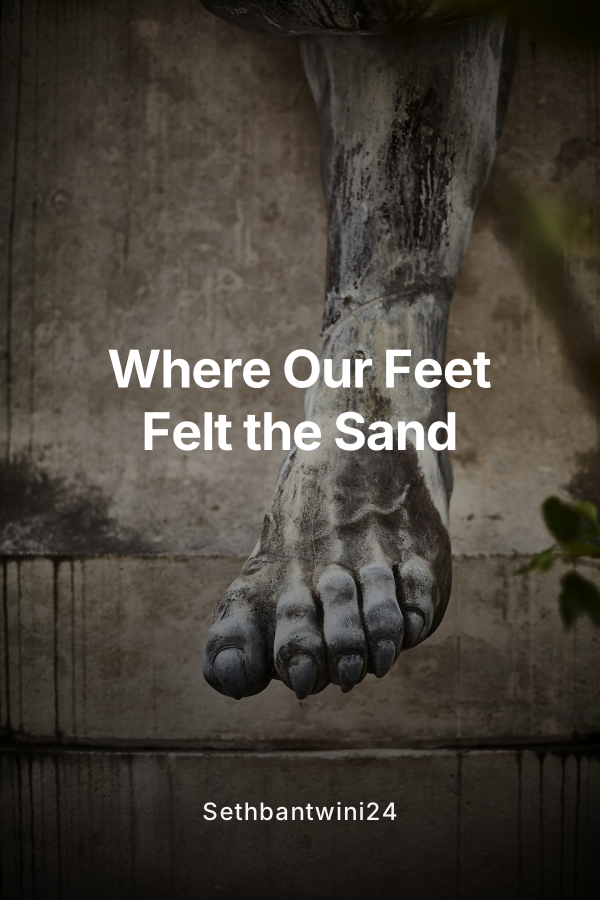
Where Our Feet Felt the Sand is a searing, lyrical meditation on what happens when a person is torn from the soil that once told him who he was. It follows a young man seized from a thriving African polity and forced through the machinery of the Atlantic slave trade, while also tracing how his terror, cunning, faith, and defiance echo in the bodies and minds of his descendants centuries later. Part narrative, part theoretical excavation, the book refuses to treat captivity as a closed chapter. Instead it reveals it as an ongoing condition, imprinted in language, behavior, biology, and belief.
The story opens at the precise threshold that gives the book its name: the last moment the protagonist’s bare feet press into the familiar coastal sand of his homeland. That touch of earth is the final confirmation of a self that once made sense, grounded in lineage, polity, and ancestors who guaranteed his place in the world. Within minutes, armed raiders transform him from citizen to cargo. The sand that once carried his footprints now becomes a memory he must defend against erasure. This initial rupture is not framed as the fall of a “primitive” figure but as the abduction of a man formed within complex systems of law, philosophy, and governance. The shock lies not only in physical capture but in the sudden collapse of an entire ontology of personhood.
As he is driven toward the coast and penned in a fortress that smells of salt, iron, and stale blood, the young man confronts the first stripping of his identity: he is rendered “lineage‑less.” The narrative lingers on this status as the core violence of captivity. It is not only that his chains are heavy, but that he has been removed from the web of names, obligations, and protections that once defined him. That loss prepares the reader for the central argument of the book. The greatest theft was not labor alone, but the deliberate attempt to unmake a particular kind of human and refashion him into an object that could circulate in a global market.
The Middle Passage becomes the crucible where this attempted remaking unfolds. The hold of the ship is not just a setting but a meticulously engineered laboratory of terror. Every sense is weaponized. The air is almost too thick to breathe, saturated with sweat, excrement, fear, and the metallic reek of blood. Chains scrape in a rough rhythm that replaces the drums of home, while the cries of women and the low, exhausted moans of the sick reverberate through the planks. Skin sticks to slick boards coated with bodily fluids. In the flickering half‑light, people cease to look like neighbors and begin to resemble unidentifiable forms stacked for transport.
Within this “floating world,” the captors attempt to impose a new grammar of reality. Silence, blows, arbitrary death, and calculated displays of power form what the book terms a “language of violence,” a total communication system that tells the captives what they are permitted to be. They are meant to receive a single message: you are nothing but transferable flesh. Yet, in small pockets of shadow, another conversation persists. The captives share fragments of songs, whispered genealogies, secret prayers to gods the traders cannot name. These quiet exchanges insist that the captors are wrong. Even in the hold, there are other possible meanings.
The protagonist’s first decisive lesson in agency arrives when a fellow captive, a boy not much older than he is, suddenly wrenches free of the guards and throws himself overboard. The act shocks him. It appears at first as a surrender to annihilation. Slowly, he comes to see it as something else. In a world where every movement is controlled, the leap into the sea is an assertion that there remains one zone of choice that no chain can fully contain. The book names this discovery “ontological sovereignty” the irreducible core of self that can still decide, even if the decision is to embrace death rather than total submission. That recognition will haunt him for the rest of his life, and it will echo down generations as a buried memory of both terror and defiance.
Arrival in the Americas shifts the architecture of dehumanization from the hold to the auction block. Here, the young man’s transformation into property is completed in public. Stripped, prodded, inspected, he is handled with the same casual expertise traders reserve for animals. Buyers probe muscles, scrutinize teeth, discuss price as if weighing the merits of a tool. There is a particular cruelty in the moment of selection, when children are peeled from mothers’ arms, lovers are separated mid‑plea, and kinship ties are dismantled with a gesture of the auctioneer’s hand. The protagonist watches those he has clung to throughout the voyage disappear into different hands, never to be seen again. In that courtyard, “family” is revealed as something the market claims the right to disassemble at will.
From the plantation outward, the book examines how captivity is organized through gender. The young man’s day‑to‑day existence is shaped by the relentless requirement to “answer to another man.” Every order, every chore, every waking moment is surveilled by an authority who claims the sole right to embody manhood. Punishment is staged as theater. Men are humiliated, stripped, whipped in front of others precisely to dull any internal sense of dignity. The protagonist develops an internal split: on the surface, he performs submission for survival; beneath that surface, shame churns with rage. The narrative explores this double consciousness from the inside, revealing how the constant demand to bow before another male figure scars his understanding of courage, care, and responsibility.
In parallel, the book refuses to leave women as background figures. It foregrounds the “commodification of the womb” as a second pillar of the system. The protagonist witnesses women treated as breeders within a calculated reproductive regime. Pairings are dictated by profit, not affection. Mothers see infants taken from them and sold once they reach a marketable age. The text details not only their grief, but their clandestine forms of resistance. Women share knowledge of herbs that can end pregnancies. They whisper about those who chose death for their children rather than a lifetime in bondage. Each act, however tragic, is framed as a fierce refusal to cooperate with a regime that would turn their bodies into factories for new property.
Through these intertwined experiences, the book builds a portrait of a social order where gender itself has been weaponized. Male identity is broken through ritualized submission; female identity is harnessed through coerced reproduction. Yet both men and women generate counter‑logics. Some men risk brutal punishment to shield loved ones or sabotage tools. Some women deploy silence, feigned ignorance, cunning intimacy, and spiritual leadership as ways to reclaim fragments of control. The plantation becomes a site not only of domination but also of ceaseless improvisation, where people continually test the small spaces left unguarded by power.
Language emerges as another crucial instrument of control. The labels hurled at the protagonist are not just crude insults. They are carefully sharpened implements designed to carve a boundary between “human” and “thing.” The book traces how certain terms shifted from neutral descriptors of color to words so saturated with contempt that they became verbal chains. These slurs operate as daily reminders that he occupies a category invented precisely to justify his treatment. The repetition of these names seeks to overwrite the name he once carried in his own tongue, the name he received as a blessing from his family and ancestors.
At a critical point, the protagonist is formally renamed by his owner. The new name, drawn from classical Europe, is spoken with a mocking pride. It is meant to signal both ownership and supposed refinement. To accept it without resistance would be to agree that the past has no claim on him. The book dwells on his internal strategy for survival. Outwardly, he responds when summoned by this imposed label; inwardly, he guards his true name like a secret fire. At night, he repeats it softly to himself, tracing the syllables under his breath, remembering the relatives who share it, the stories it carries. That whispered act becomes an anchor, a daily ritual that asserts: the core of who I am was not authored here.
Where Our Feet Felt the Sand then turns to the hidden persistence of ancestral practices under the very eyes of those who sought to extinguish them. The narrative follows the protagonist into night gatherings where drums speak in patterns that appear to outsiders as mere festivity but are in fact structured conversations with the spirit world. Facing prohibitions on their own religions, the enslaved cloak their deities in the images of European saints. In the protagonist’s eyes, statues of holy figures become vessels for powers that predate the plantation. The community learns to pray in two languages at once, one audible to the overseer, the other audible only to those who remember.
This camouflage is more than a survival trick. Over time, it generates entirely new forms of faith, music, and ritual that blend elements of Africa and Europe without surrendering the essence of either. The book describes these hybrid practices as “cultural palimpsests” layered texts where the original script is never fully erased, only written over in a way that allows it to reappear when needed. Through this religious and cultural syncretism, the protagonist discovers that captivity cannot imprison all dimensions of reality. Even when bound to fields and quotas, he participates in ceremonies that insist on his original status as a being linked to a vast network of ancestors, deities, and cosmic forces beyond his captor’s comprehension.
As years pass, the protagonist ages, but the book’s lens widens rather than narrows. The narrative voice begins to address a future reader directly, a descendant who has never worn chains yet feels them in subtle ways. Here the text introduces epigenetic research as a bridge between story and present. The sufferings of the protagonist and his peers are not left as isolated historical facts. They are treated as events that altered bodies at the molecular level. Extreme, prolonged stress recalibrates hormonal systems, stress responses, and even patterns of gene expression. Those calibrations do not vanish with one generation. They pass forward, silently shaping how children and grandchildren react to danger, hope, and uncertainty.
The book illustrates this with images rather than technical jargon. A child centuries later flinches at sudden loud sounds, scans rooms for exits, feels a constant, inexplicable need to be hyper‑alert even in ostensibly safe spaces. A mother’s worry about the world sharpens during pregnancy, altering the way her developing child’s body learns to prepare for life. The text suggests that such tendencies are not signs of weakness but echoes of strategies that once kept ancestors alive in conditions of unthinkable threat. What once was adaptive in the plantation yard may surface as anxiety or mistrust in the modern city.
This “biological ghost” theme becomes one of the book’s most haunting contributions. It argues that the Middle Passage and the plantation did not simply happen then they resonate now in pulses of cortisol, in habitual flinching, in inherited narratives about danger and worth. The descendant’s sense of recognition when encountering stories of captivity is thus framed as both imaginative empathy and a kind of cellular memory. The protagonist’s terror, endurance, and tactical submission have become part of the inherited repertoire that his distant kin carry without ever having crossed an ocean in chains.
From this vantage point, Where Our Feet Felt the Sand returns to the core philosophical questions that run through its pages. What does it mean to have an identity built out of a category that was originally invented to justify disposal? Can a stigmatized label, created to mark a group as less than human, ever become a source of pride and resistance? The text distinguishes between two layers of self. On one level lies a socially imposed identity, organized around color, hierarchy, and exploitation. On a deeper level lies what the book calls an “incomplete being in infinite relation” a self defined not by its category in a racial taxonomy but by its embeddedness in lineage, community, and a universe of meaning that existed long before the ship appeared on the horizon.
The book does not resolve these tensions simplistically. It acknowledges that the imposed label has been both poison and weapon. It has carried centuries of disdain, yet it has also been reclaimed by movements that used it as a rallying point for critique and solidarity. At the same time, the narrative insists that no imposed classification can exhaust who the protagonist or his descendants are. Beneath and beyond the label remains a consciousness capable of critique, creativity, and love, one that continues to draw from ancestral resources even when formal knowledge of that ancestry has been fractured.
In its closing sections, the book addresses the aching desire for “completeness” that many descendants feel when confronted with the broken record of their past. Genealogical tests, historical research, and cultural reclamation projects are presented as powerful tools that can reconnect people with specific regions, cultures, and histories on the African continent. The narrative celebrates these efforts as acts of repair, essential for challenging the lie that history begins with bondage. Yet it also raises a caution. To imagine that one might achieve a final, perfect restoration of self by recovering every lost name and date is to misunderstand the nature of human existence. In this view, no one is ever complete. All humans, regardless of origin, live in a state of becoming, woven between what is remembered and what is still being imagined.
For the protagonist, the path to a livable self does not depend on stepping back onto the original sand, a return he knows will never be granted. Instead, he learns to carry that sand within him as a metaphor for an enduring lineage that no decree can annul. He teaches younger people on the plantation the few words of his first language he still remembers. He passes down stories not just of suffering but of the cities, rivers, and systems of thought from which he came. He insists, whenever he can, that before he was ever rendered into property he belonged to something vast and intricate. In doing so, he seeds an inheritance of pride and curiosity that will germinate in descendants who may never know his name, but who will feel a strange recognition when they study maps of an ocean crossing.
Where Our Feet Felt the Sand concludes by inviting the reader to see themselves as part of this long continuum. It suggests that to live ethically in the wake of such history is to accept a set of responsibilities. For descendants of the enslaved, this may mean refusing narratives that reduce their identity to grievance or deficiency, instead embracing their position as heirs to traditions that survived the most concerted campaign of erasure in modern history. For others, it may mean recognizing how deeply the benefits of the present world are entangled with past harms and committing to forms of solidarity that go beyond apology.
Throughout, the book’s language is both analytic and intimate, pairing close psychological portraits with conceptual frameworks drawn from philosophy, history, and emerging biological research. It never allows the reader to forget that behind each abstract term lies a body that was once afraid, hopeful, hungry, or determined. The young man whose feet felt the sand is not a symbol. He is a person whose particular journey anchors a vast, collective experience.
Ultimately, the book argues that the true legacy of the Atlantic catastrophe is not only loss, but also the astonishing capacity of human beings to remake meaning under duress. Captors could shatter families, rename individuals, reshape rituals, and torture bodies. They could not fully script what those individuals would do with the fragments they were left. In secret gatherings, renamed gods, whispered genealogies, biological adaptations, and philosophical reflections, a new self emerged. This self carries the wounds of history, but it also carries a unique vision of what freedom, interdependence, and dignity might look like.
Where Our Feet Felt the Sand is therefore both an account of destruction and a blueprint for reconstruction. It offers readers a way to understand their own haunted feelings, their own sudden surges of grief or anger when they encounter stories of bondage, not as inexplicable quirks but as doors into a layered inheritance. By walking with its protagonist from the shore of his homeland to the inner shores of his descendants’ minds, the book shows that while the original sand may be distant, its imprint remains. The task of the present is not to pretend that the footprints were never disturbed, but to read in their altered pattern a map toward a more honest and liberated future.