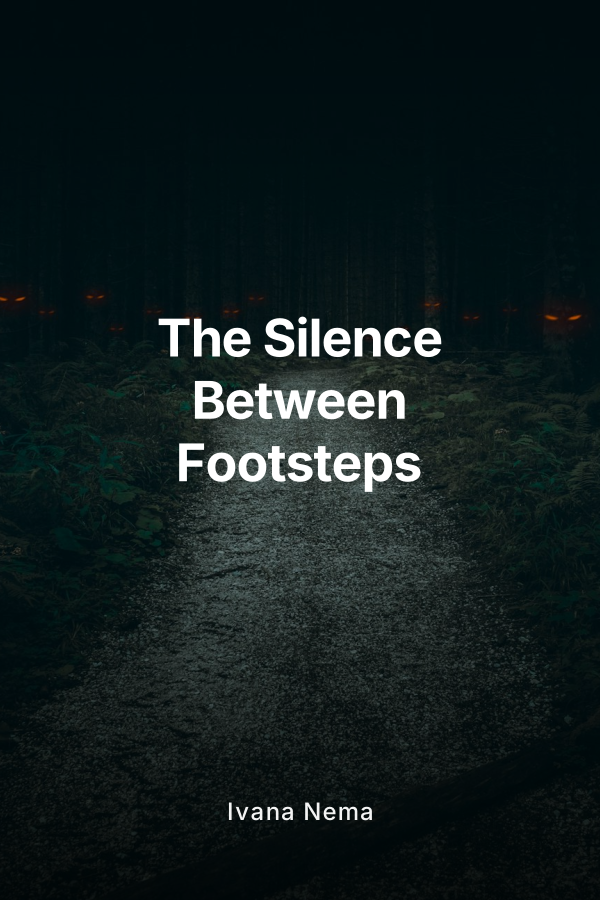
In a quiet, ordinary town that looks safe on every postcard, eleven-year-old Mara Blake only cares about three things: surviving sixth grade, keeping her anxious dad calm, and walking her shaggy white dog, Fluffy, down their sleepy street each afternoon. The town feels boring, predictable, harmless. Until the night the screaming starts two houses down.
A neighbor vanishes from a locked home. No fingerprints. No forced entry. Only one sign that anything ever happened. A message, smeared high across the living room wall, in a substance the police refuse to name: “SHE HEARD ME.”
Mara heard it too.
That same night, Fluffy drags her to the edge of their property, fur bristling, teeth bared at something Mara cannot see. Something that moves between the trees without sound, pressing against the edges of her mind. Something that knows her name.
When the police arrive, they treat it as a standard missing persons case. The adults explain it away with worried smiles and late-night whispers. But the town changes overnight. Streetlights flicker and buzz. Houses lock up early. People look over their shoulders. Every dog in the neighborhood starts barking at the same patch of darkness at the end of the block.
Only Mara notices that the darkness sometimes barks back.
Soon, more strange crimes surface. A break-in at the school where nothing is stolen, but every classroom clock is stopped at exactly 3:33 a.m. A car found abandoned on a side street, doors flung open, engine running, shallow handprints burned into the inside of the windshield. A trail of muddy, child-sized footprints that start in a dry hallway and end at a blank brick wall.
Mara sees patterns no one else sees. Each crime leaves behind a phrase. Short. Jagged. Wrong. No one connects them, but she does. Because the phrases are not random. They are sentences.
They are getting longer.
And more of them are about her.
The first twist hits when Mara realizes the crimes are not just supernatural. They are deliberate. Someone is using whatever haunts the town as a weapon, steering it, feeding it, shaping each incident like a message only she can read. The supernatural is real, yes. But the most dangerous piece of it is human.
Everyone around her turns into a suspect. The guidance counselor who always seems to know where Mara has been. The soft-spoken new cop who appears at every scene, always a little too early. The old woman at the corner house who never leaves her porch but has started humming the same three notes Mara hears when the air goes cold.
Even her own father is hiding something. A locked box in his closet full of yellowing newspaper clippings about other towns, other children, other disappearances that were never solved. One photo shows a girl who looks disturbingly like Mara, standing in front of a smudged police car, her eyes caught mid-blink as if surprised to still be alive.
With Fluffy at her side, Mara starts investigating. At first, it is just following strange noises and writing down the words left behind after each crime. But what begins as childish snooping becomes tactical surveillance. She maps locations, times, weather. She notes how Fluffy behaves before every new incident. His growls point her toward corners no one else can see. Shadows where something rustles, breathing without lungs.
The second major twist comes when Mara discovers that her town has lived this nightmare before. Buried in those clippings and in old library records is the story of a pattern that returns every generation. Children in danger, strange crimes with no human explanation, and a single child each time who can hear the thing in the dark more clearly than anyone else.
That chosen child always goes missing during the final cycle.
Mara is the new one.
Now every piece snaps into place. The crimes are escalating according to an old rhythm, a ritual that has pulsed beneath the town’s perfect surface for decades. Someone is making sure the ritual completes. And whoever it is has been grooming Mara without her noticing, pushing her to pay attention, to follow the trail, to step into the center of the pattern.
She is not just investigating the crimes. She is being led by them.
Chased by police who think she is meddling, watched by neighbors whose smiles no longer reach their eyes, and stalked by something that lives in the silence between footsteps, Mara must decide who to trust. Her terrified father, who refuses to tell her how he is connected to the last cycle. The strange cop, who gives her just enough information to keep her digging. Or the one person who seems to know everything about the pattern, a reclusive former teacher who lives alone at the edge of town, in a house with all its mirrors covered.
Fluffy is her only constant. When lights go out. When the air turns sharp and metallic. When a low humming fills the room and objects begin to move on their own, dragged across the floor by invisible hands. Fluffy always stands between Mara and the dark, snarling at shapes she can barely understand. But even he starts acting off, staring too long at empty doorways, whining at corners as if someone is standing there whispering to him.
The third, most devastating twist rips away Mara’s last sense of safety. She learns that the supernatural presence is not some random spirit haunting the town. It is a leftover echo of all the children taken in each previous cycle, fused into a single, ravenous intelligence that wants one thing: to not be alone anymore.
It does not want to kill her.
It wants her to join it.
Everything that has happened is part of a negotiation. The crimes are offerings, leverage, proof of what the presence can do if the town does not give it what it wants. And Mara’s mind, hyper-attuned and half-open since childhood, is the perfect doorway. That is why it speaks in broken sentences on walls and windows, why it toys with clocks and shadows and handprints. It is learning to talk directly to her.
And it is getting better.
When the town finally turns on Mara completely and the police name her a person of interest, the human architect behind the crimes reveals himself in the worst possible way. He has been in her life for years, woven into the fabric of her routine. He knows where she sleeps, when she walks, what frightens her father most. He has been pushing her into the spotlight so when the final crime happens, all eyes will already be on her. Blame will come fast and easy.
The most chilling revelation is his motive. He does not worship the presence. He fears it. He believes that if he can deliver Mara to it willingly, if she chooses to join, the pattern will finally end. No more cycles. No more missing children. One sacrifice to save everyone else.
To him, Mara is not a person. She is a solution.
What follows is a tense countdown through three pivotal nights as the clock races toward the prophesied final incident. Each chapter of the book tightens the noose. The first establishes Mara’s ordinary world and fractures it with an impossible crime. The second pulls apart the town’s history and layers of lies, exposing the ritual pattern and forcing Mara to step into the role she never asked for. The third pits her against both the human mastermind and the collective presence in the dark, as she gambles everything on a desperate, reckless plan.
Mara’s only chance is to turn the pattern against itself. If the presence is made of lost children begging not to be forgotten, maybe it can be split, untangled, given back its individual voices. If she can reach them, not as a victim but as another child refusing to vanish, she might break the ritual without becoming its final piece.
With Fluffy leading her into the heart of the most dangerous place in town, a forgotten underground space no adult remembers exists, Mara steps into a confrontation where every layer of reality feels thin and unreliable. Shadows move the wrong way. Time slips. Voices talk in overlapping whispers, each one tugging at her memories, her fears, her loneliness.
The line between living and dead blurs.
In the last, breathless sequence, Mara must decide whether to sacrifice herself, sacrifice the person orchestrating the crimes, or sacrifice the entire town’s safety to free the trapped presence. Any choice will have a cost that will scar her forever. Any choice will leave bodies behind.
The final twist does not come from a sudden revelation of who the villain is, but from how Mara solves a problem that adults have been failing to face for generations. She finds a third way that no one else could see, one that uses her greatest perceived weakness, her sensitivity to the dark and to fear, as her deadliest weapon. The ending balances on a knife-edge between victory and horror, leaving just enough unresolved to haunt the reader long after the last page.
“The Silence Between Footsteps” is a fast-paced, nerve-prickling supernatural crime thriller built around an unlikely heroine and her fiercely loyal dog, set in a town where every comfortable routine hides an old wound. It trades jump scares for slow-burn dread, twisting reality one small detail at a time until the familiar world no longer feels safe.
Every chapter raises new questions about guilt, sacrifice, and the dangers of a community that would rather explain horror away than face it head-on. With sharp turns, subtle clues, and constant tension, this story pulls readers into the narrow space between innocence and evil, then asks them to look closely at what lives there when no one is willing to turn on the lights.