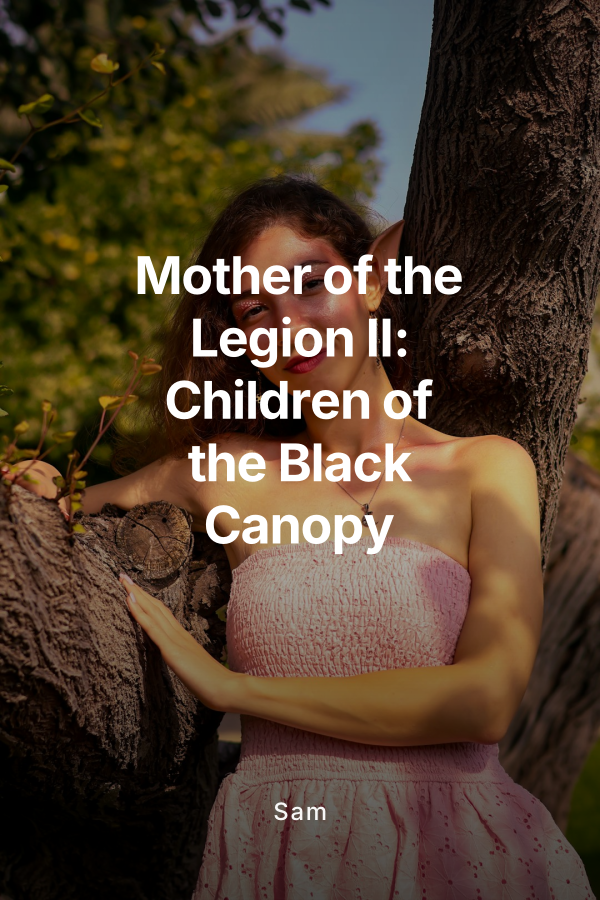
Only the first page of this book is left. We lost the rest in October 2026.
We lost access to the service that stored them, and no other copy exists. We're sorry.
In this sequel to Mother of the Legion, the haunted forest has not grown kinder, but the children have grown sharper. Frank, Julie, Joey, Susie, and Zero are no longer starving strays dragged through the trees by a masked huntress. They are a young pack in the brutal middle stretch between childhood and adulthood, ten to fourteen years old, old enough to fight and question, young enough to still need someone who will not walk away when they fail.
Mother has carved discipline into their muscles and instincts. Her creed remains unchanged: correction, then contact. Pain, then presence. She still punishes with uncompromising, physical certainty and refuses to abandon them afterward. Yet as the seasons pass, her role shifts from constant enforcer to ruthless overseer, stepping back far enough for rivalries to spark between her children while never losing track of a single misstep. The Entity’s realm surrounds them, unseen but felt in every wrong wind and watching crow, and it whispers through the black canopy into Mother’s bones. It is the quiet explanation for how she always seems to know who lied, who broke formation, who thought about running.
Children of the Black Canopy follows the Legion through the dangerous work of learning how to be a family when survival no longer depends only on obeying Mother, but also on confronting each other. Where the first book forged a pack out of scattered feral children, the sequel tests whether that pack can hold when their instincts turn inward against one another.
The story opens with the Legion older and deadlier, moving through the forest as a true hunting formation. Frank has grown broader and steadier, no longer just the boy who rages at the world. Julie’s mind maps every dip and snare, her fingers twitching at the edge of commands. Joey’s jokes have been pared down, reserved now for the hearth instead of the kill zone. Susie still feels too deeply, but she no longer freezes when blood hits the snow. Zero has learned the rhythm of Mother’s law, yet still bristles against it, a wild spark that refuses to lie flat.
They understand Mother’s gestures. They hear danger in the way her song sharpens, in the way her masked head tilts. They know exactly how it feels to be dropped over her lap, to be pinned by that iron arm and taught in fire that rules are not suggestions. They know the weight of her arm afterward, the force of her holding that will not let any of them run into the dark alone.
What they do not yet know is how to hold each other accountable without tearing each other apart.
At the heart of the sequel lies a network of rivalries that both threaten and strengthen the Legion. Frank and Julie push against each other over leadership: his instinct to shield with blunt force clashing with her demand for plans and precision. Joey resents the way silence is suddenly expected of him in the trees, while his quick tongue still defines him at the hearth. Susie fights not to be smothered by their protectiveness, determined to prove that she is more than the girl who cries. Zero measures himself against everyone, least willing to accept that he is still the youngest, still the one Mother singles out for the harshest lessons.
Mother allows these tensions to surface. For the first time, she begins to assign responsibility and freedom in ways that make the rivalries impossible to ignore. Frank is sent on supervised solo runs and then, later, on hunts where Mother stays behind and her song only threads faintly through the branches. Julie is told to call formations without waiting for Mother’s approval. Joey is ordered to manage noise and silence for the pack when they move, learning that his voice can be either a weapon or a liability. Susie is commanded to stay, to watch, to be the one who does not run when things get ugly. Zero is forbidden from last-moment lunges that satisfy his hunger for glory, but he is also the one Mother begins to position as the blade in the gaps the others miss.
With this new freedom comes a shift that terrifies them more than any monster in the trees: Mother begins to expect them to correct each other.
One of the core threads of Children of the Black Canopy revolves around the day Mother sends an older child out as the responsible lead while remaining deliberately out of sight. The Entity’s realm is still all around them, which means nothing they do is truly unseen, but the older child does not feel watched by her in the same immediate way. They are given authority over the route, the formation, and crucially, over a younger sibling whose defiance has started to boil over. When the younger one breaks a rule that endangers the pack, there is no masked huntress stepping out of the fog to seize a wrist or haul someone over a knee on the spot. There is only the older sibling, shaking with rage and fear, forced to decide whether to echo Mother’s harshness or risk losing control of the group.
This moment crystallizes the sequel’s central question: What does it mean to inherit discipline from someone whose love has always been proven in pain, and can you wield that discipline without becoming a monster yourself?
Throughout the book, sibling-style bonds are tested in ways that would have been impossible when the Legion were smaller and more frightened. Frank finds that leadership is not just shouting and shielding; it is taking blame when Zero’s wildness slips under his guard, and standing between Mother’s hand and a younger sibling’s worst mistake without pretending the mistake is small. Julie discovers that her loyalty to Mother and her loyalty to the pack do not always point in the same direction, particularly when she sees one of the others copying Mother’s methods too literally. Joey, who once believed his only value was keeping fear at bay with noise, learns that his quick reading of mood and tension makes him the hinge between warring siblings. Susie, who was taught not to look away, is the first to see when a rivalry stops being sharpening friction and starts to cut too deep. Zero, trapped between still being “youngest” and desperate to be treated as equal, vacillates between sabotage and sacrifice.
The Entity is never described outright in rules or lore, but its presence is a constant pressure on the edges of the narrative. The children notice that Mother can call out a lie they never spoke aloud, that she appears at the exact moment a rule is broken too far from the cabin to hear her song, that birds fall silent when her temper rises, as if the forest itself had been warned. The suggestion is clear: something in this realm wants the pack honed, wants them bound together by fear and devotion, and feeds Mother knowledge where her human senses would fail. She is still the woman who sings as she hunts, who wields pain like a chisel, but she is now also something more than a single hunter in a bad wood. The Entity’s influence amplifies what she already was, making her omnipresent in a way that both comforts and suffocates her children.
Yet the emotional focus remains firmly grounded in the family. Every punishment still ends with an act of presence. Mother may authorize an older child to apply a consequence on a hunt, but afterward she draws both punisher and punished into the same relentless embrace under the cabin furs, making it clear that discipline does not fracture the pack, it binds it tighter. When rivalries flare into near betrayal, she intervenes with the same terrifying precision she once turned on Frank when his anger targeted Julie instead of the enemy.
Over the course of the book, the rivalries that once felt like cracks in the foundation begin to serve as reinforcement instead. Frank and Julie learn how to argue about tactics without letting it devolve into power plays. Joey discovers that he can call for silence and be obeyed, and that his once reckless jokes hit hardest when they land after terror, not in the middle of it. Susie realizes that her sensitivity makes her the first to sense when someone is about to shatter, letting her brace them before they do something irreversible. Zero, whose earliest arc was defined by his insistence that pain was only for “fun” and defiance, now grasps, in a raw, animal way, that the rules he hates are the only thing standing between his family and the teeth in the trees.
Mother watches these changes with a gaze the children cannot read behind the mask. She gives more rope and punishes harder when that rope is used to strangle trust. She lets them taste leadership and then confronts them when they use it to elevate themselves instead of protect the pack. At the same time, there are subtle signs that she, too, is straining under the Entity’s expectations. There are nights when her song sounds thinner, as if fighting some other rhythm in the dark. There are moments when she pauses before a correction, as if hearing more than the children’s voices, and then chooses anyway.
By the end of Children of the Black Canopy, the Legion are something new. They are still the broken forest family introduced in Mother of the Legion, bound by a system where every infraction is met with firm, unmistakable consequence and equally unmistakable holding. But they are also a growing structure of their own, with internal loyalties that no longer depend entirely on Mother’s mask to enforce them. They argue, they compete, they test boundaries, and they carry the weight of punishing each other when Mother commands it.
The final pages leave them on the edge of a wider forest, the Entity’s invisible threads tugging at the treeline. Mother stands behind them, no longer the only shield between them and the world, but still the immovable center they orbit. The rivalries that once threatened to splinter them have become the grindstone that sharpened their roles. The price of this growth has been high: bruised bodies, humiliated pride, nights of sobbing into leather and furs.
Yet for children who came into the woods convinced that punishment meant rejection and abandonment, the most terrifying revelation of all is also the most comforting. In this endless, haunted realm, where the rules are written in teeth and snow, they have found a truth that feels almost like grace:
They will still fail. They will still be corrected. They will still not be left alone in the dark.