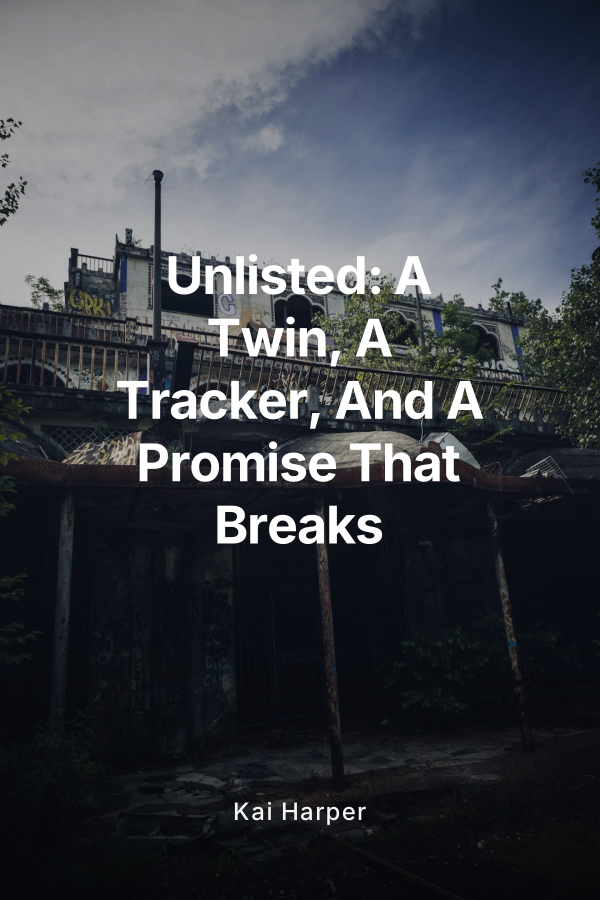
Anaya has always been the smarter twin. The one with color‑coded notes, emergency chocolate in her bag, and a perfect answer ready in every class. Ani has always been the other one. The “funny twin,” the “pretty twin,” the “please help me with math for the rest of my life” twin. Their lives are a mess of shared clothes, swapped identities, and late night arguments that end in laughter.
Until the school dentist checkup.
In a near‑future high school that looks almost normal, a new “student wellness program” invites teenagers to a free dental evaluation that will “monitor growth and support academic excellence.” The parents receive glossy booklets that promise better marks, balanced emotions, and personalized support for every child. The teachers repeat the slogans like a script. The principal smiles too much for someone who just installed metal detectors at the front gate.
Hidden under the clean smell of antiseptic and mint, the dentists are not only fixing cavities. They are implanting microscopic tracking chips in the students. The chips watch grades, sleep, and emotional spikes, feeding the data into a secret facility that sorts teenagers into categories: useful, weak, or dangerous. The “dangerous” ones are not listed in the official system at all. They become the unlisted.
When Anaya panics at the idea of drills and needles, Ani does what she always does. She jokes. She bargains. And after enough begging and blackmail about doing Ani’s homework for a month, including math, Anaya lets Ani take her place in the dentist chair. It feels like a harmless twin swap, just another story to laugh about later. Instead it is the moment that splits their lives into Before and After.
Because the machine in the clinic does not understand twins. It scans Ani, reads her as Anaya, and logs two consciousness signatures under one name. To the shadowy program that runs the chips, Ani has become the official “Anaya,” while the real Anaya is suddenly invisible to every system that runs their school. She becomes unregistered, a glitch in the network, a ghost in her own life.
At first, the changes are small. Ani starts finishing tests faster. She never forgets homework anymore. Her eyes look a little too focused. Teachers praise her “new discipline.” Anaya’s small acts of rebellion get her strange glances from adults. Their friend group notices first.
Kiana is the one who asks too many questions and writes conspiracies in the margins of her notebook. Ron hides his fear under sarcastic one‑liners. Mira, quiet and observant, carries a pain that no one asks her about. They bond over cafeteria disasters, group chats full of memes, and the subtle pressure to be “perfect students” in a school that watches every move. When Mira suddenly stops coming to class and all her digital traces vanish, the school shrugs it off as a “transfer.” The group does not believe it.
Anaya starts to notice the pattern. The missing students are not troublemakers. They are the ones who do not fit the program’s idea of normal. The ones whose pain leaks out in scribbled drawings, late assignments, and cuts they think no one sees. The ones who might ask out loud why everyone feels so tired and watched all the time.
As the chip inside Ani is turned up to a higher intensity by the facility, her emotions thin out. She moves like a student version of a soldier, focused and accurate. She becomes the perfect proof that the program works. Underneath it all, her old self claws against the walls. Envy of Anaya’s natural brilliance, years of feeling “less than,” and the chip’s cold instructions twist together until Ani cannot tell where her thoughts end and the programming begins. Her love for her twin and her jealousy collide with the orders inside her head.
When the system finally notices that there is an unregistered mind connected to Ani’s readings, alarms light up. Anaya has unknowingly become exactly what the facility fears most. Someone smart enough to see patterns, invisible to their trackers, and angry. Suddenly, the wellness program turns into a hunt.
Ani is assigned her first real mission.
Bring Anaya in.
The heart of the book is not a car chase or a gunfight. It is the scene of two sisters in a dark hallway near the back gates of the school, one running until her lungs burn, the other following with the steady steps of someone who believes there is no other choice. Anaya’s panic attack hits like a wave that does not care who drowns. Her thoughts fragment, her breathing breaks, and the world shrinks to flashing images of hospitals, sharp tools, and the memory of every time she has hurt herself just to feel something she could control. The ground meets her knees. Ani’s shadow stretches over her.
The confrontation is raw.
Ani’s voice is flat as she repeats the phrases the chip feeds her: “We have to do this. It is for your own good. It will help you.” Anaya screams back the history only they know, the broken promises, the late‑night secrets, the confession of self harm she once whispered into Ani’s shoulder when the world felt too heavy. The fight is physical, with hands shaking and hearts racing, but the worst damage happens in their words. Trust shatters in sentences both of them will remember forever.
Ani pins Anaya down. Anaya’s nails claw at the floor. The scene closes in, tight and suffocating, until the facility’s agents arrive and carry Anaya away.
She wakes strapped to a bed in a white room that smells like cleaning fluid and fear. The chains are soft restraints, clinical and polite, which feels even worse than metal. On the other side of the glass, screens show rows of sleeping teenagers, each one connected to a quiet, blinking device. The program calls them “patients.” The missing call them captives.
Mira is there.
Far from gone, Mira has become a different kind of prisoner. She was taken because her pain did not fit into any of the categories the chip could smooth out. Her scars refused to disappear. The facility lists her as unlisted, a problem and a potential asset. She has been watching, listening, and waiting. Where Anaya uses logic and plans, Mira is a fuse waiting to burn. When the organization head and the original dentist move in to cut into Anaya’s mind and finally tag her, Mira snaps out of survival mode and into attack.
The chaos that follows pushes Anaya into her true role.
Mira’s sudden tackle slams the head of the program into a metal cart. The dentist goes down under a storm of fists powered by months of held‑back rage. Anaya pulls free of the straps, adrenaline overriding fear. Running barefoot across cold floor, heart pounding in her ears, she follows the emergency signs to a room filled with servers and feeds. The security system that controls doors, chips, and surveillance blinks calmly, unaware that a sixteen‑year‑old with shaking hands is about to become its worst nightmare.
With all the hours she once spent hacking school Wi‑Fi to stream shows during lab, Anaya digs into the code of the program that tried to rewrite her life. She fumbles, fails, swears, and laughs at herself in the middle of a full‑scale breakdown, because the whole thing is too absurd and too real at the same time. But underneath the jokes and the terror, she does not stop. When the main monitors flicker and then go dark, thousands of kids inside the facility and at schools connected to the system feel a sudden lightness in their heads. The net has a hole now, and it has Anaya’s shape.
That is when she finally understands.
She has been unregistered all along not because she was a mistake, but because the system does not know how to contain someone who can see its edges. That blind spot makes her the perfect spy. No chip can lock onto her completely. No camera can find her file. She can walk between the lines of the program without leaving a trace. The facility accidentally created the person most likely to destroy it. They turned her into an undercover agent in their own building.
The story does not turn into a clean victory. Destroying the security grid is only the first move. Alarms wail as backup generators flicker awake. Ani, still under the influence of the chip but full of memories she cannot erase, moves through the shadows of the facility, torn between the command to recapture Anaya and the ghost of the sister who used to hold her when she cried over bad grades and worse thoughts.
Trust, envy, and betrayal twist through every chapter.
Ani’s jealousy is not just about school ranks. It is built from years of small comparisons, comments from relatives, and teachers calling Anaya “the gifted one.” The program digs into that insecurity like a knife. At the same time, Anaya hides a kind of cruel pride in always being the best, even when it burns her out. Their friendship group carries its own fractures. Kiana wants to expose the truth but fears no one will believe her. Ron uses jokes to hide his panic that anyone he loves can be taken away without warning. Mira’s self destruction and anger cut both herself and those who try to help her. The story treats these wounds honestly, with scenes that show the reality of self harm and trauma rather than hiding them behind metaphors.
Humor keeps slipping in at the edges, because that is how teenagers survive. Even in the facility, Mira cracks a joke about the dentist’s terrible taste in music while pinning him to the floor. Anaya complains about the security system’s outdated software in the middle of a meltdown. Ron sends voice messages that alternate between real intel and rants about cafeteria food. The jokes never erase the pain, but they sit beside it, like the friend who texts memes at 2 a.m. because they do not know what else to do.
By the end of the book, Anaya has stepped fully into her role as an undercover spy in a war she never asked for. Her missions are not about car chases. They happen in the messy space between therapy exercises the school pretends are for “resilience,” late‑night searches for missing classmates, and secret trips back into the digital ruins of the facility’s system. She learns to use her invisibility as a weapon, her panic as a signal that something is wrong, and her sharp brain as a tool for more than just exams.
Ani walks a knife edge between control and resistance. Sometimes she follows orders. Sometimes she disobeys in tiny ways that only Anaya might notice. The possibility that she is secretly leaving a trail of clues runs through the story without a clear answer. Is she still in there, fighting the chip, or has the program truly taken her away? The book refuses to make it simple.
The planned five chapters trace this arc:
• Chapter 1 introduces the twins’ daily high school life, the chipped dentist appointment, and the first cracks in their trust.
• Chapter 2 follows their friends, the rise of the wellness program, and Mira’s disappearance into the facility.
• Chapter 3 builds the emotional storm of Ani’s rising brainwashing, Anaya’s unraveling mental health, and the hallway chase that ends in betrayal.
• Chapter 4 dives into the facility, Mira’s resistance, Anaya’s breakdown on the operating table, and the chaotic escape to the security hub.
• Chapter 5 reveals Anaya’s sabotage of the system, her realization that she is the perfect undercover spy, and the unresolved threads of Ani’s true loyalty and the program’s next move.
The book ends on a cliffhanger that feels like a breath cut in the middle.
Screens across the country flicker as the main program crashes. In the facility, kids stir in their beds as the influence of the chips loosens for the first time. In a dark corridor, Ani and Anaya come face to face again, both changed and both dangerous. Somewhere in the walls, backup systems hum, ready to reboot.
Anaya has just enough time to realize that taking down the security grid also freed something else inside the network, something older and more ruthless than the dentist and the principal’s slogans. Before she can even decide whether to run, reach for Ani, or hit another key, the chapter closes on the sound of doors unlocking and a voice from the intercom saying her name like it has been waiting for her.
The story does not promise safety. It promises that the fight is only beginning, and that a girl who learned to survive her own mind is about to turn that same strength against the system that tried to rewrite it.