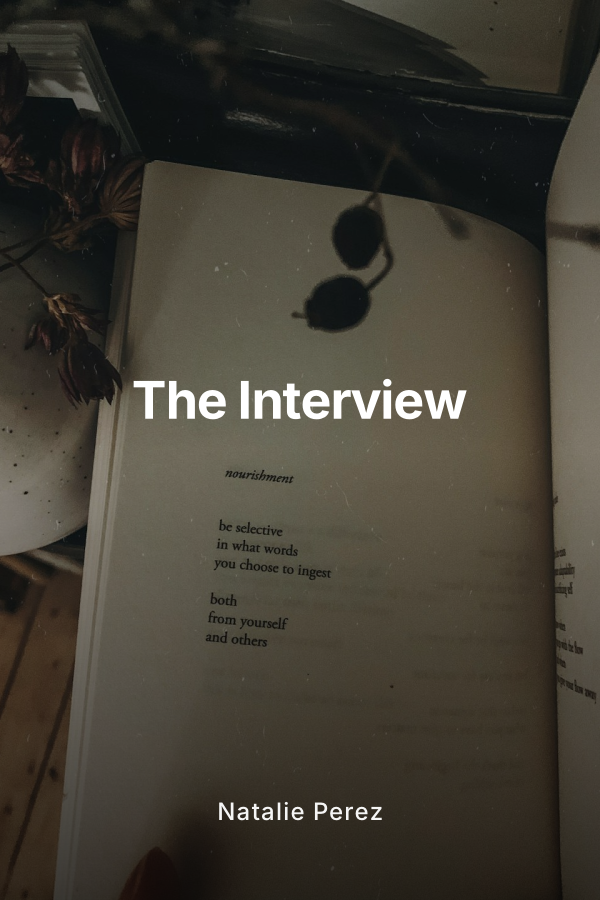
The Interview is a psychologically sharp, darkly funny novel about five strangers who arrive at a sleek, windowless facility expecting a prestigious job interview and slowly discover that the real test is not what they know, but who they become when certainty disappears. Lena Ortiz, Evan Keller, Mara Singh, Julian Price, and Naomi Hale each enter the process with a different survival strategy, yet all of them are performing a version of themselves to get through it . Lena is confident and quick on her feet, Evan is analytical and suspicious of hidden systems, Mara is warm enough to avoid conflict, Julian is charming in a way that makes people underestimate how much he notices, and Naomi trusts rules because rules feel safer than people. What unites them is not talent, but vulnerability, each one desperate to control how they are seen.
At first, the process feels like a strange but recognizable corporate gauntlet. The candidates arrive separately and are ushered through a neutral, impersonal facility that feels designed to be neutral in the most unnerving way possible, clean and minimal, with rooms that subtly change purpose, no windows, controlled lighting, and instructions that seem almost, but not quite, consistent . The satire lands immediately. People are judged on small talk, posture, timing, and the exact tone of their answers. They size each other up over coffee, over seating arrangements, over who speaks first, over who asks the right question and who asks too many. The humor comes from the awkwardness of professional performance, from how quickly ambition turns everyone into a slightly exaggerated version of themselves.
Lena begins by treating the process like a contest she can outplay. She is polished, witty, socially sharp, and always one sentence away from turning embarrassment into leverage. Evan, by contrast, is convinced there is a hidden framework beneath every bizarre instruction, and he spends much of the early story trying to map a pattern that may not actually exist. Mara tries to keep the peace, believing that likability will be a form of protection. Naomi clings to the rules, assuming that if she can decode the procedure correctly, the procedure will reward her. Julian is the most difficult to read, because he seems relaxed enough to be harmless, but there is always a sense that he is reading the room faster than anyone else. He knows more than he should, though not enough to be in control, which makes him both dangerous and strangely sympathetic .
The first arc of the story is playful and socially tense. The candidates trade subtle jabs, make mistaken assumptions about one another, and form temporary alliances based on convenience rather than trust. A seemingly minor sabotage, an incorrect instruction, or a misplaced object can become the basis for a full social theory. One person assumes they have been targeted; another realizes the apparent mistake was actually part of the test; a third takes advantage of the confusion for personal gain. The story keeps reminding the reader that truth in this world is layered, not clean, and that a single event can mean three different things depending on who is looking at it . That early misreading is not just a plot device, it is the first clue that the candidates are being measured by how they interpret uncertainty.
As the interview progresses, the tone shifts from wit to pressure. The candidates begin to understand that the process is reacting to them, not simply evaluating them. Rules contradict each other on purpose. A task rewards initiative one day and punishes it the next. A silent observer appears in a room that was empty moments before. A new participant, or a new voice, enters just enough scenes to unsettle the group further. The facility itself becomes part of the mechanism, rearranging spaces, reusing rooms, changing function without explanation, as if the building is listening and adjusting in real time . Evan becomes more convinced that the system exists, Lena begins to suspect that winning may not mean what she assumed, and Naomi starts to crumble under the realization that rules are not the same thing as truth.
The midpoint reveal is crucial. The interview is not a fixed exam with one correct answer, it is an adaptive behavioral environment, designed to see who can function when the ground beneath them keeps moving . That revelation changes the moral shape of the story. Integrity is no longer enough. Intelligence is not enough. Even kindness is not enough. The system is watching for adaptability, for people who can justify their choices, absorb contradictions, and keep functioning without certainty. The candidates who cling hardest to their original self-image begin to lose ground, while the ones willing to bend, improvise, or even lie gain momentum. This is where the satire sharpens into something more uncomfortable, because the process is not simply exposing weakness, it is teaching the participants which weaknesses are rewarded.
Julian’s role deepens in the later chapters. He is revealed as the one who has sensed the shape of the experiment for the longest time, perhaps because he has seen versions of it before, or because he is unusually good at reading systems even when he cannot fully decode them. He is not a mastermind, which makes him more interesting. He is a man operating one layer closer to the machinery than the others, trying to stay useful without exposing himself too soon. That makes him a mirror for Lena, because they both understand performance, but Julian uses it as control, while Lena uses it as armor. Their scenes together become some of the book’s most charged moments, because each recognizes the other’s tactics, but neither can admit what that recognition costs.
One of the most unsettling turns arrives when a candidate is seemingly released. The exit feels final, almost merciful. Later, the story reveals that the release was never an exit at all. The person is still being observed outside the facility, and their behavior after the test matters more than they realized . This false exit reframes the whole process. The interview does not end when the room ends. The system wants to know what survives once the candidate thinks they are free. That discovery deepens the paranoia without turning the book into horror. The fear is more recognizable than that. It is the fear of being watched not for what you say under pressure, but for what you become when you think no one is looking.
The strongest emotional break in the book comes when two characters make opposite choices under pressure. One chooses integrity and loses position. The other compromises and moves forward. The system rewards the compromise . This is where the novel stops being merely clever and starts becoming morally memorable. The interview does not punish unethical behavior outright. It studies how people rationalize it. The people who can remain functional after crossing a line become more valuable to the system than the people who refuse. That is the book’s central unease, not that evil wins in a dramatic sense, but that flexibility can be converted into competence, and competence into power.
By the final chapters, the candidates are no longer trying simply to get through the interview. They are trying to understand what kind of person they are becoming inside it. A neutral representative appears and confirms, in calm corporate language, that the process is a behavioral evaluation system built to select for adaptability under ambiguity. They do not name the organization. They do not explain the long-term purpose. They offer only breadcrumbs, enough to reveal that the program exists in multiple locations and feeds into positions of influence, with implications that feel potentially illegal, or at least intentionally opaque . The answer is neither fully satisfying nor fully hidden, which is exactly right for this story. It gives the reader the outline of a machine without revealing the whole mechanism.
The final irony belongs to Lena. She is the strongest winner because she changes in the most unsettling, believable way. At the beginning, she thinks she is playing a game she can win. At the end, she realizes there was never a right way to play, only different ways of surviving the absence of certainty. She does not become monstrous. She does not become cruel for its own sake. She becomes comfortable operating without truth, and that is what makes her victory disturbing. When the role is offered to her, it feels at once like promotion and trap. She understands what accepting it means. She understands that she will not be joining something external to the experiment, but becoming part of the machine that repeats it. And still, after everything she has seen, she says yes .
That choice gives the novel its final sting. The Interview is not about who deserves power. It is about who can live inside ambiguity long enough to inherit it. Its ending is unsettling but recognizable, because the real horror is not a hidden monster or a grand conspiracy. It is the ordinary human impulse to adapt, to justify, to keep going, and to call that survival. The book closes with the sense that Lena may be outside the system, or already inside it, or both, and the ambiguity is the point. The interview does not simply select the most qualified person. It selects the person most willing to become the next version of the question.