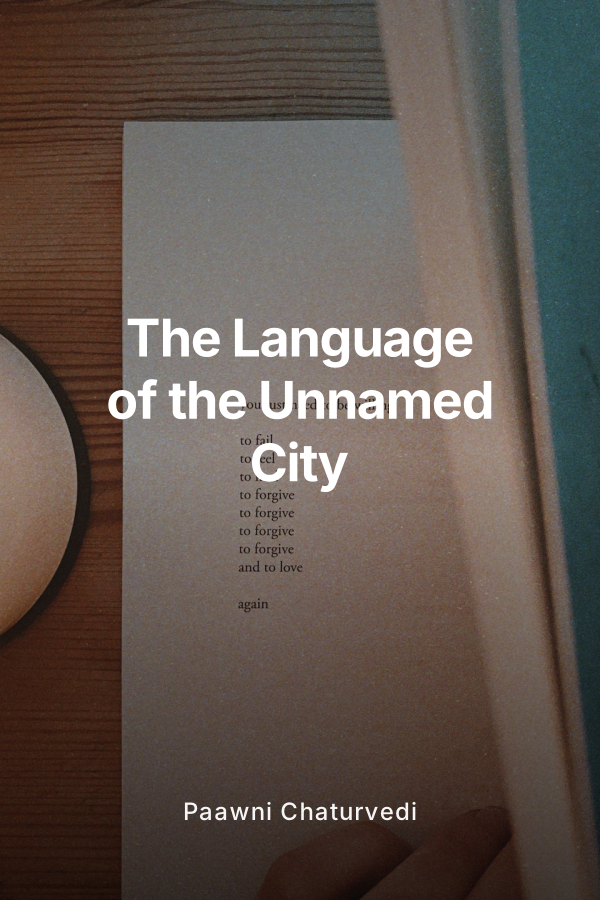
Only the first page of this book is left. We lost the rest in October 2026.
We lost access to the service that stored them, and no other copy exists. We're sorry.
We followed the memory of a sentence across a vanished map, our mouths full of broken syllables and the aftertaste of a city that no longer existed.
This book tells the story of a dispersed "we" who have survived a war and a border crossing that unmade their world. Their homeland has been reduced to fragments of rumor and ash, their shared city erased from official maps yet fiercely alive in memory. In the uncertain quiet that follows the violence, they find themselves gathered in temporary camps and unfamiliar streets, bound together not by documents or blood, but by the slow erasure of the mother tongue they once believed could never leave them.
The narrative unfolds as a constellation of interwoven voices, each speaking as "we" yet carrying a private timbre. Memories bleed into one another until individual lives become difficult to separate. A child recalls the sound of her grandmother's lullaby without being able to reproduce the words. A former teacher tries to explain grammar in a language he no longer trusts. A mother counts her missing children by the beds that remain empty each night. A young man discovers that the name of his own street, once a simple part of his identity, now feels foreign in his mouth. Their stories never settle into a singular account; instead, they pass through one another like overlapping shadows.
Across five chapters, the book traces how language breaks, thins, and reconstitutes itself in the wake of forced migration. The opening chapter lingers in the final days of the unnamed city, where people speak in hurried fragments, already translating themselves as if in anticipation of loss. The second chapter inhabits the movement across the border, where official questions demand clean answers that the refugees can no longer provide. Words become passports, mispronunciations become dangers, and silence acquires a new weight.
The third chapter centers on the camp that receives them, a place of metal bunks, queues, and ration lines. Here, lives intersect in a dusk of half-understood announcements and improvised gestures. Strangers realize they walked the same market streets in the old city, prayed in the same courtyards, or fled past the same burning school. A common phrase from their former language keeps surfacing in different mouths, altered slightly each time, until the original syntax is beyond recovery. The camp becomes a fragile archive of the lost city, preserved in the diction of those who remember it differently.
The fourth chapter follows these voices years later, scattered across foreign neighborhoods. The new language they must use for work, school, and survival has begun to settle into them, but it fits uneasily, like clothing tailored for another body. Children of the displaced speak it more fluently than their parents, and in their fluid speech the mother tongue becomes an accent, then a curiosity, then a strain of sound they cannot quite imitate. The older generation discovers that entire days can pass without uttering a single word from the language that once shaped their dreams. Shame and relief mingle in their throats.
Throughout, the book returns to recurring images that bind the many voices into a single, haunting chorus. The camp bunk that witnesses families forming and unforming. A pot in which different people attempt to recreate a vanished recipe, arguing softly over missing spices they can only name in a language that falters. The distant sound of trains that once signaled departures within the city, now an echo of the night they were driven from it. And above all, the stubborn effort to recall names: of streets, teachers, neighbors, rivers, and the dead.
In the final chapter, the narrative converges on two piercing absences. An empty bed stands in a cramped apartment far from the lost city, its sheet smoothed each morning as if the missing sleeper might still return. Around this absence, memories orbit without ever forming a complete picture of who is gone. Elsewhere, someone realizes that a beloved name, once spoken daily, has dissolved at the tip of the tongue. The syllables refuse to arrange themselves; the remembered face remains sharp while the sound that once summoned it has vanished. In this forgotten name the book locates its deepest wound, the moment when grief outlives the very word that used to hold it.
The Language of the Unnamed City does not present a single protagonist or a neat chronology. Instead, it offers a layered, impressionistic portrait of collective dislocation, where time loops and fractures much as speech does. Readers move through fogged windows, border crossings, overcrowded dormitories, and foreign bus routes, guided less by plot than by the evolving texture of how people speak, mistranslate, and fall silent.
Though it inhabits a devastated emotional landscape, the book refuses the ease of consolation. It traces how people adapt, form new rituals, and build fragile communities in the wreckage, yet it never suggests that such endurance repairs what was destroyed. The ending leaves readers with the ache of what cannot be reclaimed: a language that once felt like home, a city that survives only in conflicting recollections, and a "we" that must keep speaking even as the very tools of speech slip away.
In witnessing their struggle to name themselves after their own names have eroded, the book asks a quiet but unsettling question: when the words for home are gone, what remains of the people who once shared them?