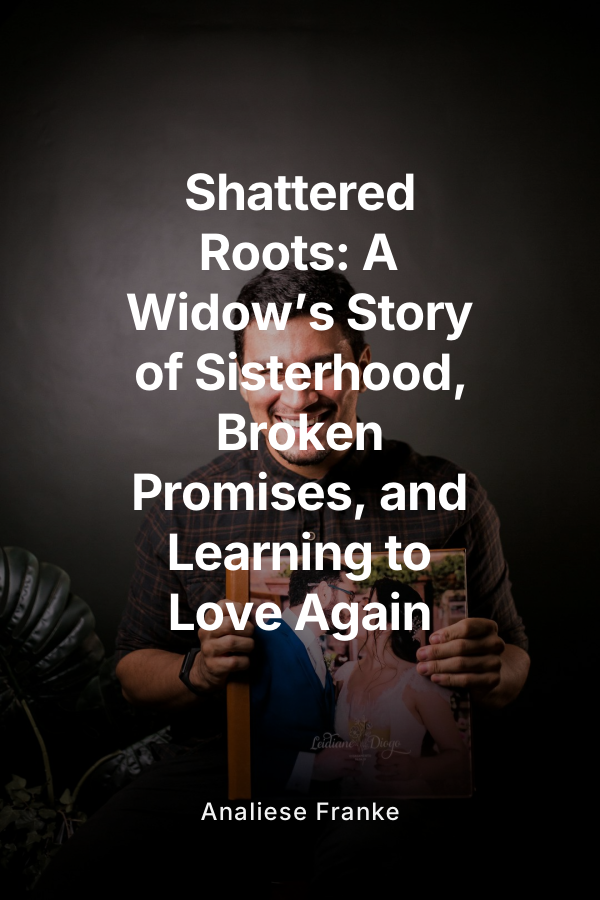
I thought I knew what my life would look like. At twenty three, I had exactly what I used to write in the margins of my high school notebooks: a husband in uniform who kissed me like I was his whole world, a tiny starter home that always smelled like coffee and cheap candles, and a job I actually loved as a stylist at a small town salon. When the pregnancy test turned positive and my husband and I were still breathless from laughing and crying on our bathroom floor, I was sure the universe had finally decided to be kind to me.
The book opens with me in that golden blur. I am already married, already in love, already building a future in my head while my husband packs his duffel for another army deployment. We argue over baby names and nursery paint colors while he rolls his socks, both of us pretending time is not racing toward the moment when he has to walk out the door again. The first chapters capture that fierce, ordinary joy through my eyes: the way his hands linger on my stomach even before there is a bump, the late night whispers about being scared and excited, the stupid fights that only happen when two people love each other enough to trust that the other one is not going anywhere. Until, of course, he does.
I tell you exactly how the knock on the door sounds to a woman who is newly pregnant and waiting for a text. How the uniforms on my porch look too neat against the chipped paint of my railing. How the world does not explode, though it feels like it should. In my first person voice, grief is not poetic. It is raw and feral. I scream at strangers in pressed dress blues. I curse at folded flags and pitying eyes. I go to bed with my husband’s T shirt bunched in my fists, begging a silent ceiling to trade places with me, to take my body instead. The only thing that keeps me upright is the fragile life inside me. Our baby. My last piece of him.
But grief does not care what it destroys. Under the weight of funerals, condolences, and the constant reminder that everyone else’s life is still moving while mine has stopped, my body finally breaks. The book does not shy away from the brutality of that loss. Through my eyes, the hospital lights are too bright, the smell of antiseptic too sharp, my own screams too loud in my ears as I understand that I am losing not just a pregnancy but the future I had clung to as a lifeline. Afterward there is a silence so deep it roars. Inside me there is only empty space, a hollowness that feels like punishment.
From there, I throw myself into overwork, and I narrate every desperate, ugly moment. I take every shift the salon will give me, stay after closing to scrub color bowls until my hands are raw, and sign up for every class I can afford. If I keep moving, I tell myself, maybe I will not feel anything. Of course I do. My breakdowns become my secret ritual. I fall apart in the shower, in my car in the parking lot, on my kitchen floor at two in the morning. I tell you how it feels when your chest hurts so much you think your ribs will crack, how sometimes the only sound in the room is your own ragged breathing and the drip of a faucet you keep meaning to fix.
I am not alone, even when I act like I am. My older sister Helena forms the second voice of this story, her chapters written in her own raw first person. At twenty five she is married with two small children, the life I always imagined I would have someday. On the outside, Helena is the capable one, the sister who handles logistics, casseroles, and paperwork when my world caves in. Inside, she is terrified. Through Helena’s eyes, you see what it is like to love someone who is determined to self destruct. She nurses a baby at three in the morning with her phone in her other hand, waiting for my text to confirm I am still breathing. She sneaks out of her house to slide into bed beside me on the worst nights so I do not drown alone. She also feels resentment sometimes, and she admits it, then hates herself for it. Her honesty keeps the story from ever becoming simple.
Our relationship becomes the spine of the book. In my chapters, Helena is the infuriating, overprotective older sister who will not stop checking on me, who makes me eat when I do not want to, who keeps showing up even when I slam the door in her face. In hers, I am the little sister who both clings and pushes away, the girl she would burn the world down for and also the woman whose pain she cannot fix. We fight. We say terrible things. We come back together anyway. The story shows that love between sisters is not soft and tidy. It is messy, loud, and stubborn enough to outlast even death.
As months pass, hair becomes my one safe place. In my chair, with a comb in one hand and scissors in the other, I can pretend I am just a stylist with a growing list of clients and dreams. I take extra classes, stay late practicing on mannequin heads, and quietly build an online portfolio. My hands shake sometimes when I take photos, but my work is good and getting better. From Helena’s perspective, this obsession terrifies and comforts her at the same time. She watches my talent bloom while still seeing the cracks underneath, knowing that no amount of likes or bookings will magically heal what has been broken in me.
Everything changes the night a high profile opportunity drops into my lap. A celebrity is in town for a film shoot, and he needs an emergency hairstylist. My boss recommends me. I almost say no. Through my narration, you hear every argument in my head: I am not ready, I am still broken, I will mess this up, I do not belong anywhere near bright lights and famous faces. Helena’s first person chapter before the appointment shows her side. She is exhausted from keeping toddlers alive and juggling her job, but she still sits across from me at my kitchen table, coffee gone cold, insisting that I am allowed to want something good again. That stepping into a hotel suite with my kit is not betrayal. It is breath.
The first time I meet him, the air in the room shifts. I describe every detail. The way his gaze lingers a little too long in the mirror, how he notices the faint tremor in my fingers when I lift a section of hair, how he jokes about his own ridiculous schedule while carefully avoiding anything that sounds like small talk about family. I treat him like any other client, all business, walls high. He is used to people fawning over him, and I do not. That intrigues him. Our connection does not explode into instant heat. Instead, it grows in cautious, stubborn moments: shared jokes, late night hair emergencies, quiet conversations in the styling chair when he lowers his guard and I forget, for a heartbeat, that I am supposed to be frozen forever in my old life.
Inside, I am at war with myself. I narrate the guilt that slams into me every time my heart stutters for reasons that have nothing to do with the husband I buried. I tell you about gripping my steering wheel after an appointment, cursing myself through tears because part of me wants to say yes to coffee and another part still sleeps next to a ghost every night. Helena’s chapters shadow this slow burn from the side. She sees color creeping back into my face, softness touching my eyes again, and she is both grateful and terrified. She knows how thin the ice under me still is, how one careless word from him can send me spiraling back into despair.
As my work with him and other celebrity clients grows, so does my career. I begin to travel for jobs, my name whispered in new circles, my social media following climbing. From my point of view, the glamour is strange and a little empty. Some mornings I wake up in a pristine hotel room and still feel like the girl on my bathroom floor, bleeding and begging a universe that ignored me. The book refuses to use success as a magic cure. Instead, it explores what it looks like to carry grief into every new room, how love can find you in the middle of work emails and flight itineraries, not because you are healed, but because you are finally tired of pretending you do not want anything more.
Central to the story is the question of moving on. In my chapters, moving on feels like betrayal, like erasing the man who died and the child I never got to hold. I wrestle with this in late night monologues, in quiet moments staring at my husband’s photo, in the way I sometimes pull back from the new man in my life right when we are about to step closer. In Helena’s chapters, moving on looks necessary yet dangerous, as if allowing too much happiness might tempt fate to punish us again. Our conversations about this are jagged and honest, full of swearing and tears, because there is no polite way to talk about loving someone new when part of your heart is buried in the ground.
By the final stretch of the book, I am not a neat success story. I still cannot walk down the baby aisle in a store without feeling my throat close. Songs can ruin me without warning. Some nights I lie awake, tracing the outline of the future I lost. But I have also learned how to lean on people without dragging them under. I have allowed myself to admit that the man who first sat in my chair as a celebrity client has become someone I want beside me, not as a replacement, but as a new chapter I never believed I would get. Our romance is tender and flawed, full of stops and starts. It shows that you can fall in love again while still grieving, that two truths can hold hands in the same body.
Helena emerges from this story changed as well. In her final chapters, she looks back on the nights she spent split between rocking a colicky baby and answering my panicked calls, on the arguments with her husband about boundaries and burnout, on the guilt of having healthy children when her sister did not. Her marriage is stronger not because it never cracked, but because they learned how to hold joy and sorrow together instead of choosing one. Her bond with me is different too. We are no longer just sisters who share a childhood. We are women who have survived something unspeakable side by side and chosen, every single time, to reach for each other instead of turning away.
Shattered Roots, told in our intertwined first person voices, does not pretend that everything happens for a reason. It does not wrap grief in tidy lessons or suggest that love fixes what was broken. Instead, it lingers in the complicated middle where most of us actually live. It is the story of a young widow learning to hold scissors and a fragile new heart at the same time, of an older sister learning that being strong does not mean never breaking, and of how family and unexpected love can coax small green shoots out of ashes without ever erasing the fire that came before.