Summary
I grew up in a house where the sacred and the institutional shared a hallway. Saint Anne’s convent in Ituna was part orphanage, part refuge, part training ground in how to sit still when your heart wanted to run. The air smelled like beeswax and lye, the floors shone like rules you could slip on, and nuns moved through the corridors with a strange mixture of sternness and tenderness you only understand years later. That is where I learned how to tie my shoes from a sister with a wooden hand, how to sleep on a blanket in the cemetery and call it fun, how to gag on purpose in the nurse’s tent because a dare was often another word for care.
Beneath the Bell Tower is the story of what it meant to be a boy in that world, and then a man outside it, trying to carry brothers, sisters, and his own battered heart through years that did not play fair.
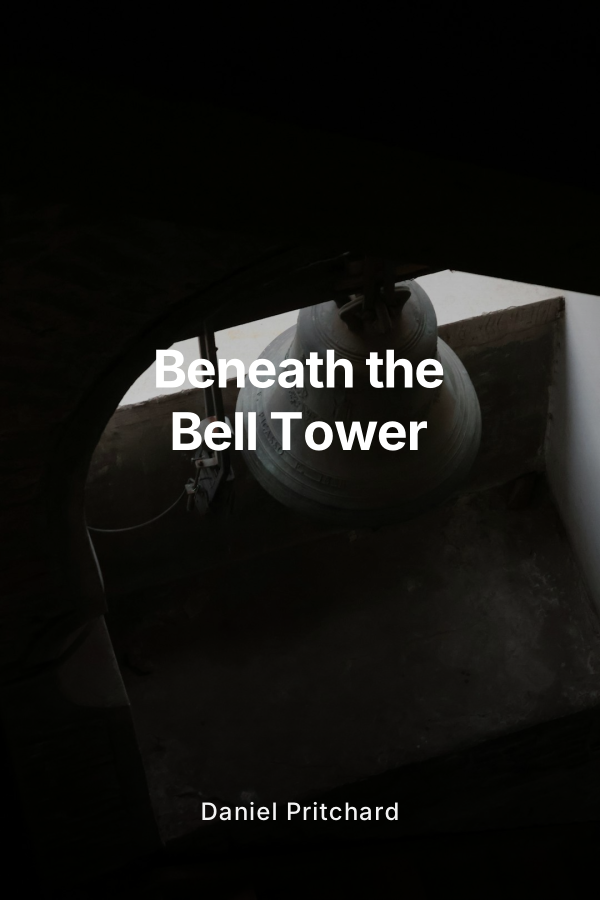
Tommy, my older brother, came into every room with a kind of bright recklessness that could turn a strict refectory into a stage. He was the sort of boy who would build a fort out of potato sacks and make it feel like a kingdom. Neil, once Barry, carried a quieter gift. He saw angles where the rest of us saw chaos, turned yards into safe triangles, and wore his new name like a map folded close to his chest. We rang the church bell together once, as altar boys, in a tower that smelled of dust and old rope. The priest’s simple words, “You’ll ring the bell today,” opened a door I did not know I would walk through for the rest of my life. That first bell is the book’s beginning: innocence, awe, the feeling of being lifted by something larger than yourself while you are still small enough to believe it will last.
But life after the convent was never simple. Our move to Regina, my mother’s quiet strength, my father’s charm and drinking, and the feeling of being outsiders in almost every yard we entered set a pattern. I left school young and learned adulthood in small rented rooms, warehouses, sandbag lines, and finally under salon lights where scissors and mirrors gave me a way to make order out of other people’s chaos. I became very good at looking capable. Perfectionism, sarcasm, and pleasing people at any cost hardened over me like a second skin.
At home, something darker was working its way in. Schizophrenia crept through my brothers’ minds in ways I recognized too late: Tommy’s license plate lists, rearview paranoia, and radio station pleas; Neil’s careful notebooks, the way he watched windows and counted breaths before breakfast. My sisters, Jackie and Shauna, carried their own early symptoms and quiet battles. We did what families do when illness does not behave. We tried. We drove, we waited, we held plastic cups of bad coffee in emergency rooms, we laughed too loudly over kitchen tables because laughter buys a few more minutes of pretending things are normal.
The memoir does not look away from the worst of it. The RCMP at my door asking if I am related to Thomas. The smell of a garage that will never leave my body. A car turned into a coffin. Gold wire glasses placed gently on a dash. Years later, another phone call, another small chapel, another winter of grief when Neil dies by the same cliff we had all been watching for. I write about the moments I am proud of and the ones I am not: the times I showed up and the times I could not make myself open a door, the open casket I refused to face, the lines I missed that now glow in memory.
Between those losses are quieter devastations. My marriage, strained by the weight of what I would not say out loud, falters. I live on my own at fifteen, then again as a grown man, carrying a history that looks nothing like anyone else’s on the block. I learn how shame hides inside success, how “doing well” can be another way of never being caught needing help. Work takes me to stages and classrooms where I teach about style and, eventually, about mental health. Spotlight and sincerity have to negotiate. The armour I forged at Saint Anne’s follows me into every salon, every talk, every night I lie awake rehearsing the sentences I cannot bring myself to speak.
Yet this is not only a book about wounds. It is also about the strange, practical mercies that kept surfacing in the worst seasons. Mrs. Larsen’s broom on a small‑town porch. Uncle Harold’s “antipasto” and card games after funerals, when shuffling a deck felt like the only honest kind of prayer. A doctor who listens without judgment. A mental health first aid course that teaches me illness is illness, not a verdict on character. My mother’s letter about an angel who carried me to the swings one night and told me I would be okay, a story I mocked until I needed it too much not to believe it. The day I washed and styled my father’s hair in the basement of the funeral home I once toured as a dare, returning a dignity addiction had stolen. These moments, small on their own, begin to string themselves into a rope strong enough to hold.
The book follows that rope through my sisters’ lives too: Jackie’s warmth that makes any room feel like a safe landing, Shauna’s music that steadies our breathing when the news is bad again, their own brushes with illness and the ways we each learn to live beside it without surrendering the whole house. It traces how chosen family gathers around the edges: friends who show up with tow straps in muddy fields, neighbours who slide plates of food into our hands when we have forgotten to eat, colleagues who remind me that listening can be as valuable as speaking.
Over time, and through many mistakes, I begin to understand something I resisted for years. We are here for a very short while. On a headstone, the distance between the dates is a couple of inches. When someone leaves early, it feels like a tear through the world, but measured that way, it is not as long as it seems before we join them. They were here long enough to press themselves into our hearts, and that impression is what lasts. A friend gives me a phrase I do not want and eventually learn to keep: remember without bleeding. A book I pick up by chance suggests that the dead would rather see our smiles than endure our lifelong punishment on their behalf. I do not borrow the wording, but I take the idea and wrestle with it on long drives and quiet evenings.
The ending of Beneath the Bell Tower returns to where it all began, but with eyes that have seen too much to remain innocent. It is Christmas. I walk up the steps of the cathedral near my home with a small bottle of wine in my pocket. Inside, Mass will start soon. Outside, I sit alone in the cold, uncork the bottle, and pour a capful as a private toast to rooftop escapades, to nurses’ tents, to tow straps, to the aunties and uncles and nuns who caught us more often than they dropped us, and most of all to my brothers and sisters. I touch the bell rope again, not to ring it this time, but to feel the old lesson in my palm: bend, hold through the arc, let the weight help, then return.
On those steps, I finally say to myself, and directly to you as the reader, what it took me a lifetime to learn. When we lose someone, we cling to sadness long after it has stopped serving them or us. We carry guilt for not having done enough, anger for being left behind, fear that joy would be a betrayal. But our time here is brief. The inches between our own dates will be small. They were here long enough to make a mark on our hearts and that matters more than any single ending. Whether there is a “somewhere” after this or not, I have come to believe they would want us to think of them with a smile in our chest. They earned that much from us. They would want us to cherish the memories we made, to let laughter back into rooms they once brightened, to live in a way that does not turn their absence into a life sentence.
So I speak as plainly as I can: One thing I learned is that grief does not have to be a punishment you serve forever. Love can count as loyalty. Remembering can happen without bleeding every time. My brothers and sisters are gone in the ordinary sense, and yet that night on the cathedral steps I know, as clearly as I knew the weight of the rope in my boyhood hands, that they have been walking beside me all along.
Beneath the Bell Tower is for anyone who has stood in a doorway with bad news in their ears, anyone who has sat in a parking lot rehearsing what to say to a child about death, anyone who has loved a person whose mind turned against them, anyone who has felt they failed the people they were trying hardest to save. It is a memoir about brothers and sisters and the kind of burdens you do not get to give back. It is about the resilience you do not recognize as courage until much later. It is ultimately about becoming the kind of person who can stand in a cold tower, acknowledge the losses honestly, and still choose to walk back down the steps into an ordinary night, carrying a quieter kind of hope.
At the very end, I turn toward you as if you are standing beside me in that stairwell and offer the only invitation I have earned the right to give: find your bell. It might not be in a church tower. It might be a kitchen table, a song you hum when no one listens, a porch where someone always made room for you, a ritual so small you are almost embarrassed to name it. When it rings in your life, let it. When the echo fades, let the quiet be true as well. The people you have lost do not need you to suffer forever on their behalf. They would, I believe, want you to smile when you say their names.
And I will.