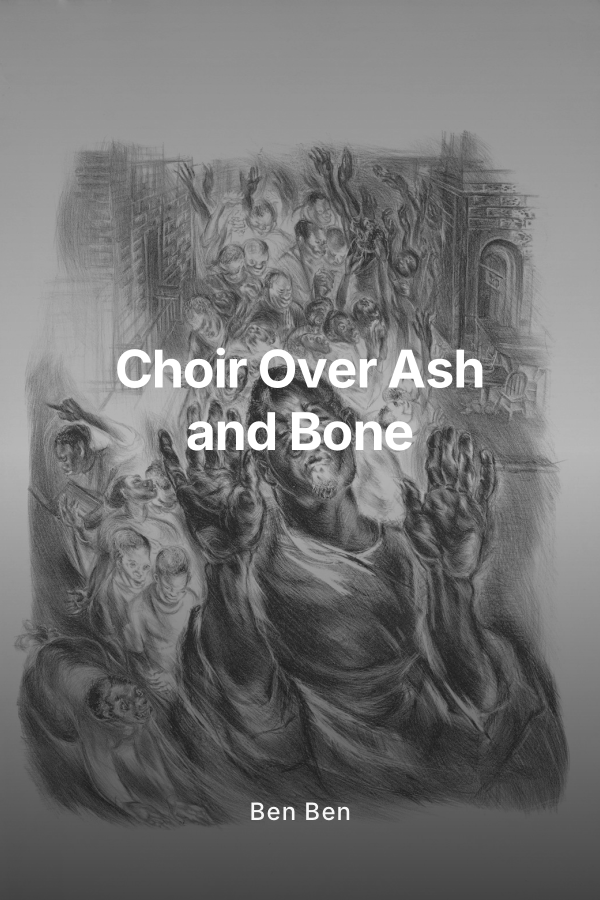
Only the first page of this book is left. We lost the rest in October 2026.
We lost access to the service that stored them, and no other copy exists. We're sorry.
Choir Over Ash and Bone is a bleak, intimate dark fantasy set in a world shattered by a false rapture, told in close first person by a nameless survivor whose mind fractures as reality itself mutates. The book is structured in three intense chapters that move from urban cataclysm to apocalyptic wandering to a lonely, myth-like extinction. It blends psychological horror and slow, suffocating suspense with vivid, desolate imagery of a world that has slipped permanently out of balance.
At its core, the story follows an anonymous young man in his mid-twenties, physically wrecked, mentally unstable, and biologically altered by the new world. He is resistant to the black, corrosive fluid that seeps from the earth and to the toxic smoke that smothers the ruined landscape, and his senses are sharpened past comfort into something predatory and raw. Inside, unnoticed by himself, his psyche has split into conflicting currents: ruthless instinct that believes in survival of the fittest, a cowering fear that wants only to hide, a lonely impulse that craves connection and invents it when none can be found, and a hollow, exhausted urge to simply stop.
He never names these parts. To him there is only “I”, and his story is told through subtle shifts in tone, language, and behavior that allow the reader to feel his inner fragmentation without it ever being explained on the page. Time in his narration is untrustworthy, looping back on itself, questioning whether certain moments have already happened, whether the echoes in his head are memories or inventions. Physical pain remains a constant dull ache that flares only occasionally, allowing the psychological erosion and hostile environment to dominate the horror.
CHAPTER I – The Day the Choir Began
The opening chapter begins on what appears to be a normal day in New York City, shown through the weary, detached eyes of a random worker at the tail end of a monotonous shift. Traffic snarls, car horns bleed into each other, street vendors shout, and a small but noisy crowd of cultists screams about impending rapture. The narrator is irritated, hungover in spirit if not in fact, thinking only about a beer and a long walk home. The world feels ordinary yet faintly off, marked by odd pockets of silence, by animals that hesitate and stare too long, by a sky whose temperament is wrong in ways that are hard to name.
The ordinary noise slowly curdles. The sky darkens far too fast, temperatures climb in a suffocating surge, and the pavement beneath his feet trembles. Cracks split open through the asphalt, stretching outward in jagged webs as low rumbles roll from deep below like something enormous turning in its sleep. Light vanishes entirely, plunging the city into deaf blackness, as every sound is snuffed at once. For a breathless interval there is nothing, then an eerie, layered choir begins to echo from nowhere and everywhere, holy in tone yet inhuman in effect.
When light returns it is filtered and wrong, pale and almost gentle. The cultists erupt in triumph, praising the rapture they always promised. Others mutter about an eclipse. Then the hands appear. Pale, grasping limbs tear through the fissures and seize people by ankles, wrists, torsos, yanking them down into the earth. Those who fight lose limbs to irresistible strength, leaving behind only ripped bodies and spraying blood. The ground becomes a feeding mouth that takes without ever revealing what lies below.
As survivors reel, angelic figures descend from the bruised sky, radiant and spear-armed. For a moment, hope blooms. A cultist spreads his arms in welcome, expecting salvation, and is immediately impaled and carried upward, corpse hanging like an offering. One by one the angels harvest humans, lifting them into the dim heavens skewered on their weapons. Any illusion of grace dies in the face of this cold, ritual slaughter. The choir swells, beautiful and unbearable, as the population is culled on a global scale.
The world does not end in a single stroke. In the aftermath, less than a tenth of humanity remains. Cracks that did not close begin to seep a black fluid, a tar-like mixture reminiscent of blood and something alien. Any living creature that touches it is slowly dissolved into steaming ash and scattered bone. Ecosystems topple in a cascade. Grasslands blacken and sag, forests twist into lifeless tangles, rivers become thick, grey veins. Skies dim into an eternal, metallic twilight. Only those who mutate in time survive, their biology rewriting itself into strange adaptations, almost magical in effect yet grounded in flesh and hormone, organ and nerve.
The narrator survives the initial catastrophe half by accident, half by instinct, sheltering in rubble while the world convulses. It is only later that he realizes he can move through toxic smoke without choking and can step around streams of black fluid without harm. It feels less like a gift than a sentence.
CHAPTER II – The Walk Through Nothing
Weeks after the first descent of angels, the main body of the story unfolds. The narrator wanders a world that has become a cold, desolate wasteland where fertile soil has turned to grey powder and vegetation has mutated into colorless husks that still grow yet no longer seem truly alive. The sun is little more than a rumor behind the dim ceiling of cloud, and the choir that once roared now hums constantly in the distance, a faint heavenly murmur that never quite stops.
His only clear objective is survival. There is no destination, no plan beyond “keep going, keep breathing, do not be where danger is.” For long stretches, his hard, calculating side leads, reducing everything to food, shelter, and escape angles. Other parts of him surface without his awareness. At times his footsteps falter near distant campfire glows or the muffled crackle of a radio, as if pulled by a need for human contact, only for his body to veer away at the last instant, leaving scenes of potential connection behind minutes before other survivors arrive. Faint screams ride the wind. Fresh footprints cross his path. He moves on, oblivious to the near-misses that might have changed his fate.
His sense of time dissolves. Days and nights blur into one long dimness. The narration begins to loop, revisiting details and sensations as if they have just occurred, questioning whether he has walked this road before, whether the bone fragments at his feet are new or remembered. Hunger, cold, and illness gnaw at him, but these are described as background textures rather than center stage. He limps on a damaged leg, coughs until his chest burns, shivers until his teeth ache, yet what truly oppresses him is the sheer emptiness of the landscape and the way sound carries in it.
The world around him is painted in rich, unsettling detail. Twisted fields of grey, glassy grass that whispers against his boots. Rivers that move like slow ink, filmed over with oily sheens from the black fluid seeping underground. Forest remnants where trunks stand bare and petrified, vines draped like the bones of some titanic creature. Everything smells faintly of rust, ash, and something sweetly rotten. Under his fingers rock feels too smooth, bark too slick, soil too fine, as if the very textures of reality are misaligned.
In quieter moments, his need for companionship expresses itself in a strange craft. He gathers small bones from the ash, wiring and tying them into crude, pocket-sized figures that he carries with him. He treats this as a practical habit at first, as if these “bone people” have some use, but in behavior the reader sees him arrange them carefully when he camps, set them upright as if watching over him, sometimes whisper half-formed words to them. They never move on their own, never show supernatural traits. Instead they stand as pure coping, a soft, sad rebellion against the total isolation.
Throughout, the narrative voice shifts in subtle ways. On some pages the language tightens into hard, clipped observation, weighing threats and resources. On others it loosens into more wandering, almost childlike noticing of sounds and shapes, or descends into bleak, detached mutterings that circle death as a release. These changes are never announced. They must be inferred from cadence and choice of detail, mirroring the unseen rotation of personalities within.
Occasionally, the story tilts outward for a heartbeat, showing a collapsed overpass in the distance, a silent city skyline half-sunk in its own cracks, an angel striding far away among skyscraper skeletons, its spear dripping black and red into the air. Yet the narrator rarely comments. To him these are simply things to pass around, to survive beside.
Gradually, his body and mind erode. He eats less, talks less even to his bone companions, and sleeps in shorter bursts. His route straightens. Almost without deciding, he begins to angle toward a particular shape on the horizon, a solitary mountain whose outline remains fixed while everything else blurs.
CHAPTER III – The Lonely Mountain, The Last Thought
The final chapter is devoted to the approach and ascent of that mountain and to the quiet, almost gentle ending of the narrator’s life. The mountain itself is not described as monstrously unnatural. Instead, its surreal quality comes from contrast. In a world of ruins and fractures, it stands whole. In a world of ragged noise, it is wrapped in a stillness so complete it feels wrong. The choir that forever hums in the background is still present as he climbs, a constant but steadying presence, neither louder nor softer, simply there.
The climb is arduous, made worse by his limp, his damaged hand, his racking coughs. The air is thin but not hostile to him. The ground grows rockier, strewn with scattered bones that may be human or animal or something else entirely. The sky overhead remains a stagnant grey lid. No wind stirs. Ash lies in drifts that do not move, as if frozen mid-fall. Being here feels like stepping outside time, into a place the catastrophe has finished with.
On the way up, his narration grows more fragmented, then slowly more lucid. Memories of the wandering blur further, but his immediate sensations sharpen. The scrape of stone under his palms. The dry rasp in his throat. The faint imprint of his own body heat in the air, as if he can sense the last traces of himself leaking away. The personalities inside him, never named, quiet one by one. The survival instinct that has driven every step falters without rage or protest. The anxious, hiding part no longer cares where danger lies. The part that sought company is tired even of its bone dolls. The part that wanted death does not cheer; it simply goes silent.
At the summit he finds no revelation, no structure, no waiting figure. There is only a small, bare space of stone surrounded by an empty horizon. The world stretches away in every direction, a flat plain of ash, cracked roads, and distant, broken towers. The choir is still running beneath everything, but weakened, like an echo of an echo. For the first time, he notices the idea of silence as something he might actually reach.
He curls up on the stone, folding himself inward, the bone figures gathered by habit near his chest. The narrative slows to his breathing, to his heartbeat. He pays attention to the feel of stone under his cheek, the powder of ash grinding against his skin, the strange sense that the pain in his joints has stepped a little further away. The choir fades. One layer of sound after another falls away, until there is only his own breath and then not even that.
His last inner experience is not an epiphany, not a coherent statement about his life or the world. Instead it takes the form of a half-formed thought, a sentence that rises from somewhere deep but never finds its ending, dissolving into the same blank quiet that has swallowed the sky. In that fading, his mind finds a fragile peace that his body will not feel until later, when the cold finally claims it.
EPILOGUE – A Choir That Outlasted Men
After his personal story ends, the narrative voice shifts. The final pages are written by an unnamed, distant chronicler, implied to be aligned with the cold realm that sent the angels, a voice from that indifferent “heaven” that looked down and judged. The tone becomes myth-like and detached, recounting the fate of humanity in a compact, bleak legend.
This chronicler describes how, long after the nameless wanderer died unseen on his mountain, scattered human bands clawed their way back from the brink. They learned to live along the edges of black fluid rivers, to hunt in twisted forests, to build crude shelters in the ribs of collapsed cities. Children were born with their own mutations, some strange and potent, some fatal. Small settlements hardened into fragile towns. For a time, there were markets again, stories by firelight, superstitions about angels and hands and the days of falling sky.
Inevitably, memories of the first culling turned into myths, then into rallying cries. Rebellion rose from hunger and rage. Simple weapons that resisted corruption were forged. One last city grew, defiant and proud, its people vowing to spit in the face of heaven itself. They watched the skies and counted every passing angel, cataloguing patterns in their movements, imagining plans where there were only incomprehensible routes.
For each key turning point the chronicler offers a brief, withered image. A vast battle on a dead plain where human armies, outnumbered but determined, charged the descending host and broke like waves against a cliff. A final generation born into a world that had never known blue sky, taught from infancy to hate what flew overhead. A last age of experiments where men and women tried to twist their own mutations into weapons, often dying in the attempt. The rebellions always end the same way, crushed under spears from above or by the slow encroachment of the black tide. Angels remain mostly distant, glimpsed walking once in a while through empty ruins, leaving behind no explanation, only the certainty that they see and remember.
Population rises, falls, and dwindles. Disease, sterility, and environmental collapse finish what the spears began. The chronicler’s voice never fully condemns and never pities. It simply records that humanity burned fiercely for a while, then flickered out. At the end there is a single human left, their name and story unimportant to the recorder. What matters is the image that closes the book.
On the final page, an angel descends over a world that has finally fallen quiet. The black rivers no longer steam, the grey forests are still, the choir is muted to almost nothing. The last human stands or kneels or crawls, it is unclear, and the angel, shining and terrible, pierces them with its spear in a single, effortless motion. No words pass between them. No plea, no prayer. The body hangs limp, blood falling in slow strands that vanish before they touch the ground.
Then, in a scene described as disturbingly beautiful and horrible at once, the angel rises into the dim sky, ascending with the corpse dangling from its weapon like a final, mute offering. The ruined world recedes beneath them into obscurity. The choir swells one last time, not in celebration, but in a calm, impenetrable affirmation that what has been done cannot be undone. The book ends with this ascent, with heaven reclaiming its last echo of humanity, and with the heavy, suffocating sense that the universe will not mourn what it has erased.