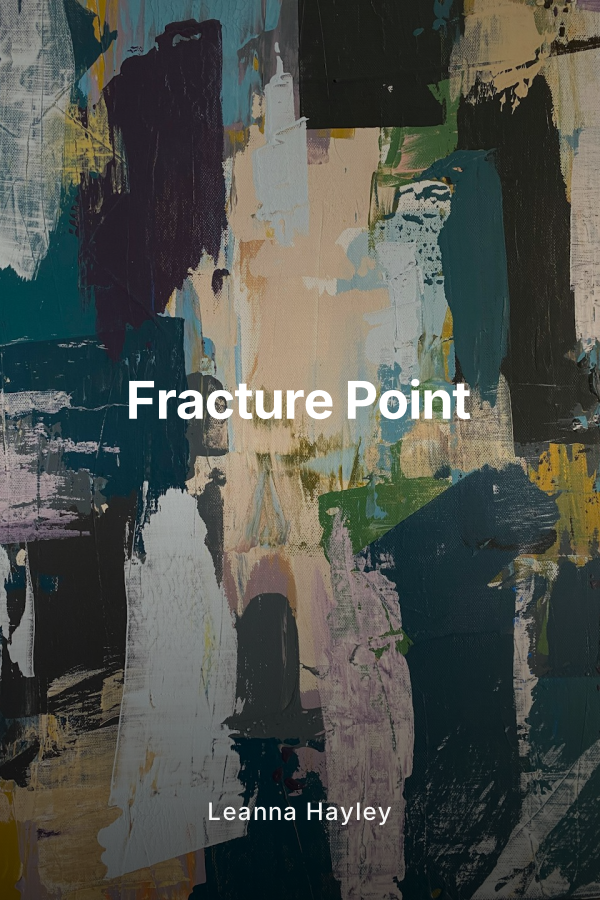
This book explores the quiet instants when life bends, breaks, and reforms, tracing how small, often overlooked decisions accumulate into irreversible change. Across two closely woven chapters, it follows a set of ordinary people standing at their own fracture points and reveals the hidden architecture beneath decisive moments.
The narrative centers on four intertwined lives in a contemporary city:
- A mid‑career professional who has built success on compromise and begins to suspect that staying safe now costs more than it protects.
- A young creator who cannot decide whether to pursue a fragile dream or accept a predictable path.
- A caregiver silently stretched to the limit, holding a family together while losing sight of herself.
- A retired worker wrestling with the sudden emptiness after a life defined by duty and schedules.
Their stories intersect in subtle, human ways: chance encounters, forgotten promises, workplace tensions, and family dramas that seem minor at first yet gradually reveal their weight. Each character faces a fracture point, the instant when postponing a choice is no longer possible and the cost of inaction becomes sharper than the fear of change.
Chapter 1 focuses on the build‑up. It draws readers into the textures of daily life, showing how quiet frustrations, unspoken regrets, and small compromises accumulate. The chapter exposes how people learn to tolerate emotional discomfort in order to feel stable, how they mistake routine for safety, and how loyalty to old stories about themselves prevents growth. Through vivid scenes, readers see the protagonists rationalize staying the same, clinging to habits that once protected them but now hold them back.
Chapter 2 moves into rupture and transformation. Each character meets a specific moment that cannot be undone: a conversation that goes too far, a missed opportunity that cannot be recovered, a medical scare, a loss, a betrayal, or a rare act of courage spoken aloud. Rather than presenting change as sudden magic, the chapter shows how fracture points clarify what has always been true but carefully avoided. Decisions that once felt impossible become unavoidable, and the characters must choose who they will be on the other side of the break.
The book blends character‑driven storytelling with reflective insight. Without lecturing, it invites readers to see their own patterns inside the characters’ struggles:
- The way worry disguises itself as responsibility.
- The temptation to accept “good enough” long after it has turned into quiet misery.
- The pressure to carry others’ expectations while ignoring personal limits and desires.
- The fear of uncertainty that keeps people repeating familiar mistakes.
Rather than offering formulas, the book illuminates recognizable emotional landscapes. It captures the physical sensations of standing at a fracture point: the tightness in the chest, the rush of heat before speaking a difficult truth, the hollow after a final goodbye, the unexpected lightness of a decision finally made. Each protagonist discovers that the moment of breakage is also the moment of honest self‑recognition.
Across both chapters, several core themes emerge:
- Change rarely announces itself with clarity. It arrives disguised as an inconvenience, a conflict, or a coincidence.
- Avoided conversations carry more power over time than the painful truths people fear to speak.
- Stability built on self‑denial eventually becomes more dangerous than risk.
- Identity is not fixed; it is shaped and reshaped at each fracture point.
The narrative structure slowly reveals how the characters’ paths influence one another. A choice one person makes ripples outward, allowing another to see possibilities that had been invisible before. A candid word from a stranger lingers just long enough to surface at a crucial decision. An act of quiet rebellion in one household challenges resignation in another. These subtle interconnections emphasize that no one reaches a fracture point in isolation.
While the book remains firmly rooted in fiction, it incorporates psychologically realistic observations about fear, attachment, and resilience. Concepts that readers might recognize from works on cognitive habits, emotional regulation, or behavioral change are translated into concrete scenes and internal monologues rather than presented as abstract theories. This approach lets readers feel the concepts instead of merely understanding them intellectually.
By the end of the book, not every character achieves a perfect resolution. Some embrace change and discover new forms of purpose, intimacy, or creative expression. Others choose safety again, though with more awareness of the tradeoffs they are making. The story honors both courage and ambivalence, insisting that growth is not a straight line but a series of uneven steps.
Fracture Point is written for readers standing at their own edge: people sensing that “something has to give” but unsure what that something is. It speaks to professionals considering a career shift, caregivers wondering who they are beyond their responsibilities, young adults torn between security and authenticity, and anyone who has postponed a difficult decision for so long that postponement itself has become exhausting.
The tone is intimate yet unsentimental. It neither glamorizes upheaval nor romanticizes endurance. Instead, it offers a clear, compassionate mirror, helping readers recognize that the tension they feel is not a personal failure but a signal that their inner life is outgrowing its old shape.
Ultimately, the book proposes a quiet, powerful idea: fracture points are not simply moments when things fall apart. They are also the precise places where a truer life can begin.