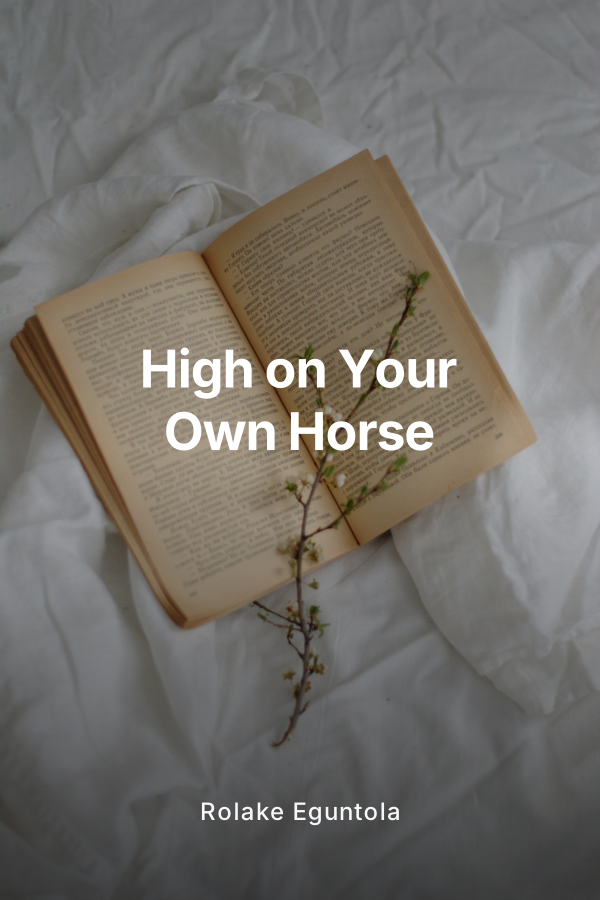
Only the first page of this book is left. We lost the rest in October 2026.
We lost access to the service that stored them, and no other copy exists. We're sorry.
You are the man who believes he has solved the puzzle of other people’s hearts. In a world that rewards the loudest confidence, you rise as a modern Solomon: the relationship sage on every screen, the voice quoted in arguments, the name invoked in late night texts. You speak in absolutes, in clean formulas, in aphorisms that make loneliness sound like a simple user error. People come to you desperate and leave feeling that, if they only follow your rules, they will never be hurt again.
This book tells, in second person, the story of how that certainty destroys you.
High on Your Own Horse follows your climb from obscure commentator to cultural authority on love and relationships. You start as a sharp, almost endearing contrarian, offering “tough truths” that slice through the usual comfort and sentimentality. You tell others that vulnerability is leverage, that whoever cares less holds the power, that boundaries are weapons rather than protections. Each small, arrogant choice feels clever. Each dismissive answer to a stranger’s pain wins likes and shares. Step by step, your rise is built on the humiliation and simplification of people you insist you are helping.
But the story does not rush your fall. It lingers on the sweet taste of influence and the way you begin to confuse applause with wisdom. The book traces how you slowly cut away anything that might contradict your self-image as a flawless judge of hearts: old friends who remember when you were unsure, partners who ask questions you cannot easily dismiss, clients who do not fit your neat narratives. You turn every challenge into proof that you are right and they are weak. Your “wisdom” hardens into dogma, and you ride higher and higher on the invisible horse of your own ego.
Irony seeps into the story through a series of quiet reversals. The techniques you preach to keep others at a distance start to isolate you. Your rules about never texting first, never apologizing, never admitting doubt leave you circling inside your own head, incapable of real closeness. You tell millions how to recognize “red flags” and avoid “toxic people” while becoming the very danger you warn them about. Clients quote your words back to you as justification for cruelty. Lovers use your frameworks to measure and discard you. You become trapped in a hall of mirrors made from your own advice.
As your profile rises, so does the gap between the persona you defend in public and the person you cannot bear to sit with in private. The narrative tightens around key turning points where your arrogance quietly backfires. A flippant answer in an interview alienates someone powerful who once supported you. A smug, public diagnosis of a stranger’s relationship spills into their real life in ways you never bothered to imagine. A client you treated as raw material for content refuses to be edited into a lesson and pushes back in a way that can no longer be contained.
The book’s second person perspective is not a stylistic gimmick but a moral trap. By placing you at the center of every scene, the narrative forces the reader to inhabit your certainty, your justifications, and then your disintegration. You feel the self-righteous rush when a viral clip proves you “right,” and you feel the private nausea later when you witness how your words are used to justify coldness, abandonment, and manipulation. Each small arrogant decision returns with a slightly altered shape, like ripples reaching the shore long after the stone is thrown.
The central metaphor, a man so high on his horse that the horse throws him face first into the mud, unfolds figuratively across the book rather than in one literal event. Your “horse” is the pedestal of public adoration, the algorithms that reward outrage, the clients and followers who project their hopes onto you. At the height of your success, you feel untouchable, almost separate from ordinary human limitations. In that altitude, you stop listening. You stop learning. You stop actually seeing the people in front of you. The horse has to buck eventually, and the book shows that the real act of being thrown is not a sudden scandal, but a series of accumulated consequences that finally become too heavy for the narrative you have built about yourself.
When the obvious ruin comes, it is not subtle. Messages you once sent in contempt, mocking the people who trusted you, find their way into the open. Videos stitched by those you dismissed circulate with a fury that cannot be muted. Those who once framed you as their savior now frame you as their mistake. Clients, colleagues, past partners, and nameless strangers begin to speak, and for the first time, your voice is not the loudest in the room. The book does not revel in this downfall as justice, but presents it as the inevitable end of someone who built their status on other people’s vulnerability while refusing to honor their own.
Yet the most devastating ruin is not public; it is internal. The narrative holds you in the moments after the noise, when the notifications fade and the statements are issued and the brand managers retreat. Alone with yourself, you finally meet the full weight of what you have done. You realize that in telling millions how to avoid pain, you have never truly learned how to love or be loved. Every rule you crafted to keep yourself safe has achieved its dark perfection. No one can reach you now. The fortress of your cleverness has become a tomb.
High on Your Own Horse is bitterly ironic, not because your pain is undeserved, but because you are the one who authored it. The book’s chapters move from the thrill of early certainty, through the seduction of influence, into the slow contraction of your world as you cut away genuine connection to preserve the illusion of expertise. It exposes how a person can be praised as wise and still live as a fool, particularly in a culture that confuses confidence with truth and charisma with character.
This summary outlines a story that is not a warning to anonymous “gurus” somewhere out there, but an intimate guided descent into what it feels like to become your own cautionary tale. The second person voice keeps the reader uneasily close, seeing the world as you see it, rationalizing as you rationalize, until the distance between “you” and “I” begins to blur. The book asks difficult questions about what happens when a person treats relationships as systems to be controlled rather than living bonds to be honored, and what it costs when you insist on standing above everyone else instead of among them.
In the end, the mud is not only humiliation, scandal, and loss, but the reality you spent a career teaching others to avoid: the raw, uncurated experience of being fallible, alone, and in need of forgiveness. High on Your Own Horse invites readers into the spectacle of your very public collapse, then quietly leaves them with an unsettling recognition. The real irony is not that a foolish Solomon falls, but that he never learned what wisdom actually was while he had the world’s attention.