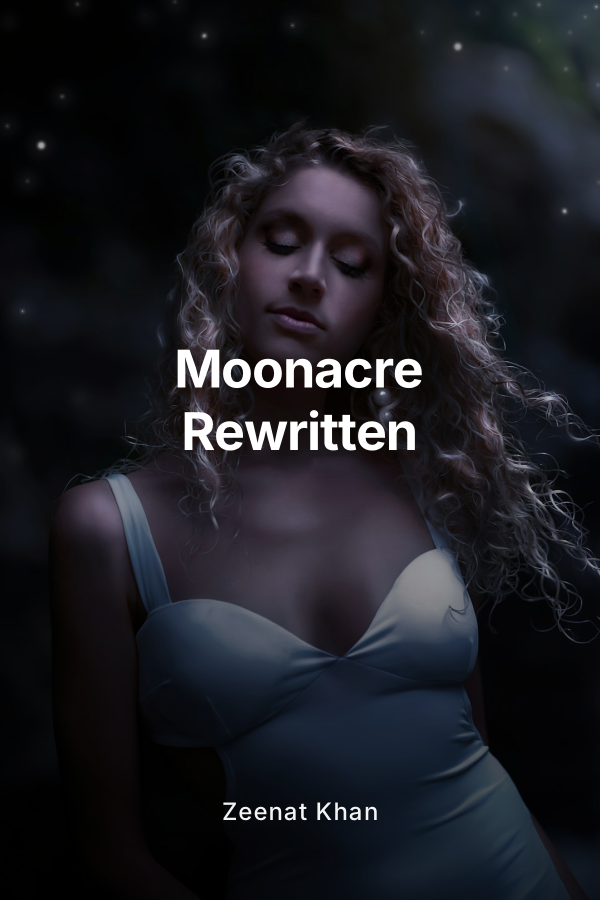
In the hidden valley of Moonacre, where old curses linger in the roots of the forest and family feuds stain the stones of proud houses, a new story begins when Zeenat Merrryweather arrives at her uncle’s manor with her young friend Maria and the formidable Miss Heliotrope. Zeenat is no ordinary companion. She is 18, breathtakingly beautiful, sharp-minded, funny, and fearless, with golden-brown eyes, long wavy brown hair that catches the light like spun honey, and a habit of wearing practical clothing that hides blades in her sleeves and boots. Calm on the outside and constantly thinking beneath the surface, she is the kind of girl who solves problems before anyone else realizes there is one, even if her overthinking sometimes leads her straight into danger. She is Maria’s closest friend, and she has come to Moonacre for one reason only: to help Maria through her strange, enchanted adventure. That decision pulls Zeenat into a world of inherited hatred, impossible riddles, and a centuries-old mystery tied to the Moon Princess, the lost pearls, and the dark burden of the de Noir name.
Their arrival at Sir Benjamin’s ancient stone manor is anything but peaceful. On the bumpy road through the valley, the carriage is attacked by bandits from the de Noir clan, a dangerous family whose reputation is as rich as it is feared. But the attack only gives Zeenat her first real taste of Moonacre’s absurdity and menace, because while chaos erupts outside, the coachman barely reacts, opens the gates as if this is all routine, and drives on as though violence is merely another Tuesday. At the manor, Zeenat and Maria are welcomed by Sir Benjamin, the silent and unsettling Wrolf, the cook, and the butler, each stranger than the last. The house itself seems to breathe with old sorrow. In its shadows, Zeenat begins to sense that Moonacre is not merely a place but a wound, one that has been reopened by time, pride, and buried truth. That night, she and Maria learn the tale of the Moon Princess and the destiny that has long hovered over the valley, setting the stage for a conflict much larger than either girl expected.
The first real spark of danger and attraction comes the next morning in the forest. Zeenat and Maria discover a rabbit trapped in a cage, and Zeenat, unable to ignore the suffering of any creature, unlocks it while Maria cradles the animal in her arms. Their rescue is interrupted by Robin de Noir and his gang, who circle them with the easy cruelty of boys raised on old grudges and too much confidence. Robin is eighteen, annoyingly handsome, sharp-tongued, and impossibly self-assured, a cheeky devil whose wit is nearly as fast as his grin. He notices Zeenat first for her looks, then for her bite, then for the way she carries herself like she is dangerous enough to be a problem. Their conversation is all sparks and barbs. He mocks her softness; she answers with sarcasm cold enough to cut glass. He pretends to be amused; she pretends not to notice that he is trying very hard to get under her skin. Their duel of words is interrupted only by the ominous sound of the de Noir horn, which forces Robin and his companions to retreat, leaving behind the first crackling impression that the chemistry between them is not merely hostile, but deeply, unsettlingly alive.
As the days pass, Zeenat and Maria study Moonacre’s history and the impossible feud between the Merryweathers and the de Noirs. Zeenat quickly becomes the clearer thinker of the two, while Maria’s imagination and impulse often lead them toward trouble. When Maria gets the reckless idea of infiltrating the de Noir castle to reclaim the pearls, Zeenat is uneasy, but loyalty wins over caution. Together they sneak through the valley past soldiers, guards, and townspeople, reaching the de Noir stronghold where light, gold, black velvet, and laughter make the castle feel both seductive and sinister. Inside, a feast is underway in a hall full of carvings, tapestries, jewels, and candlelight. Zeenat pauses near the window while Maria moves toward the balcony stairs, and in a matter of seconds everything goes wrong. Robin’s father notices Maria, the guards seize her, and Zeenat only realizes something is wrong when she turns to speak and finds her friend gone. She is captured too, dragged into the glare of enemy eyes with a face full of exasperated calm, while Robin restrains her with an arm far too firm to be casual. Zeenat cannot resist throwing back the sarcasm he once gave her in the forest, and Robin, infuriatingly, seems to enjoy every second of it.
In the dungeon, the girls are delivered to the dark logic of old hatred. Maria jerks her arm free and insults one of the guards, while Zeenat gives her a look that says she could have chosen a less ridiculous word than oaf. They are locked away, but not before Robin gives them a mocking farewell that makes the whole scene feel like a performance in a play written by spite. Even then, Zeenat and Maria remain themselves, and their escape from the prison is clever, frantic, and just absurd enough to work. They flee through the castle and into the open, only to be pursued by Robin, his friends, and the royal guards. Cornered at the edge of a stone drop, Zeenat makes a split-second choice that reveals both her daring and her instinct for survival. She jumps. Maria follows. The boys do not expect it, and that single reckless leap buys the girls enough time to escape down the hills and vanish into the landscape of Moonacre, leaving behind a furious Robin and a father who hardens the threat against them. Yet even in the aftermath, Robin is the one who mutters Zeenat’s name under his breath, as if annoyance has already begun to blur into something more personal.
Back at the manor, Miss Heliotrope descends into dramatic alarm while the girls try to recover from everything they have learned and survived. Soon afterward they meet Loveday, and the story opens further into Moonacre’s hidden heart. Loveday becomes another important thread in Zeenat’s life in the valley, adding warmth and tenderness to a world otherwise full of barbed history. As the mystery deepens, Zeenat’s role grows more central. She is not just Maria’s protector. She is the one who notices patterns, asks dangerous questions, and keeps the others grounded when the truth threatens to spiral beyond them. She searches the records, follows the clues, and begins to understand that the pearls are only part of a much larger puzzle. The rivalry between the houses is not simply inherited pride. It has been fed by lies, pain, and manipulation for generations.
When Zeenat finally goes into the forest alone to seek Robin’s help, the moment carries both tension and inevitability. Robin assumes she is surrendering herself, and of course he cannot resist taunting her with the dagger he carries, as if intimidation is a language he enjoys speaking fluently. But Zeenat has never been easy to scare. She cuts through his posturing with intelligence, wit, and the kind of calm that makes a dangerous man pay attention. He listens because he has to, though not without a fight. Together, they begin the search for the missing pearls and the truth hidden behind them, following clues, solving riddles, and moving through Moonacre’s strange, beautiful landscape with increasing unwilling admiration for each other’s abilities. Zeenat discovers that Robin is smarter and more layered than his arrogance suggests. Robin learns that Zeenat is more than beauty and daring, more than the girl who can kill with daggers and laugh while doing it. She is thoughtful, loyal, and unexpectedly kind in ways that disarm him. Their banter grows more personal, their silences more charged, their glances too long to be innocent. The enemies-to-lovers tension becomes a constant, electric presence, never fully spoken but impossible to miss.
As the mystery edges toward its conclusion, Moonacre itself seems to lean into the story. The valley grows stranger, the stakes heavier, and the old magic more visible. Zeenat and Robin work through danger, fear, and suspicion to uncover the truth of the pearls and the lies that kept the Merryweathers and de Noirs locked in hostility. Along the way, Robin’s father emerges as a layered villain, still threatening and controlling, but shaped by bitterness, inheritance, and wounded pride rather than simple evil alone. Zeenat’s overthinking, once a private trait, becomes one of her greatest strengths. She notices what others overlook. She anticipates traps before they spring. She keeps calm in situations that would shatter someone less stubborn. At key moments, she fights with deadly precision, both with blades and with words, proving that her beauty is not a weakness but a weapon of a different kind.
By the time Moonacre’s secret is finally brought into the light, the valley can no longer survive on lies. Peace begins to replace suspicion, and the old feud starts to break apart. The resolution follows the spirit of the original tale but gives Zeenat a larger place at its center, allowing her to stand not just beside Maria but at the heart of the restoration itself. She helps bring the truth home, helps mend what was broken, and helps lead the people of Moonacre toward a future they have long denied themselves. Robin, for all his swagger and stubbornness, changes too. He becomes less the boy who mocks from a distance and more the man who sees her clearly. Their rivalry softens into trust, then into something warm, private, and increasingly impossible to hide. The flirtation that began with insults and suspicious glances becomes a quiet, dangerous affection.
In the aftermath, as peace settles over the valley, Zeenat and Robin continue circling each other with the same teasing energy that once made them enemies, now turned toward affection instead of combat. They prank each other, trade insults that sound too fond to be serious, and find excuses to be near one another. On a star-filled night, the last barriers finally begin to fall. What starts as banter turns intimate, and what was once a war of words becomes a confession without speech. In the end, Moonacre is saved not only by prophecy and courage, but by truth, loyalty, and the unlikely bond between a girl who came only to help her friend and the boy everyone expected her to hate. Zeenat leaves the valley changed, and Robin does too. The future they build is hard-won, tender, and theirs alone.