In a quiet public middle school where the loudest sounds are slamming lockers and echoing laughter, twelve-year-old Elliot Moreno has built his life around control. He is the boy teachers rely on and classmates largely overlook, the one with perfect margins in his notebooks and a mind that parses the world into clean, logical categories. His intelligence is his anchor and his armor. It earns him praise, predictable routines, and the security of knowing exactly who he is supposed to be: the smart kid who always has the answer.
Underneath that tidy surface, though, Elliot is restless. He watches social interactions like they are complicated equations he can never quite balance. He can solve for x but not for why his chest tightens around people who move through the world with a kind of easy, unthinking charisma. No one embodies that baffling ease more than Nico Alvarez, the class clown whose laughter turns every dull period into a stage.
Nico, with his untamed curls, dimples, mismatched socks, and unzipped backpack, is everything Elliot is not. Where Elliot is methodical, Nico is impulsive. Where Elliot orchestrates his days with color-coded precision, Nico stumbles through them with chaotic charm. Nico’s jokes ricochet around the classroom, cracking open tense silences, drawing giggles from the back row and exasperated sighs from the front. He is a gravitational center without trying to be, collecting attention like orbiting moons.
What nobody at school sees is that Nico’s performance is not just a personality trait. It is survival. At home, the atmosphere is tight and thin, filled with unsaid things and careful steps. Conflict hums under the surface, sometimes rising into raised voices behind closed doors, sometimes sinking into silence that feels just as loud. Nico has long since learned that a well-timed joke can redirect almost anything, including his own fear. School is his refuge, a place where he can pretend that his life is just punchlines and pranks.
Elliot’s home looks nothing like Nico’s. His evenings unfold with predictable rhythms: quiet dinners, a stack of homework completed at a neatly organized desk, parents who check in on grades and ask polite, practical questions. It is a safe, structured environment that protects him from chaos yet leaves him aching with an unnamed loneliness. His parents love him, but they do not know about the spiral of rehearsed conversations in his head, or how much effort it takes to say even a simple hello to someone who matters.
Their lives intersect in the one place they cannot avoid each other: school corridors, shared classes, lunch tables where choice and chance collide. For years, Elliot has known Nico only as background noise, the boy who sometimes borrows his homework answers and ruins carefully timed lessons with ill-timed jokes. Nico, in turn, has known Elliot as the quiet brainiac in the front row, the one teachers praise and classmates half-admire, half-ignore.
The day everything truly begins, however, is unremarkable to everyone else. It starts with a shared class period where Nico turns a dull assignment into an impromptu comedy routine, and Elliot does something he rarely does in public: he laughs, uncontrollably and without restraint. That laughter is Elliot’s tipping point. For the first time, he recognizes that his attention to Nico is not just annoyance or curiosity. It carries heat, fascination, and the unmistakable thrill of a crush he cannot reason away.
From that moment, the ordinary architecture of their days takes on new meaning. In class, Elliot tracks Nico’s movements as if they contain some pattern he might decode. In the lunchroom, Nico begins to drift toward Elliot’s table, drawn first by the reliable audience, then by something quieter and more grounding that he does not yet name. In the hallways, their near-misses and brief exchanges accumulate into a subtle orbit neither fully understands.
The story unfolds in a slow burn that respects their age, their inexperience, and the careful, stumbling way twelve-year-olds inch toward self-knowledge. Each chapter layers school life over home life to emphasize the painful contrast between public performance and private reality. We see Elliot through the clear, observational lens of a boy who notices everything but struggles to express what he feels. We see Nico from the inside of his own chaos, where humor is both escape and prison, and where the thought of anyone seeing the truth behind the jokes terrifies him.
As their days wind on, small moments become significant turning points. A private joke shared between them during a group activity. A lunch conversation where Nico remembers a tiny, throwaway fact about Elliot that no one else bothered to retain. A quiet hallway encounter when Nico, for once, looks less like a comedian holding court and more like a tired kid holding himself together. Elliot stores every one of these details like data points, building an emotional graph he is not ready to name “crush,” even as it defines his every thought.
At home, the narrative bends inward, shifting into close perspectives that reveal the gap between who they are in public and who they are when no one is watching. Elliot, surrounded by the tidy comfort of his room and his orderly notebooks, replays the day’s interactions on a loop, analyzing tone, micro-expressions, and what Nico’s laughter sounded like when it was aimed just at him. Nico, sprawled across a worn mattress or hunched over a cluttered desk, listens to arguments muffled through thin walls, clinging to the memory of Elliot’s steadfast presence as proof that not all spaces are unstable.
The novel’s emotional engine lies in the contrast between these twin lives and the fragile bridge that forms between them. Elliot’s need for logic clashes with the irrational warmth of his feelings. Nico’s instinct to perform collides with his gradually growing longing to be seen without a costume. The book tracks how two very different boys learn to notice each other not only as roles within the social ecosystem of school but as entire, complicated people.
Across five chapters and roughly ten thousand words, the story traces a careful arc:
Chapter One introduces their school day in vivid detail, showing the first clear signs of Elliot’s crush and Nico’s unconscious gravitation toward him. Shared class scenes highlight their differences in learning and behavior. A lunch sequence reveals early hints of their chemistry, as Nico’s jokes collide with Elliot’s dry, unexpected responses. A final juxtaposition of their separate home lives underscores the theme of divided selves and the emerging emotional stakes.
Chapter Two deepens their classroom proximity and begins to explore group dynamics, including mild peer teasing, shifting alliances, and the subtle ways kids notice and misinterpret each other’s habits. Elliot wrestles with how obvious his attention feels, while Nico begins to rely on Elliot’s presence as a stabilizing force, even if he still frames it as friendly dependence.
Chapter Three introduces a small but meaningful school event, such as a project or club opportunity, that places them formally on the same side for the first time. Structured collaboration forces them into more sincere conversations, drawing out Nico’s guarded vulnerability and revealing Elliot’s capacity for quiet emotional support. The contrast with their home scenes becomes sharper, as Nico’s situation shows cracks that readers can see even when adults in the story cannot.
Chapter Four brings tension. A prank or joke goes too far, or Nico’s impulsiveness collides with Elliot’s need for order, resulting in misunderstanding. Nico’s instinctive withdrawal clashes with Elliot’s planned but halting attempts to reach out. The slow burn flavor intensifies here, as both boys feel the risk of caring more than they know how to handle. Their separate POVs at home highlight how each misreads the situation through the filter of their own fears.
Chapter Five refocuses on small reconciliations rather than grand resolutions. The story does not leap into dramatic confession or instant transformation. Instead, it offers a series of quiet gestures, shared glances, and tentative choices that signal growth. Nico learns to let one or two serious sentences sit without undercutting them with humor. Elliot chooses spontaneous, imperfect action over perfectly rehearsed silence. The chapter closes not with the fulfillment of their crush, but with a sense of widening possibility, as both begin to accept that connection is not a problem to solve but a messy, living process.
Throughout, the tone balances softness with honest exploration of anxiety, loneliness, and the subtle pains of early adolescence. Humor threads through the narrative, especially in school scenes where Nico’s antics and Elliot’s understated commentary create lightness without erasing darker undercurrents. Sensory detail brings the setting to life: the stale smell of hallways, the scrape of chairs, the buzz of fluorescent lights during a math test, the warmth of sun-drenched fields outside the classroom windows that feel just out of reach.
The central themes revolve around identity, perception, and the tension between who we perform as and who we are when we think no one is looking. Elliot’s journey invites readers to consider how intelligence can become both a comfort and a cage, especially when it is praised while emotional expression is overlooked. Nico’s arc examines how humor can save and isolate at the same time, and how difficult it can be to believe that someone might care about the person behind the jokes.
Importantly, the romance element is gentle and age-appropriate. The narrative honors the intensity of a first crush without forcing it into an adult framework. Feelings are expressed through lingering glances in shared classrooms, the quiet thrill of a remembered joke, the instinct to sit closer at lunch, and the secret weight of a name scribbled in the margins of a notebook. Emotional intimacy grows through trust, consistency, and the gradual shifting of how they think about each other when they are alone.
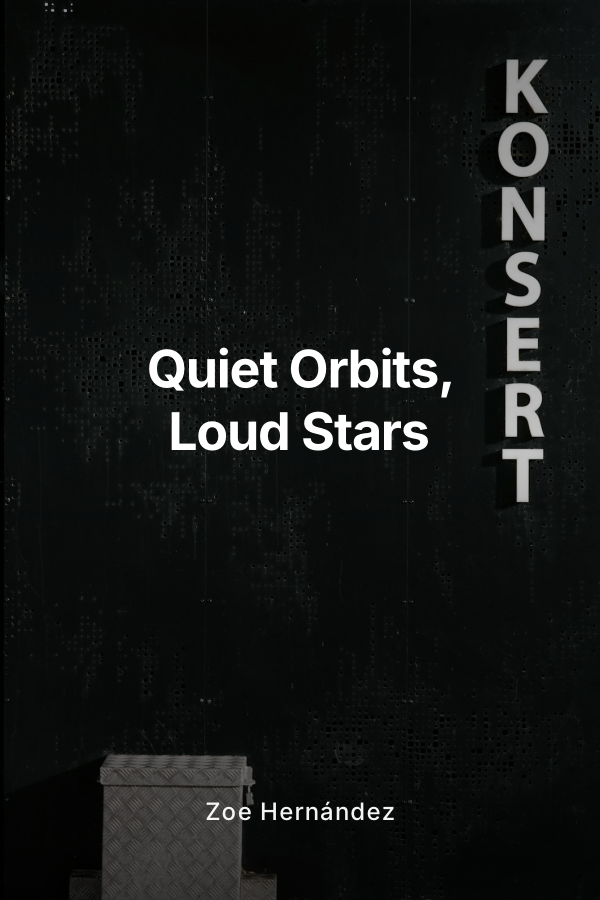
Quiet Orbits, Loud Stars positions Elliot and Nico as two points in space slowly drawing into mutual orbit. One shines with the steady glow of order and intellect, the other flares with the unpredictable brightness of laughter and impulse. Between them lies a slow, careful journey toward recognition: of self, of each other, and of the possibility that connection can exist in the space where logic and chaos intersect.
By the final pages, the book does not promise an easy future. Nico’s home life remains complicated, and Elliot’s perfectionism does not dissolve overnight. What it offers instead is a truthful snapshot of a formative time in their lives, when the first fragile threads of affection begin to weave across the gap between two very different boys. It invites readers to remember the first time someone’s joke echoed in their mind long after the laughter faded, and to recognize how brave it is, at twelve years old, to quietly decide that another person is worth the risk of being seen.