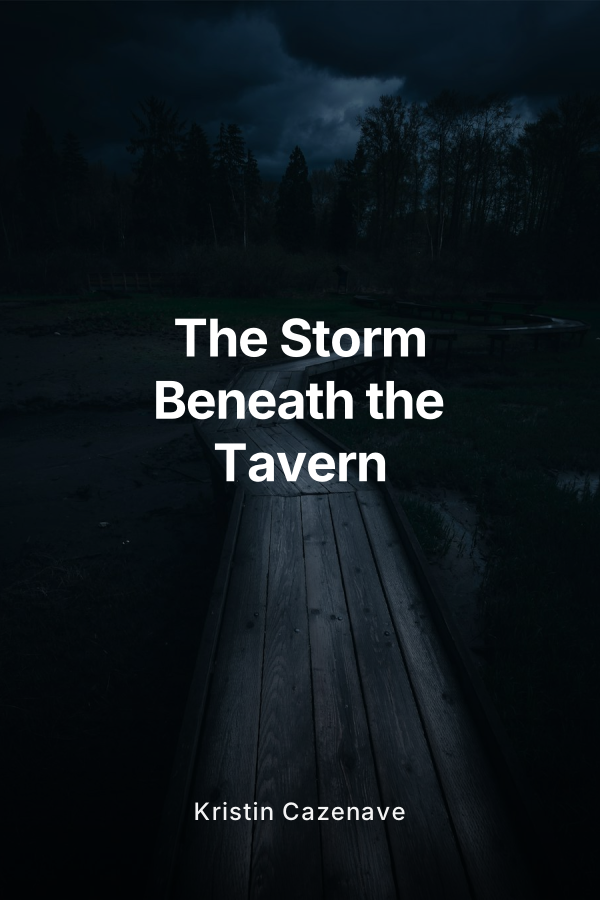
In a hidden cellar beneath a quiet Swiss tavern, an Air Force trumpet player named Kristin wakes into a nightmare of pain, terror, and impossible life growing inside her. The Storm Beneath the Tavern is an emotional and physical drama that blends claustrophobic sci fi horror with a story of unflinching male tenderness, as eleven men fight to keep their friend alive, present, and human when a secret experiment turns her body into a battlefield.
On temporary duty in Switzerland with the Air Force band, Kristin is the only woman in a tight-knit brass section that treats her like a sister and sometimes like the heartbeat of the whole unit. Her days are a blur of rehearsal rooms, laughter, and late night banter in the hotel lobby with Dave, Jacob, Luis, Tim, Jess, Chris, Andrew, Josh, Kevin, and their chief, Senior Master Sergeant Daniel. The opening scenes sketch an affectionate portrait of these friendships: inside jokes about missed notes, shared stories from deployments, and the easy comfort of teammates who have slept on the same hangar floors and marched on the same runways.
That comfort shatters when Kristin vanishes between evening chow and the next morning’s formation. The first chapter alternates between Kristin’s fragmented, sensory confusion as she is taken from the hotel and subjected to coldly clinical torture, and the men’s dawning panic when she does not appear at breakfast. What happens to Kristin is brutal but stripped of sexualization: she is restrained, assaulted with instruments, and injected with an experimental biotechnological compound developed by a clandestine local group whose research has moved far beyond ethical boundaries. She is left chained in a soundproofed cellar under a tavern, the first host to a forced, accelerated pregnancy with four engineered fetuses that will grow to term in a single week.
As Kristin’s memories break off into flashes of light, restraints, and invasive procedures, the narrative spends equal time on the men upstairs in the mountain town, their search radiating from confusion to dread. Each man’s voice emerges in turn: Dave’s nervous humor, Jacob’s analytical calm, Luis’s quiet worry, Tim’s impulsive anger, Jess’s careful observation, Chris’s stubborn optimism, Andrew’s quiet faith, Josh’s practicality, Kevin’s empathy, and Daniel’s strained leadership. Their banter frays as they canvas the streets, question locals, and confront the terrifying thought that one of their own has been deliberately taken.
Their search ends in the tavern, where an off detail and a fragment of sound guide them to a concealed door and down into the cellar. What they find there is not the Kristin they know but a hollow, unresponsive shell, eyes empty and body racked with waves of nausea and shock. She recoils from their touch, flinching and whimpering as if every hand were an instrument of pain. In this central discovery sequence, the novel leans into the men’s tenderness. They slow their movements, soften their voices, strip their uniforms of anything that looks like restraint. They call her by name, remind her of concerts and stupid jokes, and narrate every gentle action before they take it. Bit by bit, they break the panic’s surface and unbolt her from the wall, bracing her weight with care and murmured reassurance.
As they carry her into a small back room to wait for emergency services that never arrive, a mountain storm slams into the valley. Roads wash out, power fails, and they find themselves trapped with Kristin in the old stone building. Her vomiting grows more frequent, souring the room with the smell of bile and fear. None of them yet understand that her nausea and wrenching cramps are the first signs that the injected fetuses are accelerating through early development.
A local doctor, summoned before the storm cuts off the town, manages to reach them. His careful exam of the unconscious Kristin becomes a pivotal moment in the book. Using portable equipment and practiced hands, he discovers the unimaginable: she is pregnant with four fetuses whose growth curve looks impossible, their heartbeats too strong and too synchronized for a normal gestation. He shows the scans to Daniel and, behind a closed door, struggles to explain what he sees. The chief listens with clenched jaw and wet eyes as the doctor lays out the grim projection. Within a week, Kristin’s body will be stretched to term with quadruplets that were not conceived but installed, engineered to grow at a punishing pace.
When Daniel relays the truth to the rest of the men, the group fractures emotionally. There is rage, guilt, denial, and a crushing sense of helplessness. But the storm outside and the strange behavior of the tavern’s absent owners hint that this is no random crime. Through the doctor’s guarded admissions, they learn fragments about a shadowy bioscience group operating in the region, a network that may still have eyes and ears in the town. The men realize they cannot rely on outside rescue. All they can do is protect Kristin, hour by hour, breath by breath, while waiting for a break in the weather.
The second chapter deepens the emotional and physical ordeal. As days pass and the fetuses reach full gestation in an impossible week, Kristin drifts in and out of consciousness. Her dreams are skewed memories of torture and band life spliced together, chords and screams blending into the same sound. When she surfaces, she is terrified, wracked with morning sickness, and disoriented by the rapid swell of her belly. She does not remember the injection or understand what is happening to her body. The men surround her with patience, repeating explanations she rarely manages to hold on to, holding her hair as she vomits, lifting cups of water to her lips, and talking her through each wave of cramping as if it were another tough rehearsal set.
Short flashbacks break the claustrophobia: Kristin laughing on a bus after a concert, correcting Jess’s embouchure, trading solos with Dave, arguing with Daniel about tempos. These glimpses of who she was sharpen the contrast with who she is now - frail, apologizing for every sound she makes, ashamed of needing so much help. She tries to cook for the men or insist they sleep while she watches the door, but simple movements exhaust her. The men, in turn, refuse to let her apologize. One by one, they tell her she is their mission now, that they will not let her stand alone in this.
Around them, the tavern creaks with the storm and with other, stranger noises. Footsteps scrape above at odd hours. A door closes somewhere they cannot reach. Voices murmur in a language the Americans cannot quite make out. The secret bioscience group remains unseen, a constant, eerie presence that adds a layer of dread to each contraction and each failed attempt at radio contact.
When the fetuses reach full term, Kristin’s body finally stills into a fragile equilibrium. Her belly is enormous, her skin tight and bruised with strain, but the worst of the early sickness passes, allowing brief moments of calm connection. She can now hold a conversation for more than a few sentences, lean her head against Kevin’s shoulder, laugh weakly at one of Chris’s jokes. The men, in turn, have learned the rhythms of her new body - the way she curls when a contraction twinges, the slackness that signals a rare moment of relief.
Then the early contractions begin. At first they are sporadic, a tightening that makes her pause while stirring a pot or folding a blanket. Kristin tries to hide them, unwilling to be more of a burden, but the men notice her unsteady pacing, the way her breath hitches as she grips a table or a wall. They respond with quiet organization: someone takes her elbow; someone else starts timing the gaps; another rearranges bedding on the floor. Their voices remain calm even as their eyes betray exhaustion and fear.
The final chapter is an extended, harrowing account of Kristin’s drawn out labor in the storm locked tavern. Over several days, she paces, rests, moans, and curls into herself while her body struggles to bring four engineered lives into the world. The narrative shifts frequently between her internal experience - a blur of pain, panic, and intrusive flashbacks to the experiment - and the men’s outward attempts to ground her. They sleep in shifts beside her, hold her hands when each contraction hits, knead her hips and lower back to ease the pressure, offer sips of water between retches, and repeat an endless litany of encouragement: You are not alone. We are here. You can do this. You do not have to be strong by yourself.
When the urge to push finally comes, Kristin is already burned out. She sobs that she cannot do it, terrified that her body will tear apart under the strain, but her muscles bear down regardless, stealing her words and turning them into guttural cries. The men, many of whom had never been this close to birth before, have to improvise. Guided by the doctor’s instructions and hazy memories of childbirth classes their partners once attended, they coach her through breathing and bearing down, using the same language they once used in endurance training but gentled almost beyond recognition. Hours blur into one another, until at last the first baby arrives, tiny and wailing.
The sequence repeats with relentless intensity: waves of pain, declarations that she is done, the men’s shattered yet steady support, another baby born. Each time, Kristin grows weaker, her voice reduced to a hoarse rasp. She trembles as she lets the men guide a newborn to her breast, her eyes closing even as instinct and duty to the tiny life tug at her. The men cradle the babies with a reverence that borders on awe, their uniforms stained with sweat, tears, and the tangible evidence of birth.
By the time the fourth child crowns, Kristin has almost nothing left to give. She rests her forehead against the broad chests of the men around her, begging them to make it stop, apologies spilling out between contractions. Her teammates answer those apologies with fierce, quiet devotion. They tell her she has nothing to be sorry for, that she has already done the impossible three times, that they believe in her even when she does not believe in herself. Gently, they shift her into positions that give her gravity as an ally, supporting her thighs, her back, her shaking shoulders. With their help, with her last reserves of strength, the final baby is delivered. Kristin lets out a heavy sigh, unclenches her fingers from the hand she had been gripping, and loses consciousness, her face still etched with lines of pain and effort.
The novel closes not with rescue but with a fragile ceasefire. The storm begins to break, but the roads are still blocked. The unseen bioscience group may yet be close, listening behind thin walls. In the cellar, amidst blankets and makeshift cradles, four newborns sleep and squirm. The men move softly around Kristin’s still form, wiping her brow, adjusting the babies on her chest, whispering their gratitude and admiration into the dim air even though she cannot yet hear them. They are exhausted, traumatized, and still in danger, but united around a single conviction: they will not let what was done to Kristin define the rest of her life or the lives of these children.
The Storm Beneath the Tavern is, at its heart, a story about what it means for a group of men trained for discipline and precision to step into a role of radical gentleness. It explores how trust can be shattered and patiently rebuilt, how bodies can carry both horror and hope, and how loyalty can hold when every external support has fallen away. In the echoing quiet after the storm, Kristin and her team are not healed, but they are together, scarred and still standing, hands linked around four fragile new lives that should not exist and yet, unmistakably, do.