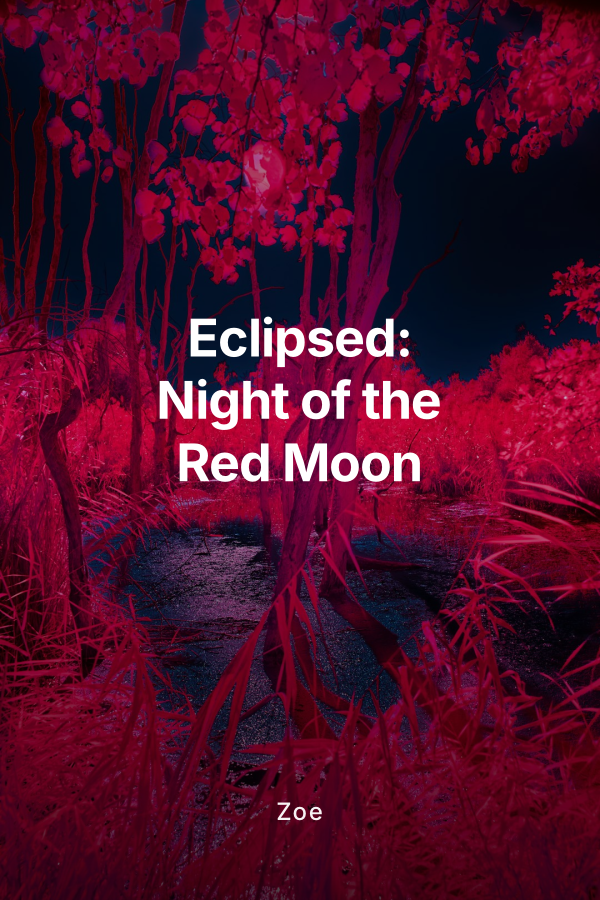
Chapter 1: The Bus Ride Into Omen
Fynlei Nurise has always lived like a spark meant to become a wildfire. Fierce, funny, quick to act, and stubbornly self-reliant, she wears confidence like armor and keeps her deeper fears buried beneath bright jokes and reckless courage. Her younger twin brother, Kyan, sees through her better than anyone, while her best friend River, brilliant and indecisive, has always been the one person who can slow her down when the world begins to tilt. When rumors spread of a red moon rising during their senior graduation trip, Fyn’s instincts sharpen into dread. She sees patterns no one else notices, feels the air thickening with a pressure that is almost prophetic, and warns everyone to stay inside during the strange hour when the eclipse will peak.
But warnings are only as strong as the trust behind them, and Fyn has spent too much of her life believing that being strong means carrying danger alone. On the bus to camp, time warps in sickening ways, the windows flicker with impossible reflections, and Fyn begins to see hallucinations so vivid they feel like memory or warning. The trip itself becomes the first test of a larger truth: something celestial is bending reality, and the forest camp waiting at the end of the road is no ordinary school getaway. The atmosphere turns hushed and brooding, as though the land itself is holding its breath. Fyn arrives already frayed, already defensive, and already certain that something is terribly wrong.
At camp, the staff are welcoming, but one of the nature guides unsettles her immediately. The woman smiles too carefully, speaks too softly, and seems to notice Fyn a little too much. Fyn decides not to say anything, not even to River, telling herself she is only being paranoid. Yet the silence costs her, because the camp is not merely unsafe, it is occupied. By the time she understands that the staff are actually evil clones sent by a hidden enemy, the horror has already begun to unfold. The graduation trip has become a trap, and the first night under the red moon is only the beginning.
Chapter 2: The Wrong Kind of Trust
Fyn finally confesses her fears to River, who is hurt that she kept him out of the truth but chooses concern over resentment. Their partnership becomes the beating heart of the story as they begin piecing together the clone conspiracy, using River’s careful logic and Fyn’s instinctive bravery to shape a plan. He thinks through possibilities until he nearly paralyzes himself, and she leaps before she has fully weighed the danger. Their friendship, long familiar and deeply rooted, starts to gather dangerous warmth as crisis strips away the ordinary distance between them. In the fear and confusion, every look lingers longer, every touch matters more, and every moment of mutual protection reveals feelings neither of them has fully named.
Yet the deeper they dig, the more the truth twists. Fyn discovers that one of the people she trusts most, her older adoptive sister Ophelia, is speaking privately with the lead clone. The revelation shakes her nearly apart. She tries to protect Ophelia, but Ophelia turns the moment into an act of survival, commanding Fyn to run before the clone can strike. It is a brutal lesson in the cost of misjudgment and the danger of believing that love alone can keep people safe. Fyn’s desire to protect her family becomes the very thing that drives her out into the forest, hunted and uncertain, carrying the ache of betrayal in her chest.
Alone in the vast woods, Fyn begins to understand that her greatest weakness is not her anger or her recklessness, but her refusal to let anyone share her burden. She has spent so long acting as if dependence is failure that she has turned vulnerability into a threat. The forest answers her isolation with silence, then with pursuit. Shadows move through the trees, the moon hangs like a wound in the sky, and the camp’s cheerful graduation dreams rot into something older and crueler. Somewhere in the dark, the real staff are still missing. Somewhere else, the clones are hunting. And the red moon keeps rising.
Chapter 3: The Cave and the Truth Beneath the Surface
Fyn finds shelter in a cave hidden among the forest’s roots and black stone. The space feels ancient, pressed with damp silence and the faint taste of old earth. Inside, she discovers the original staff of the park, alive but in hiding, and the truth they offer reshapes the entire conflict. They have been hunted, displaced, and nearly erased by the clone infiltrators. What Fyn assumed was a local threat is actually part of a much larger celestial corruption, one tied to modality magic, ancient cycles, and the kind of prophecy people are foolish enough to ignore until it starts devouring them.
These hidden survivors challenge Fyn in ways no enemy has managed to. They force her to listen, to wait, to cooperate, and to accept that bravery without strategy is only another form of self-destruction. Slowly, she begins to work with them, and the cave becomes a place of reluctant alliance, shared grief, and hard-earned trust. Fyn starts to see how badly she has been clinging to the fantasy of being enough on her own. The story’s road-trip energy fades into survival horror as the group prepares to move through the forest, evade the clones, and protect the scattered students before the red moon event fully manifests.
Their escape turns tragic when one of the staff sacrifices herself so the others can flee a clone attack. The loss lands hard and immediate, forcing Fyn to confront the consequences of every choice she made to keep others at a distance. For the first time, her grief is not abstract or hidden behind determination. It is raw, communal, and impossible to outrun. River’s absence from her side makes the ache worse, and her instinct to solve everything alone begins to collapse under the weight of what it has already cost. In the darkness of the cave and the violence outside it, she starts to understand that survival may require something she has always feared: asking for help.
Chapter 4: The Trap in the Forest
Determined to reunite the scattered campers, Fyn devises a magical SOS signal, a celestial beacon meant to call allies through the thickets of the vast forest. The idea feels like a turning point, a long-awaited victory over chaos. When someone responds, she believes the tide may finally be turning. She thanks the surviving staff, follows the signal, and enters the next stage of the nightmare with renewed hope. But the red moon has been waiting patiently, and hope is only ever another shape danger can wear.
The beacon is a trap. Fyn arrives to find the lead clone holding Kyan hostage, and the revelation detonates every fear she has spent the story swallowing. Kyan, who she has always tried to shield, is now the one most at risk, and the sight of him in enemy hands tears through her restraint. Her anger surges with the force of a storm, and the volcanic energy of Haleakala answers her emotions with devastating power. The eruption throws the forest into fire, turning ash into screaming light and transforming the campgrounds into a battlefield of smoke, falling embers, and panic. The clones are wounded but not destroyed, and they vanish with threats of return that sound less like promises and more like destiny.
This is the moment where Fyn’s dependence issues, her protective instincts, and her guilt all collide. She has fought so hard to be the lone defender that she nearly becomes the source of the disaster. The fire she unleashes is both a manifestation of her fury and a warning about what happens when celestial magic is guided by panic instead of trust. In the chaos, her relationship with River shifts again. He is not just the boy who worries over every decision anymore. He is the one who keeps showing up, even when she pushes him away, and the one whose steady care starts to feel like the safest place in the world.
Chapter 5: Blue Fire and the Red Moon
After the eruption, the survivors regroup outside the campgrounds, where the wreckage of the night glows with supernatural residue. Fyn is burned and exhausted, shaken by guilt and by the terrible possibility that her impulsive choices may have endangered everyone she wanted to save. Kyan finds her there, and what happens next changes the shape of the story. He heals her burns with blue fire, a mysterious power that does not fit the life he was supposed to have lived. The same blue flame appears again when Fyn’s rage finally begins to settle, extinguishing the fire she caused and revealing that the magic binding the twins is deeper, stranger, and far more dangerous than anyone knew.
The revelation is not just that Kyan has powers, but that his supposed powerlessness was an illusion, or a protection, or perhaps the result of a hidden celestial design waiting for the right catastrophe to awaken it. This becomes the book’s final, haunting turn. The red moon event was never only about Fyn’s leadership or River’s careful brilliance. It was a threshold. A test. A signal that the family trauma Fyn has carried, especially the wound tied to Kyan, is part of a much larger pattern. Somewhere behind the clone invasion and the corrupted staff, a greater cosmic force is moving pieces across the board, and the twins may be central to whatever comes next.
Fyn and River survive, but not unchanged. Their friendship has become something tender and dangerous, shaped by mutual fear, shared rescue, and the first fragile edges of love. Neither of them says everything out loud, but the quiet between them is no longer empty. It is charged with what could become. Fyn learns that vulnerability is not the opposite of strength, and that leadership does not mean isolation. She also learns that protecting the people she loves may require trust, not martyrdom. The final image of the story leaves the red moon hanging over a damaged world, Kyan’s blue fire glowing in the dark, and the promise that the next chapter will demand even more courage than the last.