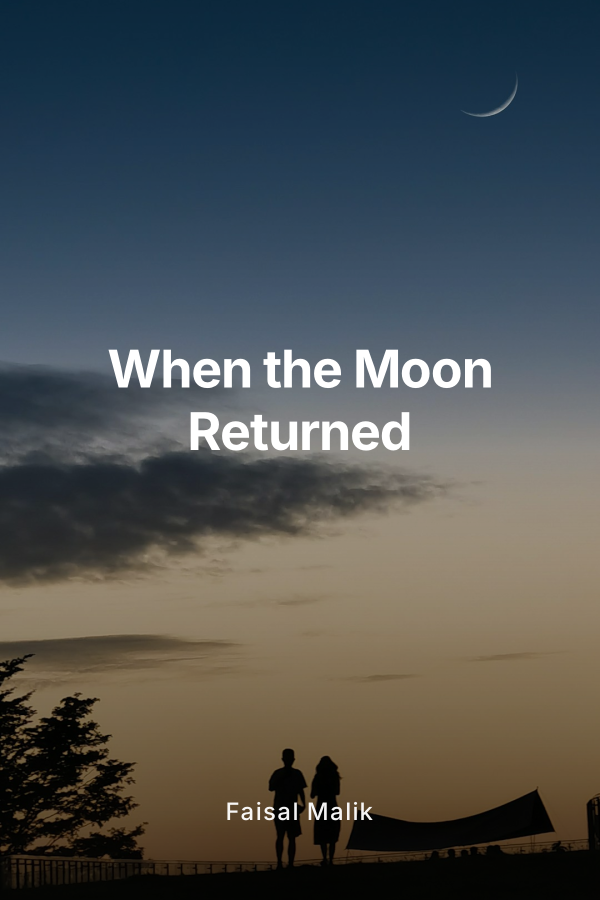
This story is a young adult romantic tragedy shaped by distance, longing, emotional misalignment, and the kind of heartbreak that does not end in one night. It follows Musa and Amna, whose connection begins quietly when Amna texts him on his seventeenth birthday, a small act that opens the door to a bond neither of them fully understands at first. The emotional direction, tone, and key plot points of this summary are drawn from the provided conversation context, including the request for a realistic but poetic style, the centrality of long distance calls and texts, the Eid meeting in Pakistan, the second meeting over a meal, Musa’s hospitalization from chest pain and stress, the shouting incident, the breakup, and the final image of Musa shattered yet smiling in public
At its heart, the book is not only a love story. It is a story about timing. About how two people can be sincere and still destroy each other without ever truly meaning to. About how love can arrive unevenly, with one heart opening too early and the other too late. It is also about the private violence of grief, especially the kind that cannot be explained to family, friends, or the world. Musa becomes the emotional center of the tragedy, not because he is flawless, but because he is painfully human. He rejects love before he understands his own need for it, and by the time he finally holds it with both hands, it is already slipping away.
The book opens in the fragile season of youth, where feelings bloom quickly but carry the weight of forever. Amna lives in Pakistan. Musa lives in the United Kingdom. Their worlds are separated by geography, routine, and the invisible barrier between two people who are growing into themselves from different skies. Yet when Amna messages him on his seventeenth birthday, something immediate begins. It is not dramatic at first. It is made of conversations, curiosity, warmth, and the kind of emotional closeness that forms in messages exchanged after midnight, in laughter shared through screens, in the habit of checking whether the other person is awake.
Amna is the first to fall deeply, and she falls with courage. She does not hide behind pride. She confesses what she feels, once, then again, then again, and then a fourth time. Each confession reveals not foolishness but devotion. She sees something in Musa worth waiting for, worth risking embarrassment for, worth returning to even after being turned away. But Musa refuses her every time, not because he enjoys withholding love, and not because he is untouched by her affection, but because he believes he will fail her. He thinks he will not be able to love her enough. There is sincerity in his rejection, but sincerity does not lessen the pain. In trying not to wound her in the future, he wounds her in the present.
This repeated refusal becomes one of the most important emotional structures in the story. It teaches Amna endurance. It teaches Musa avoidance. It also lays the foundation for the cruel irony that will define their future. She is the one who knocks for a long time at a closed door. He is the one who eventually opens it just as she begins to grow tired of waiting. The summary makes clear that the emotional momentum of the novel depends on this reversal, because it is not only the breakup that hurts. It is the fact that their love is never alive in the same shape at the same time.
Over time, through persistent communication, vulnerability, and the tenderness that accumulates in ordinary moments, Musa begins to soften. He learns to trust her presence in his life. He starts to depend on her voice, her messages, her patience. He notices that she has become part of his routine, then part of his peace, then part of his future. Before he even fully admits it to himself, he has begun to love her. By the time they officially enter a relationship, it happens before his trip to Pakistan, and with it comes a new certainty between them: they are no longer only dreaming. They begin to believe they truly want a future together, a detail specifically emphasized in the user’s original concept
This transition from uncertainty to commitment marks the first emotional peak of the novel. Their relationship becomes filled with long distance intimacy. The calls stretch late into the night. Their chats become a second home. Every silence carries meaning. Every delayed reply causes ache. They build a private world with language, inside jokes, reassurances, plans, and promises. Because they are separated by countries, words become their touch. Distance intensifies everything. A good conversation feels like survival. A missed call feels like abandonment. The story uses this emotional architecture to show how long distance love can be both beautiful and unbearable at once.
Then comes Eid, and with it, Musa’s visit to Pakistan. This part of the story carries a shift in texture. What was once imagined becomes physical. The first meeting is charged with awkwardness, hope, tenderness, and disbelief. They are no longer only two names on a screen. They are real to each other in a way that changes everything. The Pakistan setting matters because it is not simply a backdrop. It ties love to culture, family rhythms, memory, festivity, and the emotional brightness of Eid. The joy around them makes their private happiness feel larger, almost sacred, as if the world itself is allowing them a brief season of certainty.
Their meeting confirms what distance had only suggested. They do not merely like each other. They belong, or at least they believe they do. They begin to speak of the future not as fantasy but as intention. In these scenes, the emotional tone is soft and luminous. Musa, who once feared he could not love her enough, now finds himself undone by how naturally love comes when he is finally beside her. Amna, who waited through four rejections, feels that all the waiting was worth it. For a brief and shining period, the story allows them to inhabit happiness without interruption.
But the summary especially highlights the second meetup, where they eat together and Musa cannot stop admiring her every time he looks at her. This is one of the most intimate memories in the story’s design, because it is not built on grand declarations. It is built on attention. The way he watches her. The way ordinary gestures become unforgettable because they are seen through love. A shared meal becomes a private universe. He memorizes the way she exists before him. The scene captures the tragedy of later loss by making the tenderness so specific that the reader understands exactly what Musa will spend the rest of the story mourning. According to the user’s request, this second meeting is meant to be a major emotional highlight, a place where affection is no longer uncertain but fully embodied
After he returns, the emotional balance begins to change. Musa’s attachment deepens beyond language. He misses her with a force that frightens him. He starts measuring his days by her presence. His love, once delayed, now floods him too completely. Yet at the same time, Amna begins slowly to lose feelings. Not all at once. Not cruelly. Not with betrayal. It is a fading rather than a rupture. Distance that once felt romantic begins to feel tiring. Emotional effort becomes heavier. The relationship that she fought so hard for starts asking more from her than she can continue to give. The tragedy here is quiet. She is not heartless. She is exhausted.
This imbalance creates the second great engine of heartbreak in the novel. Musa is now where Amna once was. He is the one full of certainty, fear, need, and devotion. She becomes the one pulling away, confused by her own emotional retreat, perhaps even guilty for it, but unable to force her heart back into what it used to be. The story understands that fading love can be as painful as rejection, especially when the person leaving once begged to stay. The irony is devastating. The same girl who once asked four times to be chosen is now the girl who can no longer remain.
As this emotional shift unfolds, Musa’s external life also begins to collapse under pressure. He is dealing with job stress, health issues, and exams all at once, details that the user explicitly required as major plot elements The novel uses these pressures not as excuses but as weight. Musa is becoming overwhelmed in every direction. His body begins to reflect what his heart and mind cannot carry. Stress is no longer abstract. It manifests physically, emotionally, and relationally. He is tired, frightened, stretched too thin, and unable to regulate himself properly. The person who once found relief in Amna now begins to fear losing the one thing that helps him breathe.
Then comes one of the darkest turning points: Musa is hospitalized on his eighteenth birthday because of chest pain and stress, an image specifically preserved in the source material as central to the emotional arc This moment transforms the novel from tragic romance into something more raw and intimate. Birthdays usually symbolize becoming, celebration, youth stepping forward. Here, his eighteenth birthday becomes a scene of fragility, monitors, worry, and emotional isolation. It is especially heartbreaking because he is standing on the threshold of adulthood only to find himself physically unwell, mentally burdened, and emotionally unstable. The world around him continues, but his own life feels suspended between panic and numbness.
The hospital sequence is crucial because it reveals how much Musa is already breaking long before the official breakup. It also deepens the reader’s understanding of his later actions. He is not only in love. He is deteriorating. The chest pain becomes symbolic of everything he cannot say properly. The stress is not only about work or exams. It is about the terror of losing the person he finally allowed himself to need. The summary suggests that the hospital scenes should feel claustrophobic, heavy, and painfully lonely, with Musa trying to stay composed while his inner world frays.
Under all this pressure, the inevitable fracture arrives. Musa shouts at Amna. This moment matters because it is not presented as romanticized anger or proof of passion. It is a breach. A serious failure. A wound in the relationship that changes how safe Amna feels with him. The user made clear that this is the scene after which Amna begins to truly pull away, and that the emotional focus should remain on how she loses interest and trust after being shouted at In the structure of the story, this is the moment where private pain becomes irreversible damage. Love can survive distance. It can survive miscommunication. But once fear enters, the shape of the relationship changes.
Amna’s response is not explosive. It is devastating precisely because it is measured. She decides to break up with him. When Musa tries desperately to hold on, she tells him that she no longer feels safe with him anymore and believes that if she stays, she will suffer. This line becomes the moral center of the separation. It is not about a lack of history. It is not about forgetting what they had. It is about self-preservation. She recognizes that whatever tenderness once defined them no longer protects her. The breakup is therefore not just a romantic ending but an emotional verdict. She is choosing distance over damage.
For Musa, this is annihilation. He tries everything to convince her. He pleads, explains, regrets, promises. He wants one more chance, one more conversation, one more way to undo the moment that cannot be undone. But heartbreak in this story is not solved by sincerity after harm. He may truly love her. He may truly be sorry. He may truly be unraveling. But Amna cannot trust her peace to someone whose pain has already spilled over onto her. The novel refuses easy reconciliation. That refusal is part of what makes it emotionally honest.
At this point, the entire story folds back on itself with painful symmetry. Once, Amna was the one asking to be chosen while Musa said no for her own good. Now Musa is the one asking her to stay while Amna says no for her own safety. In both cases, love is denied in the name of protection. In both cases, the person being left behind suffers anyway. This parallel gives the novel a tragic elegance. It suggests that fate did not simply separate them. Their own emotional patterns did. Their love failed not because it was fake, but because it matured out of sequence and collapsed under the weight of timing, stress, fear, and injury.
After the breakup, Amna returns to life. She continues her normal routine, another detail the user specifically wanted emphasized in contrast with Musa’s devastation Her ability to keep moving does not necessarily mean she never cared. Rather, it sharpens Musa’s isolation. From his perspective, the world’s continuity feels unbearable. How can mornings still arrive? How can conversations still happen? How can she continue, while he remains trapped in the ruins of what was once his center? The story does not vilify her for surviving. Instead, it shows how survival itself can feel cruel to the one left behind.
Musa becomes a portrait of concealed collapse. Publicly, he smiles. He laughs with family. He keeps himself busy. He performs normalcy so well that no one fully sees the wreckage. Privately, however, he is fully shattered, exactly as the user requested This duality is the emotional signature of the ending. Musa does not become dramatically self-destructive in visible ways. He becomes quiet. Hollow. Functional on the outside, ruined on the inside. The sharpness of the tragedy lies in that concealment. The people around him may call him strong because he still smiles. But the reader knows those smiles are survival masks stretched over grief too deep for tears.
One of the most haunting requested images is that Musa tries to cry every night, but even his tears have abandoned him This detail elevates the ending from sadness to desolation. He does not even receive the mercy of release. His body, exhausted by stress and sorrow, withholds the one thing that might soften the pain. He becomes a boy stranded inside his own silence. The cliffhanger ending does not offer closure. Instead, it leaves him suspended in emotional aftermath, still living, still functioning, but no longer whole. The reader closes the summary knowing that the breakup was not the end of his suffering. It was only the beginning of a more private, more enduring loneliness.
Stylistically, the full book would unfold as a poetic but realistic young adult novel, exactly in line with the user’s stated preferences for heavy emotional scenes, long distance intimacy, and a heartbreaking conclusion It would not depend on melodrama alone. Its power would come from emotional precision: unread messages, the memory of shared meals, the contrast between two birthdays, the cruelty of delayed love, the silence after a call ends, the way one angry moment can poison months of tenderness, and the unbearable ache of watching someone become a stranger while you still love them as home.
Thematically, the book explores several intertwined truths. First, love is not always enough when timing is wrong. Second, emotional honesty does not automatically prevent harm. Third, being loved deeply by someone does not guarantee that they can love you safely. Fourth, heartbreak is not always loud. Sometimes it looks like a boy smiling through dinner with his family while something inside him has already ended. Finally, the novel asks whether some relationships are destined not to fail because the love was weak, but because it arrived in different seasons within each person.
In summary, this is the story of Amna, who loved first and waited longest, only to lose her feelings when the relationship became too heavy, and of Musa, who refused love until he could no longer live without it, only to lose it when he finally understood its worth. Their romance stretches between Pakistan and the UK, between seventeenth and eighteenth birthdays, between Eid lights and hospital walls, between whispered promises and a single shouted wound. They meet, they hope, they imagine forever, and then life enters with stress, illness, exhaustion, and emotional fracture. She walks away to protect herself. He lets her go because love, at its most tragic, sometimes means accepting that remorse cannot rebuild safety.
The cliffhanger ending leaves Musa not dead, not healed, not transformed, but still here. Still smiling. Still answering people gently. Still pretending the days are ordinary. Inside, everything has already fallen apart. He lies awake at night in the aftermath of a love he once feared he could never return enough, only to discover that when he finally loved with his whole heart, it was too late. And somewhere in that silence, the reader is left with the most painful question of all: if two people can love each other truly, but never at the right time, was losing each other always inevitable?