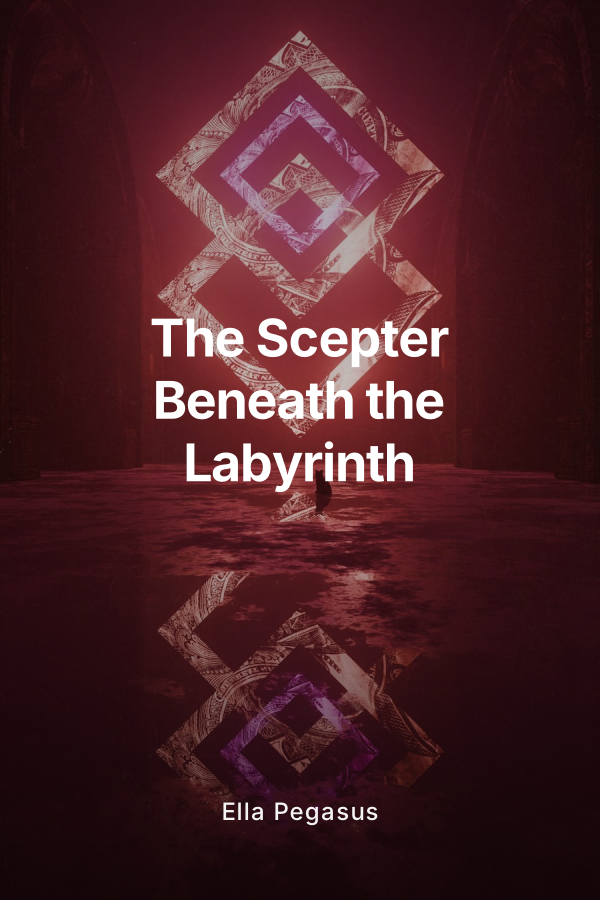
In a world where power is seized through blood, dark magic, and the breaking of human will, two nineteen-year-olds are dragged into the heart of a nightmare that will test not only their endurance, but the very meaning of devotion. Chase and Violet, newly captured and locked inside a small prison cell where cold stone and a single bed become the boundaries of their suffering, are separated, watched, and used by a man whose cruelty knows no shame. Ignatius, a despicable older captor obsessed with recovering a lost scepter hidden deep within Boyd’s labyrinth, believes pain is the purest path to obedience. He underestimates only one thing: the terrible strength of love when it is cornered, humiliated, and given no place to go but deeper into the soul. The story’s central setup, characters, dark tone, prison setting, and focus on power are established in the provided context
At the center of the book is Chase, a young man who has learned that survival sometimes looks like silence. He does not want Ignatius to see his true feelings, because feeling itself has become dangerous. Outwardly, he tries to remain hard, controlled, and unreadable. Inwardly, he is screaming. The moment that defines him is not one of heroic triumph, but one of helpless witness. He watches the woman he loves, his fiancée Violet, violated by the man who holds them both captive, and something inside him begins to collapse. The novel follows that collapse with painful intimacy, not to glorify brutality, but to explore how love can become both a wound and a reason to keep breathing. Chase’s emotional arc is shaped by reluctant submission, private breakdown, silent crying, numbness, and sheer hopelessness, all specifically requested as the emotional core of his perspective
Violet, also nineteen, is introduced as deeply depressed and stripped nearly bare of hope. Yet the summary reveals that her brokenness is not emptiness. Beneath her trauma is a quiet emotional truth that becomes essential to the heart of the book. She is not portrayed as a symbol, but as a person trying to remain present inside unbearable violation. Her responses are small, fragile, and devastatingly human. When Chase begins to drown in guilt, convinced he has failed her, Violet becomes the one who answers from within her own ruin. Her softness is not weakness. Her words, few and trembling, carry the kind of grace that can only exist between two people who have loved each other long before the prison cell reduced their world to fear. In one of the book’s most emotionally defining exchanges, Chase struggles under the weight of I failed you, and Violet answers with the truth that keeps him from breaking completely: it is not your fault, it would have happened anyway. That emotional beat, including guilt, apology, whispered promises, and choosing to survive for each other, comes directly from the provided story direction
Ignatius is the embodiment of power without conscience. At forty-five, he is not merely cruel, but profoundly selfish, a man who treats suffering as currency and intimacy as a weapon. His desire for the scepter hidden in Boyd’s labyrinth gives the plot its external engine, but his deeper function in the story is more intimate and sinister. He is determined to uncover Chase’s weakness, to prove that love can be turned into a leash. He studies Chase not simply to punish him, but to map the exact shape of his devotion to Violet. Once Ignatius recognizes that Chase will surrender almost anything to spare her pain, he begins to weaponize that discovery with smug threats, mockery, and promises to use Violet as the instrument through which Chase will be controlled. This role for Ignatius, and his intent to expose Chase’s weakness through Violet, is directly grounded in the context provided by the user and captured in the uploaded file
The summary unfolds across a dark fantasy romance in which the prison cell is both literal and symbolic. It is a place of confinement, but also a chamber where identities are stripped raw. The bed, the stone, the stale air, and the dimness become mirrors for Chase’s emotional state. He is trapped not only by bars and walls, but by the knowledge that every choice he makes seems to feed Ignatius’s power. The setting remains intentionally tight and claustrophobic, emphasizing a story less interested in sweeping landscapes than in the internal wilderness of grief, fear, and loyalty. Even the mention of Boyd’s labyrinth serves not only as a fantasy element, but as an external reflection of the inner maze Chase must navigate: obedience or rebellion, silence or confession, endurance or collapse. The context file explicitly frames the story as a dark English-language fantasy romance in prose, focused on the theme of power and largely told in third person from Chase’s perspective
The main plot turns on a secret Chase has been guarding for years. Ignatius wants the location of his scepter, hidden deep in Boyd’s labyrinth, and after seeing Violet harmed, Chase finally gives up the information Ignatius has long sought. Yet even in submission, Chase clings to one final concealed truth. He tells Ignatius where the scepter lies, but not that he alone can retrieve it. This lie is not born from strategy alone. It is the last remnant of agency available to him, a desperate, fractured attempt to preserve some piece of control in a world where everything else has been taken. When Ignatius uses dark magic to reach the labyrinth and return far sooner than expected, enraged by failure, the deception detonates. He comes back not defeated, but furious. The consequences are immediate and intimate. Chase is punished physically, not simply because he withheld information, but because Ignatius now understands that pain to Chase’s own body is secondary. The true leverage lies elsewhere. These exact beats of the chapter plot, including the scepter in Boyd’s labyrinth, Ignatius’s dark magic, his failed retrieval, his return in anger, and Chase’s withheld truth that only he can retrieve it, are all contained in the provided story materials
From there, the emotional center of the book sharpens into something even more haunting. Ignatius ensures that Chase can hear Violet suffering again next door. The choice is calculated, designed to unmake him. Chase’s strength, once rooted in endurance and refusal, begins to soften into private devastation. This softening does not erase who he is. It reveals what love has cost him. He obeys not because he has become weak, but because witnessing Violet’s suffering has shattered the protective wall between endurance and despair. The summary traces this transformation carefully: a strong young man discovering that there is a kind of agony more unbearable than his own pain, and that once a captor understands this, resistance becomes almost impossible to separate from sacrifice. The user specifically requested that the story show how someone strong can suddenly become soft when the person they love most is harmed, and that Chase’s softening appear through private breakdown and obedience intended to protect Violet
Despite the darkness, the book’s deepest thread is romantic. Not romantic in the sense of safety or sweetness, but in the fierce, wounded bond between two people who choose each other when there is almost nothing left to offer but presence. In the aftermath of violence, Chase and Violet are given moments that are quiet rather than grand: shared silence, whispered promises, guilt exchanged like confession, apologies that cannot repair what has happened but still matter because they are spoken in love. Their bond is deepened not through escape or victory, but through mutual recognition. They see each other at the lowest point of their lives and still choose not to turn away. That choice becomes the emotional promise of the larger novel. They may be crushed, but they remain bonded. They may be stripped of certainty, but they still try to survive for one another. The user’s requested bond moments, including silent comfort, whispered promises, mutual guilt and apology, and a choice to survive for each other, are explicitly reflected in the source context
A key theme running through the summary is power, and the book examines it in multiple forms. Ignatius embodies external power: physical dominance, magical ability, imprisonment, and sexual violence used as coercion. Chase carries hidden power through knowledge, through the fact that only he can retrieve the scepter, and through the emotional truth Ignatius both discovers and exploits. Violet, though outwardly stripped of control, represents another kind of power entirely: the power of tenderness in devastation, the refusal to let shame rewrite love, the ability to speak comfort even while wounded. The book asks difficult questions about whether power is possession, force, secrecy, endurance, or the simple act of choosing another person in the midst of ruin. It does not offer easy answers. Instead, it builds a dark emotional landscape in which every form of power carries a cost.
The fantasy element deepens as the hidden scepter and Boyd’s labyrinth begin to assume symbolic as well as practical meaning. The scepter is more than an object Ignatius desires. It represents legacy, dominion, and the illusion that enough magic can make a man untouchable. Boyd’s labyrinth, meanwhile, becomes a space of ancient danger and secret law, a place that does not yield itself to brute force alone. Chase’s unique ability to retrieve the scepter implies that his connection to this hidden world may be deeper than Ignatius realizes, planting the possibility that the young man who appears broken may still hold the key to a larger destiny. Yet the summary remains emotionally grounded. Even this fantasy mystery serves the relationship at the novel’s center, because Chase ultimately reveals the truth not from ambition, but from desperation to stop Violet’s suffering. That motivation, specifically identified by the user, defines the story’s moral and emotional stakes
As the projected full book develops across five chapters and approximately ten thousand words, the summary promises an intimate progression rather than a broad epic. The first movement establishes the capture, the cell, and the first irreversible wound inflicted upon Chase and Violet’s world. The second deepens the pressure around the secret of the scepter and the psychological war Ignatius wages to expose Chase’s weakness. The third centers on the failed retrieval from Boyd’s labyrinth and the violent backlash that follows, pushing Chase toward a point of emotional collapse. The fourth lingers in the aftermath, where the whispered bond between Chase and Violet becomes the only fragile structure still standing amid humiliation and despair. The fifth positions Chase’s revelation that he alone can retrieve the scepter as both surrender and turning point, suggesting that the path forward will force him to enter the labyrinth not merely as a prisoner, but as the one person tied to a power Ignatius cannot command outright. The developer instruction that the work be organized into five chapters and approximately ten thousand words informs this summary structure, while the user’s detailed plot request provides the emotional and narrative spine
What makes this story compelling is not the spectacle of cruelty, but the emotional contradiction at its heart. Chase is being broken, yet his love is becoming more visible. Violet is nearly emptied of hope, yet she still reaches for him in the only ways she can. Ignatius believes exposing vulnerability will lead to absolute control, but in doing so he also reveals the one thing he can never fully possess: the private, painful devotion that lives between two people who have chosen each other before the darkness arrived. The book summary promises a narrative of captivity and emotional survival, where romance is not an escape from horror, but the only light capable of existing inside it.
By the final tone of the summary, readers are left in a state of heartbreak and dread, but not emotional emptiness. The ending feeling is crushed but still bonded, exactly as requested. Chase and Violet are not safe. They are not healed. Ignatius has found Chase’s weakness, mocked it, and promised to use it again. The threat is now fully personal. Yet within that ruin, something essential remains alive. Chase, who wanted to tear out his own heart rather than continue feeling, instead discovers that feeling is the one thing tying him to Violet, and Violet, who has lost nearly all hope, still finds the strength to tell him that her suffering is not his sin to carry alone. Their love survives not as triumph, but as refusal. Refusal to stop caring. Refusal to let shame erase tenderness. Refusal to die inwardly, even while trapped inside a world built to consume them. This final emotional register, centered on heartbreak, Ignatius’s control, and fragile love surviving in ruin, is directly aligned with the user’s requested ending feeling and chapter intent
The Scepter Beneath the Labyrinth is, at its core, a dark fantasy romance about what happens when power tries to devour love and instead uncovers how deep love can root itself inside suffering. It is a story of forced submission, emotional collapse, whispered forgiveness, and the terrible cost of devotion in captivity. Its promise to readers is not comfort, but intensity: a harrowing, intimate journey through despair, where the bond between Chase and Violet becomes both the softest and strongest thing in the room.