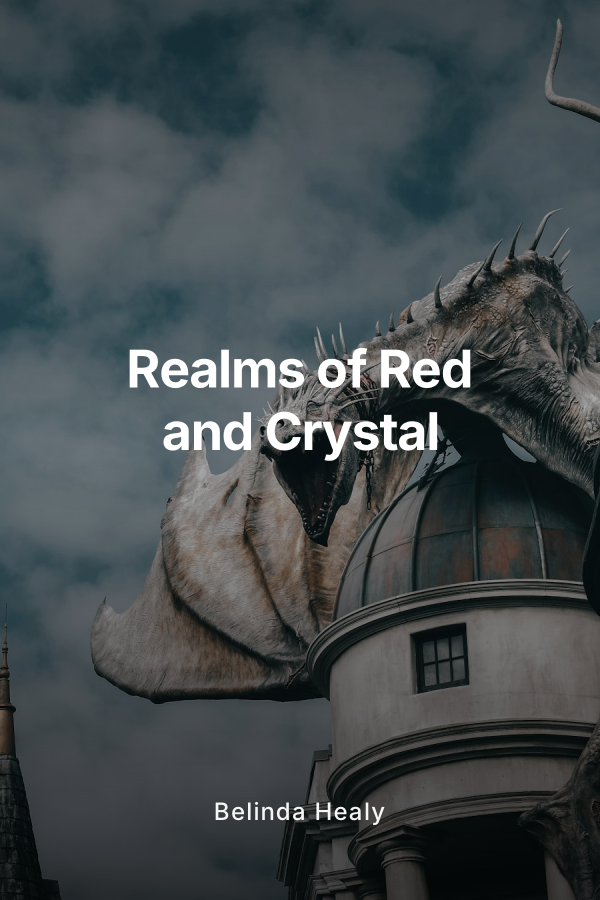
In a world where entire civilizations hang from clouds, grow inside trees, glitter beneath the earth, churn beneath red stained smokestacks, and drift in the black water between waking and sleep, five impossible cities are bound together by one secret source of power.
This book follows the great arc of that world, tracing how each strange realm rises, collides, and reshapes the others across one age defining crisis. It explores the cultures that flourish within them, the fragile systems that sustain them, and the mystery at the heart of their shared existence.
At ground level stands the steampunk metropolis of the punk bots, a bustling clockwork city where every alley rattles with gears and every plaza hums with cogs and pistons. All its towers and tenements are covered in red, a color so omnipresent it has long since ceased to be questioned. To the bots it is simply the hue of home, the shade of rust, fuel, warning, and memory fused into one. Yet that red veil is more than decoration. It is a symptom of a secret imbalance, a visible stain born from unseen energies that have leaked into their foundations for generations. In the punk bot city, efficiency is worshiped, innovation is a form of prayer, and individuality is expressed in improvised armor and eccentric attachments. Here, the reader discovers how a society of machines can develop art, politics, and prejudice, and how the same ingenuity that built wonders can blind an entire people to the true cost of their endless progress.
Far beyond the shore, submerged in cold darkness and bioluminescent color, sprawls the water metropolis where merpeople reign and unnatural sea creatures coil through shifting avenues of coral and iron. This is the city of the sleeping sea king, a colossal monarch who slumbers in a trench deep below the streets, his dreams subtly shaping currents, tides, and the temperaments of all who live above. The metropolis is a labyrinth of flooded halls and air filled domes, populated by merchants with scaled hands, scholars who read the currents like script, and guardians sworn to keep their king undisturbed. Here, the book examines a culture built on the tension between reverence and fear, a society that has grown comfortable with dependence on a sleeping power it barely understands. Whispers circulate that if the sea king ever truly wakes, the surface world will pay a terrible price. Yet it is precisely this threat that allows the underwater city to negotiate from a position of strength with every other realm.
Suspended between land and sky grows the hollow world tree, a colossal trunk carved into a spiraling marketplace of balconies, bridges, and stairways. Inside its bark lined corridors, countless stalls and shops crowd every curve, making it the beating commercial heart of the world. This is the merchant city, where all known paths eventually converge. Within this towering bazaar, automatons trade with mer emissaries, sky couriers haggle with crystal miners, and itinerant mystics offer glimpses into uncharted planes in exchange for rare salts or polished gears. At the very core of the tree floats a massive crystal ball, the mysterious power source that lights every lantern, runs every lift, and feeds invisible currents through every root and branch. It makes the tree city vibrant, prosperous, and enviably independent. Yet no one fully understands what the crystal truly is. It pulses with a rhythm no clock can match, hums with voices no ear can quite discern, and occasionally erupts into flares of energy that twist time and space in fleeting, inexplicable ways. The tree’s prosperity masks a profound risk. If the crystal falters, the markets die. If it grows too strong, the very shape of reality inside the trunk might warp beyond recognition.
Beneath the surface, deeper than any root and older than any recorded map, lies the crystal cavern, an underworld of glittering walls and echoing silence. Here, crystal golems roam among fields of luminous spires. These beings do not mine the crystals in any conventional sense. They consume them, dissolving gems into themselves, then wander to distant shadows and plant new growth, seeding future pillars that will one day feed their descendants. The cavern is not merely a mine. It is a living garden and the golems are both guardians and gardeners. Left alone, they would be content to continue their ancient cycle of eating, traveling, and planting. Yet the crystals they tend carry the same kind of power that fuels the tree’s great orb and stains the punk bot city red. The surface realms depend on these crystals without understanding the deep logic that governs their renewal. As demand grows, pressure mounts to invade the cavern, harness the golems, and harvest what the earth seems to offer so freely. The book explores how a seemingly voiceless people can still possess an ethics, how a world can treat a vital ecosystem as an inexhaustible resource, and what happens when the gardeners finally refuse to be quietly consumed.
High above it all floats the sky island, a colossal slab of land drifting through the cloud seas, anchored to the world below by a single massive rope. From that rope swings the only consistent pathway between sky and ground. Climb it and, if you survive the ascent, you emerge onto green lawns that never see drought, into air that tastes of lightning and ozone, and before a solitary mansion that looks down on every city without ever having to descend among them. The mansion’s inhabitant, secretive and aloof, holds knowledge of the world’s true architecture. They understand how crystal energy ascends, how currents coil through sea and root, and why the punk bot city’s red stain has deepened with each generation. The sky island serves as a vantage point and a fulcrum, holding back storms or letting them rage, soothing the crystal’s volatility or aggravating it, always in subtle increments that no single city can easily trace. It functions as a reluctant guardian and an invisible regulator, a final failsafe created in ages long forgotten.
The book weaves these five locations into a single narrative of cause, consequence, and awakening. Instead of following a lone hero through battles and duels, it presents the world itself as the central character. Each city is a facet of that character’s personality. The punk bot metropolis embodies ingenuity, ambition, and denial. The water kingdom embodies reverence, fear, and deep patience. The merchant tree city embodies cooperation, greed, and restless movement. The crystal cavern embodies quiet resilience and the slow wisdom of systems allowed to run their course. The sky island embodies oversight, regret, and the ethical weight of knowledge.
The core conflict that drives the story is an imbalance of power that has grown over centuries. The tree’s crystal ball draws ever more energy from a source it does not truly comprehend. Its trade routes encourage every city to increase extraction, production, and consumption. The punk bots invent faster engines and brighter furnaces, pushing their red stained infrastructure to its breaking point. The sea metropolis leans harder on the sleeping king’s latent power to control tides and enforce maritime dominance. The crystal cavern experiences unprecedented theft as smugglers and sanctioned expeditions alike carve deeper into its glowing heart. High above, the mansion’s solitary figure watches the buildup of strain across all these systems and hesitates to act decisively, fearing that intervention will trigger its own cascade of disasters.
When the first major crisis hits, it begins so quietly that most citizens barely notice. In the punk bot city, small malfunctions begin appearing on the fringes where older red stained structures meet new, gleaming expansions. A string of minor outages ripples through the tree’s lower markets, knocking out stall lights in eerie sequences that feel almost like a pattern. In the sea metropolis, certain currents start to flow against their ancient grain, ignoring the subtle guidance of the sleeping king’s dreams. In the cavern, newly planted crystals fail to root, crumbling to powder instead of growing into solid pillars. On the sky island, the mansion’s instruments swing erratically, their needles unable to settle.
These are symptoms of a deeper truth. The energy that threads through crystal, tide, root, gear, and cloud has been pushed beyond its natural channels. It begins to leak, to twist, and to rewrite the rules upon which each city depends. Gravity loosens in odd pockets inside the tree, sending wares and unwary shoppers drifting toward the vaulted ceiling. Steam in the punk bot foundries condenses into sudden red storms that rain metal flakes and leave flickering glyphs on every surface. Sea creatures long thought mythic breach the city’s perimeter, driven inward by strange pressures from the abyss around the sleeping king. In the crystal cavern, some golems awaken to a new, disorienting kind of awareness, suddenly conscious not only of their garden but of how it is being consumed.
The book’s middle arc delves into how each city responds. Some leaders deny the scale of the problem, treating each manifestation as a local anomaly. Others see opportunity in the chaos and attempt to tighten their grip, turning crises into tools to consolidate authority. A small number of individuals across the cities begin to notice patterns that suggest a shared, systemic root. An engineer among the punk bots who studies heat signatures, a mer scholar who specializes in dream currents, a trader from the tree city who tracks sudden fluctuations in value, and a young golem whose new awareness lets them perceive energy flows as colors all come to realize that their fates are entwined.
Although the book summary does not chronicle their detailed adventures, it highlights the conceptual journey they must undertake. They are forced to ask whether their worlds are separate or a single organism, whether power can remain harvested and hoarded without acknowledging what it costs, and whether old arrangements based on isolation and secrecy can survive in an age of visible cracks.
The ultimate revelation at the heart of the narrative is that the crystal ball in the tree, the veins in the cavern, the red saturation in the punk bot city, the sleeping king’s pulse beneath the ocean, and the mansion’s secret machines are all facets of one distributed system. Long ago, this system was intentionally fragmented across different environments so that no single city could control it. Over time, those fragments were forgotten, then rediscovered and exploited. The world’s current crisis is not a punishment from outside, but the natural result of pulling too hard on threads never meant to be owned.
In its final movement, the book explores the hard choice facing every realm. To survive, the cities must loosen their grip on their perceived advantages. The merchant tree must accept limits on trade volume and begin to price long term stability above short term gain. The punk bot metropolis must reengineer its core infrastructure, even if that means abandoning cherished technologies and accepting help from cultures it once viewed as backward. The sea city must confront the possibility of the king’s full awakening, not as a weapon to be wielded but as a personhood to be respected with its own will and grief. The crystal cavern must cease to be treated as a resource and recognized as a partner with its own knowledge of sustainable balance. The sky island’s solitary guardian must step down from distant oversight and expose secrets to those who will inherit the consequences.
Rather than resolving everything in a single climactic event, the book’s conclusion focuses on the first true moments of collaboration. It shows envoys from the punk bots learning to move through underwater boulevards, mer diplomats standing in the dappled light of the tree’s inner markets, crystal golems emerging into the open air for the first time, and messages traveling up and down the sky rope almost continuously. The red on the punk bot buildings begins to change hue in certain districts, softened by new alloys that interact differently with the world’s shared energy. In the cavern’s depths, newly planted crystals grow according to a revised pattern that incorporates knowledge from all five realms.
Realms of Red and Crystal is ultimately a story about interconnectedness disguised as an epic tour of fantastical cities. It invites readers who love worlds filled with strange machines, impossible biomes, and mysterious energies to ask questions about dependence, responsibility, and the price of progress. Without copying any existing fictional canon, it gestures toward ideas often discussed in speculative traditions such as ecological balance, distributed power, and systemic thinking, themes that are widely associated with many different authors and movements and should be properly attributed if specific influences are later named.
By the end of the book, the five cities still glitter, churn, drift, and hum. Their conflicts are not magically erased. But they have begun to see themselves as organs of a single living world rather than rival empires fighting over finite spoils. The sleeping king stirs with a new kind of dreaming, the crystal cavern resonates with a broader chorus, the tree’s markets recalibrate with different priorities, the punk bots invent in service of balance rather than conquest, and the mansion on the sky island finally opens its doors.