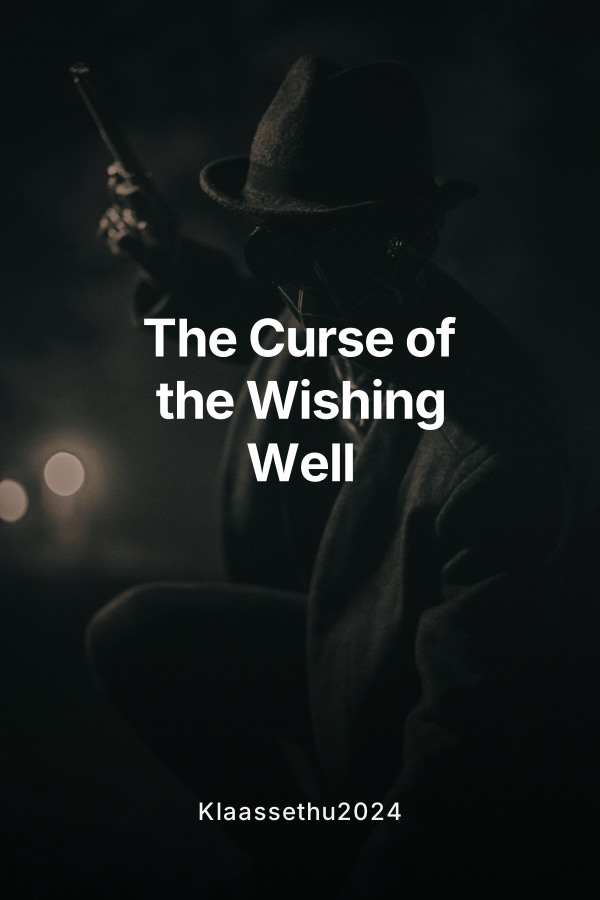
In the heart of South Africa’s winelands, between dignified old oaks and orderly rows of vines, stands a small hotel whose beauty has always been out of proportion to its size. By the 1950s, the little hotel in the town of Franschhoek had already gained a modest reputation as a honeymoon retreat, a place where new couples could begin their lives together with quiet walks, lingering breakfasts, and whispered promises beside an ornate stone wishing well that drew visitors from far and wide. Locals spoke of the well’s romance and charm, not its danger. That would change in a single rainy morning that no one in the valley would ever forget .
The story begins with a young couple from Stellenbosch, newly married and full of ordinary hopes. The rain outside the hotel was a soft curtain, the sort that makes warm dining rooms feel even more intimate. They were in love, sheltered from the storm, enjoying breakfast while the kindly hotel owner fussed over them. The atmosphere was peaceful, if slightly subdued by the weather, until four armed men burst through the doors.
What followed was brutal and senseless. The intruders demanded cash, only to be told that the hotel’s earnings had already been deposited at the bank. Frustration turned to fury. In a heartbeat, the owner was shot and killed. The honeymoon couple were tied up, dragged from the safety of their dining table, and forced into a nightmare whose rules they did not understand.
The gang fixated on the wishing well, the very feature that had drawn the couple there. Known throughout the region as a symbol of romance and eternal devotion, the well had long been a place where lovers cast coins and wishes into the dark water. In a sick twist, the men ordered the groom to go to the well and jump in. According to the mockingly invented “test,” if he could locate the exact coin he and his bride had thrown into the water, then both of their lives would be spared .
Driven by terror and love, the groom obeyed. He fought the cold, the depth, and the panic, groping blindly in the dark water for a single coin among countless others. The test was impossible. He never came back up. He drowned in the same water that had seemed so magical only hours before. The horror did not end with his death. One of the intruders committed unspeakable violence against the bride before killing her as well. By the time the authorities found the bodies of the owner and the couple, rigor mortis had already set in. The hotel was shut down, abandoned to dust and rumor, a place people hurried past instead of sought out .
Years crawled by. Memories dimmed, though the tragedy never vanished completely from local gossip. Eventually a real estate developer acquired the decaying property. He did not believe in curses or ghosts. He saw only an undervalued asset in a picturesque town. The hotel was renovated. The wishing well was carefully restored, its stonework cleaned, its story polished into a marketing hook for romantic getaways. The new owner thought he was resurrecting a dream. He did not realize he was reawakening something hungry.
When the hotel reopened, the first wave of guests arrived with high expectations and carefree hearts. They paid for weekends or weeks, checked in with excitement, took photographs, and unpacked their luggage. Then they vanished. Again and again, couples would simply be gone. Their rooms remained filled with their clothing, their toiletries, their half-read books. Their cars stayed in the parking lot. Yet there were no bodies, no footprints in the mud, no signs of a struggle. Investigations were launched. The police combed through security records, interviewed staff, reconstructed timelines. Every time they hit the same wall. No evidence of foul play. No explanation at all .
Whispers of a curse spread quietly among the townspeople. The pattern was too precise to ignore, even if the details remained maddeningly vague. Couples disappeared. Belongings remained. The wishing well, lovingly advertised in brochures, became the center of every dark theory. Some locals warned visitors under their breath not to toss coins into it, not to treat it like any other romantic gimmick. Others shook their heads and blamed modern hysteria. But the disappearances continued.
The mystery finally caught the attention of a team of paranormal investigators. Unlike the police, they did not arrive in uniform or under the weight of official explanation. They showed up with cameras, recorders, thermal sensors, and the determination of people who make a living standing in the overlap between skepticism and fear. To them, the hotel was not just a crime scene; it was a story still unfolding.
They checked in, set up equipment in hallways and guest rooms, and focused particular attention on the wishing well itself. Night after night they waited for signs of movement, anomalies in temperature, unexplained sounds. The first rounds of recordings were frustratingly dull. No spectral figures drifted through walls, no disembodied footsteps echoed on their monitors. Their cameras captured nothing more dramatic than the play of moonlight on stone. It seemed that if something was indeed wrong with the place, it knew how to hide.
By the final day, the team was exhausted and irritated. They began to pack up, resigned to the possibility that the hotel’s tragedy might be nothing more than a sequence of human crimes clever enough to leave no trace. Equipment cases clicked shut. Wires were rolled, labeled, and stacked by the door. The sense of anticlimax was heavy.
Then one of the audio devices captured something.
At first, it sounded like random interference, a murmur beneath the ordinary noise of luggage zippers and closing doors. But as they listened closely, the sound sharpened into a man’s voice. Calm, almost resigned, it spoke of the wishing well, not as a legend but as a binding law. The voice laid out the rules of a curse that linked the living and the dead more tightly than anyone had suspected .
According to this captured confession, whenever a couple throws coins into the well, a condition is immediately set. One partner must eventually jump into the water. If neither does, both are doomed to die a slow, agonizing death. If one jumps, salvation is still uncertain. The diver must locate the exact coins they dropped into the dark, cold depths. Only then do they earn a chance to save both their lives. Failure carries its own terrible symmetry. The partner who stays dry dies a prolonged, tormenting death. The one who dives but fails to find the coins drowns. The well keeps their body forever. No trace is ever discovered.
The old honeymoon tragedy, with its coerced leap and impossible search, suddenly looked less like a random act of cruelty and more like the cursed template for every disappearance that followed. The voice hinted that the original violence had twisted the natural romance of the well into something malevolent, turning every lover’s wish into a potential death sentence. Whether this was a supernatural consequence, an echo of extreme trauma, or something darker still, the investigators could not tell. What they knew for certain was that couples who treated the well as a harmless bit of lore were unwittingly entering a binding contract.
This captured message reframed the entire history of the hotel. Those missing guests had not simply walked away from their lives. They had fallen into the grip of a cruel bargain. Some may have tried to ignore the strange dreams, the creeping sense of suffocation, the inexplicable pain that marked the curse’s slow unfolding. Others may have discovered the conditions too late and tried to bargain with a force that did not negotiate. The lack of bodies now made an awful kind of sense.
The book that follows expands this chilling foundation into a layered narrative of love, guilt, and the unseen prices we pay for our deepest wishes. Across two substantial chapters, it traces the arc of the wishing well’s transformation from innocent symbol to cursed threshold, and explores the lives that intersect with it across generations.
Chapter one focuses on the 1950s couple and the original crime, turning the brief summary of their fate into a full, emotionally grounded story. Readers will follow them from their courtship in Stellenbosch through the journey to Franschhoek, the small personal hopes they tie to their honeymoon, and the tender moment when they choose a coin, make a wish, and let it fall through the water’s surface. The chapter builds toward the armed robbery, not as an isolated event, but as the brutal collapse of every ordinary dream they held. Their ordeal at the well becomes both a literal and symbolic descent into horror. The groom’s frantic search for their coin, his failure, and his drowning are presented not only as acts of physical desperation but as the pivotal moment the well itself changes character. The bride’s suffering and death complete a tragic triangle of victim, witness, and violator, setting the emotional tone for the supernatural disturbance that will echo through the decades.
Within this first chapter, the hotel’s original owner also receives attention, transforming him from a nameless casualty into a person whose pride in his small establishment, and whose affection for romantic guests, makes his loss more than a statistic. His death, alongside the young couple’s, charges the building and the well with overlapping layers of grief and rage. These human elements give the curse weight. The reader understands that what haunts the hotel is not simply a vague “evil” but the residue of lives cut short and loves betrayed.
Chapter two moves into the present day and introduces the readers to a new set of characters, primarily the paranormal investigators who arrive at the revived hotel. At first, they are professionals approaching the property as one more case in a portfolio of unexplained events. As they begin to gather testimonies from surviving staff, comb through reports of missing guests, and experience the hotel’s strange stillness at night, their rational frameworks begin to strain. Subtle phenomena build tension: misplaced objects, patterns in guest logs, recurring references to coins and wishes. Each small discovery brings them closer to the realization that the disappearances form a pattern that revolves relentlessly around the wishing well.
As they place their equipment and plan their vigils, the investigators must also confront their own beliefs about love, sacrifice, and risk. Some of them are in relationships themselves. Others carry old regrets. Their work at the hotel forces them to consider uncomfortable questions: What would they be willing to do to save someone they love? How far would they go if they believed that a single reckless act could alter the fate of another person? The curse of the well becomes a mirror for each character’s private fears and desires.
The turning point of the chapter arrives when the audio recording captures the male voice that lays out the curse’s conditions. This moment bridges the gap between personal haunting and objective evidence. The investigators, who have encountered countless ambiguous sounds and blurry shapes in prior cases, are now faced with a message too coherent to dismiss. The book explores their varied reactions: intellectual curiosity, moral outrage, deep sorrow for the unnamed couples who vanished without understanding the rules that doomed them.
From here, the narrative delves into the ethical dilemma of exposure. If the curse is real and the rules are known, what responsibility do the investigators bear? Do they publish their findings and risk attracting thrill seekers to the hotel, desperate to prove their love in the worst possible way? Do they suppress the truth and quietly pressure authorities to close the property, leaving countless questions unanswered? The haunting has moved beyond simple fear and into the tangled realm of choice, consequence, and accountability.
Throughout this second chapter, the renovated hotel itself grows into a character in its own right. Its polished surfaces and carefully restored details stand in stark contrast to the hidden violence intertwined with its foundations. Corridors that appear warm and welcoming during the day become ambiguous at night, their shadows hinting at presences out of sight. The wishing well, preserved as a romantic centerpiece in the courtyard, is revealed as the true heart of the story; its surface reflects the sky like a mirror, yet below that shimmering skin lies a history of drowning breaths and unreachable bodies.
By the end of the book, readers will have traversed a complete emotional journey from the innocence of the first honeymoon through the layered tragedies and mysteries that follow. They will understand the curse not simply as a supernatural plot device but as a dark metaphor for the risks hidden inside our most hopeful acts. Tossing a coin into a wishing well is, in ordinary life, a gesture of pure faith that the future can be shaped by desire alone. In this story, that same gesture carries a price that no one would willingly pay.
The intended audience includes fans of atmospheric horror, tragic romance, and psychologically rich ghost stories. Rather than relying on graphic imagery, the narrative emphasizes mood, character, and the terrifying power of unseen rules that govern human lives. The slow unfolding of the curse’s logic, combined with the investigators’ incremental discoveries, keeps readers in sustained suspense. At the same time, the enduring love and desperate choices of the victims give the book a sense of tragedy that lingers after the final page.
“The Curse of the Wishing Well” is ultimately about what happens when a place designed for love becomes permanently entangled with death, when a symbol of devotion is turned inside out by violence. It asks whether any curse born of human cruelty can ever be undone, and whether knowledge of danger truly protects us from it. Rooted in the evocative setting of mid twentieth century and modern South Africa, it offers a haunting, emotionally charged exploration of how a single act on a rainy honeymoon morning can ripple outward to claim the lives and hearts of those who come seeking joy in the decades that follow .