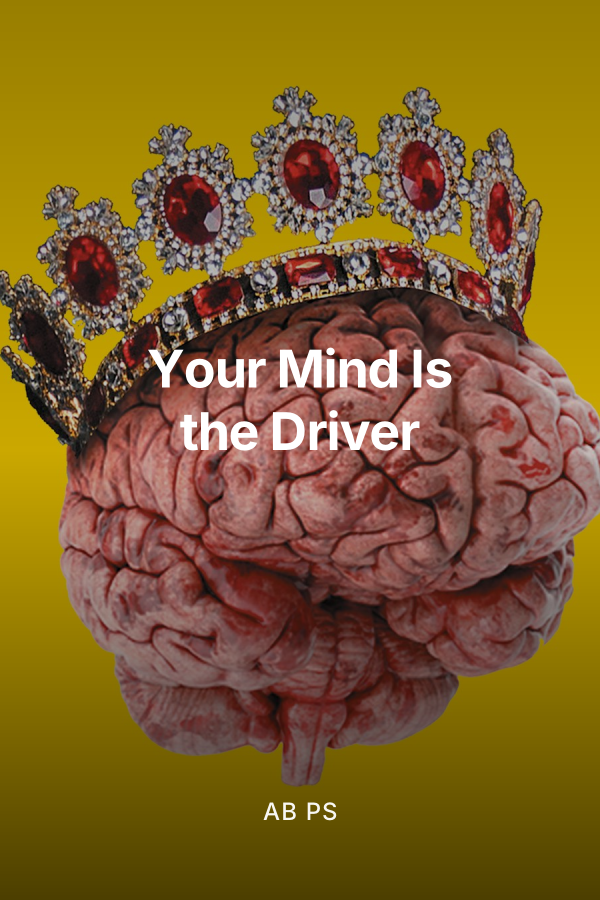
This book is a short, philosophical guide written in very simple English for people roughly between 15 and 30 years old who are growing up with AI in their pockets and on every screen. It is not a technical manual about how AI works on the inside. It is a book about what quietly happens inside you when thinking becomes optional, and how to stay in the driver’s seat of your own mind even while you use the most powerful tools humans have ever built.
The core promise is straightforward. By the end of these five chapters, the reader will still use AI a lot, maybe even more than before, but with one inner shift: they will feel and understand that tools are powerful, yet their mind is the driver. The book’s voice is that of a thoughtful friend who is also learning, not a distant expert. It speaks directly, honestly, and without complicated words, so that a tired student, a new employee, or a young creator can all read it without feeling judged, scared, or talked down to.
The book uses the same clear, calm, habit-focused tone as the existing material about “Two Choices” and “The Anti-Prompt Rule,” while staying original in its structure and expression. It treats thinking as a habit that grows when you use it and fades when you quietly outsource it, and it returns again and again to one practical idea: use AI second, not first. Think, even for a short moment, before you ask a tool, so that the tool serves your mind instead of replacing it.
Across the five chapters, the book moves in a simple arc:
-
The New Question: Are You Still Doing the Thinking?
The opening chapter starts inside a very familiar day. A student writes a long prompt explaining a homework question instead of thinking about the homework itself. An intern spends more effort describing the situation for an email reply than actually deciding what they want to say. A young creator feeds half-formed ideas into AI to get a finished script, then posts something they barely recognize as their own. In each scene, the work has quietly shifted from doing the thing to asking the tool to do the thing.Here the book introduces the central concern in gentle language: this is not mainly about cheating, grades, or productivity. It is about your relationship with your own thinking. The chapter explains that the human brain loves efficiency and naturally avoids effort when it can, which means that if AI always offers a shortcut, your brain will slowly stop offering effort on its own. This is not a moral failure, it is basic wiring. But once thinking starts to feel optional, you can easily slide into a life where asking feels more natural than trying.
To show that this pattern has appeared before, the chapter compares AI with earlier tools like the printing press, electricity, industrial machines, and smartphones. In very simple timelines and side by side comparisons, it illustrates how each technology spread, how long it took to reach many people, and how AI’s growth is far faster and broader. The statistics are approximate and clearly described as such, with a friendly reminder that readers should look up exact numbers if they need them for school. The message is that humans have gone through big tool-shifts before, but this time the speed and closeness of the change are new. Tools are no longer just in factories or libraries; they sit in your hand all day.
The chapter closes with a quiet question instead of a warning: “If a tool can think for you in almost every small moment, how will you protect the part of you that still wants to think?”
-
When Prompts Became the Work
The second chapter goes deeper into one specific modern habit: we now think about prompts more than about the work itself. Instead of asking “What do I want to say in this email?” we ask “How do I write a better prompt so the tool can say it for me?” Instead of wrestling with a confusing idea from class, we write “Explain this to me like I’m 15” and move on as soon as the answer looks neat, without checking whether the idea really lives in our own mind.Through simple, everyday examples from school, work, and online life, the chapter shows how easy it is to slide into “prompt thinking.” The inner work shifts from deciding, judging, and understanding to describing our situation to a system and waiting. On the surface, we still feel busy and smart. We type fast. We scan lots of output. We even feel powerful when we see paragraphs appear in seconds. Under the surface, however, something subtle changes:
- We start solving “How do I ask?” more than “What do I think?”
- We become very good at adjusting tone and style, but less practiced at deciding what we actually stand for.
- We confuse output with understanding and speed with depth.
This chapter stays kind and self aware. The narrator admits that they too have sent messages written by a tool that they did not fully understand, or answered a complex question by pasting a neat explanation they never really owned. This vulnerability keeps the tone friendly and equal, not moralistic. The aim is not to say “prompts are bad,” but to make visible how the center of gravity has shifted from mind to interface.
The chapter introduces a first simple practice: take two minutes with the question before you open any AI tool. Just two quiet minutes to ask yourself what you already know, what you don’t know, and what you really want. This brief pause creates a gap where your own thinking can appear before any answer does. It is a small habit, but it is the beginning of staying in the driver’s seat.
-
Habits, Effort, and the Cost of Easy
Chapter three steps back and looks at thinking as a habit. It builds on the idea that the mind behaves like a muscle: it responds to what you ask of it. When you face difficulty, confusion, or uncertainty, and stay with it even a little, your mind becomes more capable. When you always route around difficulty through tools, your practical capacity shrinks over time.In simple language and short examples, the chapter explains:
- Effort is not the enemy of a good life. It is one of its main ingredients.
- We spent centuries trying to make life easier, and we mostly succeeded, but ease also has a hidden cost when it removes all friction from learning and deciding.
- AI is excellent at removing effort. That makes it powerful and useful, but also risky if used without boundaries, because “effort removed” can turn into “growth removed.”
The chapter explores how, when effort becomes optional, most people will skip it by default. There is no siren, no moment when you clearly “lose” your thinking. Instead, you quietly stop placing yourself in situations that demand it. Hard things start to feel unfamiliar. You hesitate more. You reach for confirmation sooner. Little by little, you come to trust yourself less than you trust the screen.
To balance this, the chapter introduces a set of gentle, memorable rules:
- Think first: always give the problem some of your own attention before you open a tool.
- Struggle a little: do not run from every uncomfortable feeling; that discomfort is where learning happens.
- Use AI second: treat AI as a check and an amplifier, not as your starting point.
- Never outsource judgment: let AI offer options, but you make the call.
- Explain it without AI: if you cannot explain something in your own words, you do not yet own it.
These rules are presented as small guardrails, not strict laws. The tone invites experimentation: “Try these quietly for a week, not to be perfect, but just to notice what happens to your own sense of clarity and confidence.”
-
Borrowed Thoughts, Real Understanding, and the Anti-Prompt Rule
The fourth chapter focuses on “borrowed thinking” and why it fails exactly when you most need it. It describes what happens when you take in ready answers without walking the path that created them. The result looks complete. It can impress others. Yet the first time someone asks a deeper question, or the situation shifts slightly, you feel an empty space where your understanding should be.The book compares two invisible students, two quiet workers, two creators: one who mostly copies, pastes, and adjusts what AI gives them, and one who uses AI after they have tried to reason things out. Their outputs can look similar on the surface, especially early on. The key difference is invisible: one has a mental map of the ideas they are using, the other holds a set of phrases that collapse once the screen is gone.
Here the book introduces its central rule in a simple, memorable line:
If you cannot explain it without AI, you do not own it.
The chapter clarifies that this is not about perfect recall or academic performance. It is about ownership. There is a deep difference between carrying an idea inside you and carrying a printout of someone else’s thinking. A printout is helpful until conditions change. Your own understanding, even if imperfect, can flex and adapt.
The Anti-Prompt Rule is presented as a mirror rather than a test. Before you move on from anything important, you pause and ask: “Can I explain this, in simple language, to another person or to myself on a blank page?” If yes, keep going. If no, that gap is not a shameful weakness but useful information. It tells you exactly where to slow down, ask AI for teaching instead of answers, and build real understanding you can rely on later.
By the end of this chapter, the reader sees that in a world full of people producing content they cannot really explain, becoming someone who actually knows what they are doing is both rare and quietly powerful.
-
Same Tools, Two Futures: Staying in the Driver’s Seat
The final chapter zooms out to show two futures built from the same tools. It explains that almost everyone now has access to similar AI systems, apps, and platforms, but not everyone will end up in the same place. The difference does not come from talent or access. It comes from intention and habit.Using clear, simple scenes, the chapter contrasts:
- People who always ask first, then approve what AI produced, and
- People who try first, then use AI to refine, challenge, or extend their own ideas.
Both groups may look productive. Both may move quickly. But underneath, the second group is building judgment and depth, while the first group is mostly training themselves to validate what already appears on the screen. Over time, this leads to a quiet new hierarchy:
- At the top are those who define problems and direction.
- In the middle are those who prompt well and execute.
- At the bottom are those who simply follow whatever output arrives.
The chapter is careful not to shame anyone. It emphasizes that this hierarchy is not fixed by degrees or job titles. It is shaped by what you practice every day. If you practice deciding, your ability to decide grows. If you mostly practice following, your dependence on outside direction grows. AI does not care which path you choose. It will assist either way. That is why your choice matters.
The book closes by returning to its central image: your mind as the driver and AI as the car. You do not need to reject technology or live more slowly than everyone around you. You only need to keep the order clear: think, then tool. Use AI to multiply curiosity, effort, and judgment, not to replace them.
The final pages remind the reader that the future will not simply reward those who can prompt well. It will reward those who can still think when prompting is the easy path: people who can ask original questions, sense what really matters in a messy situation, and stand behind their decisions with understanding they actually own. Tools will keep getting faster. Convenience will keep growing. Against that background, the rare and valuable thing will be simple: a human being who still knows how to think, and chooses to.
Across all five chapters, the book keeps its language simple and its tone gentle, like a friend walking beside you. It does not try to scare you away from AI, and it does not promise that you will be “safe” if you follow a checklist. It offers something quieter and more practical: a way to notice what is happening to your own mind in an age of instant answers, and a handful of honest rules to protect the habit of thinking so that, no matter how powerful the tools become, your mind remains in the driver’s seat.