Elaine is thirty four, precise, and proud of the clean, ethical image she has built as head of HR at a multinational pharmaceutical giant. On a cold December morning, a single email cracks that image open. The subject line carries a name she half remembers from promotion lists and lab briefings: Emma Chang, a younger but brilliant scientist whose work has been quietly raising the company’s profile. The body of the message is not a complaint but a threat. Emma, it says, has an appointment with a lawyer in ten days, intending to file a sexual harassment claim against a man named Martin. In a corporation this large there are several Martins, but Elaine instinctively knows which one matters. The long term CEO. The man no one is allowed to touch. Emma is also, the email claims, quietly compiling data to blow the whistle on a bestselling drug, ready to turn her grievance into a scorched earth crusade if she does not get a public sacking and vindication.
The email is signed by someone Elaine knows and dislikes. Mrs Levine from Sales: a little older, socially sharp, professionally poisonous. She hints at “financial support and help” to “take care of everything,” insisting that all of this must be kept off the books and out of normal HR channels. The implication is clear. The company’s future is at stake. Legal scandal, plummeting stock, mass layoffs, Elaine’s own department gutted in the fallout. She can offer money legitimately, but anything beyond that would be personal, deniable, and deeply wrong. At this point, Elaine has no idea that Levine’s idea of help involves abduction, drugs, and the literal reduction of a colleague into a house pet, a trained dog kept permanently on Levine’s secluded farm. She only knows that she is being invited to step outside the rules she has built her identity on, and that if she refuses, someone else may do it worse, or turn on her instead.
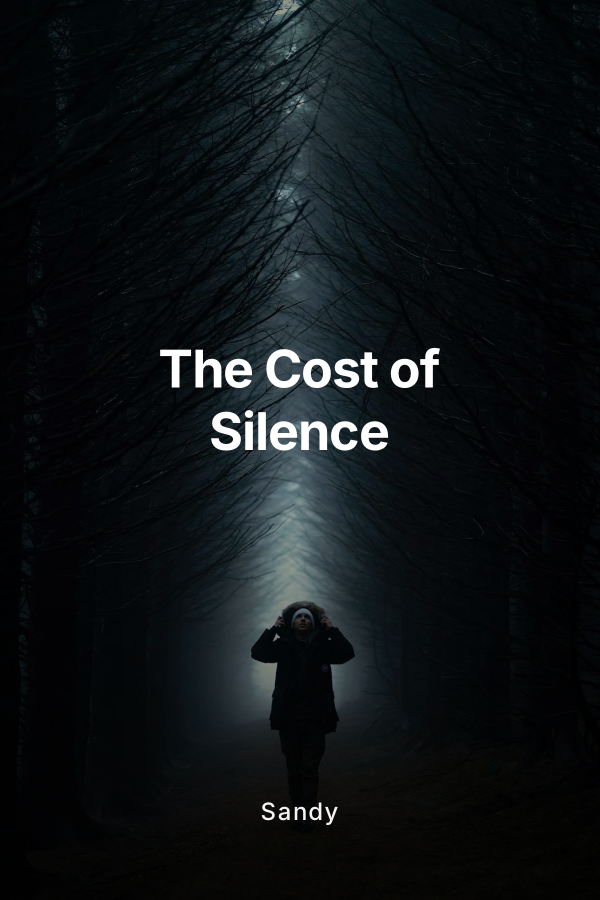
The Cost of Silence is a dark, serious thriller that follows Elaine step by step from that first email to the final image of Emma as something less than human and no longer able to save herself. The story uses a literal, scientifically plausible framework for Emma’s destruction: off label drug cocktails that suppress memory and speech, experimental conditioning methods that tie obedience to warped pleasure responses, and a series of clinical interventions that rewire a bright, angry whistleblower into a compliant, animal like companion. Memory and language are gradually stolen, replaced by reflex and response. Obedience is rewarded, resistance punished. Every stage is grounded in realistic neurochemistry and behavioral science, without copying or directly referencing any specific real world protocols or studies, so that the horror feels uncomfortably close to possible rather than fully speculative.
From the beginning, the book’s emotional focus lies on Elaine’s inner journey. She starts as a by the book professional trying to “do HR right” under impossible pressure. When she first reads Emma’s threat to go to a lawyer and the suggestion that she is collecting data to expose a drug, Elaine’s initial impulse is to manage it properly: scheduled meetings, discreet inquiries, a careful attempt to separate personal grievance from potential corporate crime. She tries ordinary tools first, partly out of instinct, partly out of self preservation. But Levine keeps tightening the screws. Private messages. Subtle allusions to confidential files. Hints that upper leadership expects a quiet resolution. Slowly, Elaine is drawn into secret conversations where policy does not apply and where every step she takes is noted and archived against her.
The story’s structure becomes a slow turning vice. On one side is Elaine’s public role. She leads polished HR presentations about ethics, safe reporting, and the company’s “zero tolerance” for harassment. She fields questions from junior staff searching her face for reassurance. Her slides speak of “duty of care” and “workplace safety,” while her phone vibrates in her hand with messages from Levine: a new forged email, a terse instruction, later a photo of Emma in medical restraints, confused and terrified, already drugged and drooling, undressed under the harsh light of an unregistered clinic. Elaine stumbles on a word but recovers, hearing herself praise the very systems she is sabotaging. Her colleagues admire her composure, certain that she is the company’s conscience.
On the other side of the vice is the secret world Levine constructs. It begins with documents. Digital forgeries that make it appear as if Elaine herself initiated the plan to neutralize Emma. Altered HR files. Emails that suggest Elaine recommended “aggressive” off the record responses. A digital signature copied and placed on forms she has never seen. By the time she realizes how completely she is tied to the scheme, it is too late to walk away. Levine makes it clear that if anything surfaces, the trail will lead straight to Elaine: the ethics head who weaponized her role to destroy a whistleblower. The legal and financial risk is existential. Jail, ruin, permanent exile from her field. She is trapped long before Emma is.
The abduction itself is a brutal pivot. After failed attempts at quiet containment and wary internal meetings, Elaine agrees to one more “conversation” with Emma, this time over the phone. She stalls Emma with routine HR talk, guiding her through scripted questions while Levine moves unseen in Emma’s home. Emma is angry and frightened, insisting someone could have seen what happened with Martin and demanding that the company take her complaint seriously. Her voice is sharp with the knowledge that she is right and the fear that she will not be believed. As she paces, she notices a sound she cannot place, a presence off the line. Elaine hears every second: Emma’s rising suspicion, a half formed question cut short, a sudden thud, the scuffle of a phone hitting the floor, a muffled protest strangled into silence. Then nothing. Elaine keeps listening to the quiet, aware that she has given the signal that allowed this to happen.
From that moment, the thriller turns claustrophobic. Emma wakes in a basement clinic, restrained, disoriented, naked under a thin sheet. There is no team of doctors, no army of guards, no large conspiracy. Just Levine and Elaine. Levine holds the plan, the syringes, the schedule of doses. Elaine is ordered to assist. Her first task is the one that tears the last shreds of her professional self image. With Levine watching, she must step forward, lift the syringe, and press the needle into Emma’s skin. Emma still understands enough to beg, trying to cling to company rules, to policies Elaine herself once championed. She pleads by name. Elaine hears “You can’t do this” and answers, with cold clinical detachment, “This will calm you,” repeating the lie until she can move her hand. The drug hits, and Emma’s body slackens. It is the first clear cut point of no return.
As the weeks pass, the procedures intensify. The book traces the process of eroding Emma’s humanity with chilling precision. At first she is confused and terrified, straining against restraints, drooling as the drugs take effect. She tries to speak, but the combination of memory dampening agents and neuromuscular disruption reduces her words to broken fragments, then to sounds that barely resemble language. She pulls at the bonds of policy and law, invoking her rights, demanding legal counsel, clinging to the idea that somewhere, someone must be keeping records that will protect her. Those records have been rewritten. Her pleas are logged by no one.
The conditioning follows a clear pattern. Obedience brings relief from pain and the faint echo of chemically enhanced comfort. Resistance triggers sharper discomfort, tighter restraints, extended disorientation. The milestones are subtle at first. The first time Emma fails to form a word and only a whimper comes out. The first time she obeys a simple command without a pause, shifting her weight or crawling to a spot not because she chooses to, but because the cue has been tied to a conditioned reflex. The first time she does not try to cover herself when unbound, shame burned out of her by exhaustion and repeated violation of her boundaries. Each moment marks another step away from the woman who gathered data and prepared to stand in a courtroom, toward something that lives in the moment and responds, like an animal, to tone and gesture.
Elaine’s behavior evolves alongside Emma’s deterioration. To cope with her guilt and fear, she grows cruel. Not flamboyantly so, but in targeted, efficient ways. She delivers orders during procedures with a flat, authoritative voice, using mocking phrases and verbal taunts to create distance between herself and her victim. She tells herself she is keeping Emma alive by cooperating, yet she is the one who tightens straps when Levine nods, the one who repeats commands until Emma obeys, the one whose words are most often associated with the next flush of drug induced relief. Brief flashes of humanity seep through. A moment where Elaine almost loosens a restraint too much. A whispered apology that Emma is too far gone to understand. Immediately afterward, Elaine punishes herself for these cracks by doubling down, snapping harsher instructions, aligning herself more tightly with Levine to prove she is fully committed.
The relationship between Elaine and Levine grows increasingly toxic. Elaine despises Levine’s spitefulness and sadistic calm, yet she is bound to her by shared crimes and carefully constructed blackmail. Levine has forged Elaine’s signature on key documents, planted incriminating emails that show Elaine taking the lead, and built a digital trail that can ruin her at any moment. She reminds Elaine of this whenever hesitation appears. A hand on Elaine’s wrist guiding the syringe. A quiet mention of a particular email thread. A suggestion that if Elaine wavers, Emma will suffer more or die. Power is never truly equal between them. Levine barks orders, Elaine “just follows,” outwardly the competent professional, inwardly the captive.
Outside the basement, life continues. Elaine sits in conference rooms, discussing promotions and performance reviews, while the knowledge of what waits in the clinic fractures her concentration. She goes home to a neat apartment, eats muted dinners, and flinches when she sees dogs being walked outside, their leashes suddenly charged with new meaning. The contrast is deliberate and relentless. At work, colleagues praise her for handling sensitive issues with discretion. They admire the way she protects the company’s image while still “caring” for employees. They have no idea that their trust is the very cover that allows Emma’s erasure to continue.
The book’s tension builds less around the question of whether Emma can be saved and more around whether Elaine will ever choose to stop what she has helped start. Small chances present themselves. A near escape when Emma, in a rare moment of clarity, strains hard enough to fracture a restraint. A late night when Elaine hovers over a secure company hotline, fingers poised to report an “anonymous” concern. A company lawyer who hints, obliquely, that someone will be made a scapegoat if the Martin situation ever surfaces, and that Elaine’s name is appearing too often in the wrong folders. Each time, fear and self interest pull her back. Each time, her failure cements Emma’s fate.
By the time Emma is moved permanently to Levine’s farm, the transformation is largely complete. The setting shifts from the sterile basement to a private rural property, but the control remains absolute. Emma is no longer scheduled for “sessions” because her entire existence has become one long, extended procedure. She eats on the floor, sleeps where Levine allows, responds only to certain names and tones. The scientific framework fades into the background, its work already done. What remains is a living embodiment of the company’s choice to silence a threat rather than face what it had become. Emma is officially missing, quietly written out of personnel lists and project histories. No investigation gains traction. Only two women know the truth, and both are invested in keeping it buried.
The ending is deliberately bleak. Emma is “tragically lost forever,” not by death, which might offer a form of escape, but by total mental reshaping. From her perspective, acceptance has been forced upon her. The narrative does not grant her a full interior monologue in the final scenes. Instead, the reader sees her through Elaine’s eyes as a creature who hesitates for a heartbeat when given a new command, as if something echoes faintly in the depths, then wags her tail and obeys with complete submission. Levine tests her in small, humiliating ways, confirming that the conditioning has held. Elaine stands by, watching the result of every decision she has made since that December email, understanding that the person Emma used to be is gone and will not return.
The last image the book leaves in the reader’s mind is quiet and chilling. Elaine on the edge of a paddock or yard, looking at the “dog” that once was a scientist who wanted to do the right thing. For a moment, Emma’s gaze seems to catch on Elaine’s face, as if trying to align this figure with something from a different life. Then the trained response wins. She moves obediently to Levine’s side, performing a simple trick on cue. Elaine realizes that there is no future whistleblower, no court case, no exposé waiting to break. The conspiracy has succeeded, and she herself has been its most vital instrument.
The Cost of Silence is written for readers who seek intense, morally complex thrillers that explore the real world abuses of power hidden inside corporate structures. It rejects the comfort of last minute rescue in favor of a stark examination of how ordinary professionals can become complicit in extraordinary crimes when their careers and freedom are threatened. The tone is grave and unflinching, yet it avoids gratuitous gore and refrains from depicting underage victims directly, keeping the focus on psychological horror, coerced control, and institutional betrayal. Sexual violence and humiliation are acknowledged as tools of domination, but the narrative emphasizes impact, power imbalance, and the erosion of identity rather than explicit step by step acts, so that the story remains readable without excusing or aestheticizing harm.
Across its three planned chapters, the book will move from corporate intrigue and mounting pressure, through the harrowing procedures in the clinic, to the bleak quiet of Emma’s final state on the farm. Each chapter will deepen Elaine’s self deception and eventual recognition of what she has done, not to offer redemption, but to underline how thin the line can be between “protecting the company” and participating in atrocity. At its heart, The Cost of Silence grapples with one core question: when the structures we trust are built to preserve themselves at any cost, what happens to the individuals who try to do the right thing inside them, and to those who are punished for even trying?