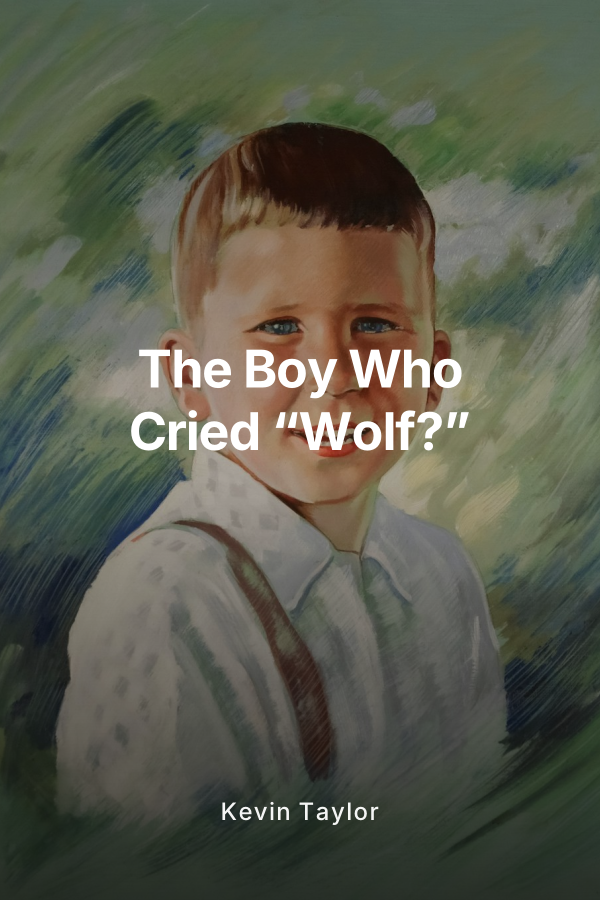
This book is a short, two chapter family story about a lively little boy who keeps startling his parents, Michelle and Kevin, with cries of “Wolf!” that always turn out to be misunderstandings. It combines comedy and warmth with a simple, memorable lesson about honesty, trust, and how families can turn mistakes into shared laughter instead of shame .
The protagonist is a curious, talkative boy who loves words and imagination. He lives at home with his caring but often confused parents, Michelle and Kevin, who are busy, loving, and sometimes a bit too quick to panic. The boy never sets out to lie on purpose. Instead, he mixes up words, overreacts to ordinary things, and lets his imagination race ahead of reality. These mistakes always seem to happen at the worst possible time, which sends his parents racing to the rescue over and over again.
Throughout the story his “wolf” cries are playful twists on the old fable, yet they come from accidents, half truths, and silly interpretations rather than deliberate tricks. In each mix-up, he and his parents discover that small misunderstandings can grow very big when everyone jumps to conclusions. The tone stays light and humorous, but underneath the comedy runs a gentle message: trust is precious, and being clear and honest helps everyone feel safe.
Chapter 1 centers on a series of escalating misunderstandings. It opens on a normal day in the family home, where the boy plays with a toy wolf he has just discovered. Excited, he runs through the house shouting about his “wolf,” not realizing how alarming that sounds. Michelle and Kevin drop what they are doing and race to find him, only to discover him proudly holding up a small plastic figurine. They are relieved, a little annoyed, and slightly amused. They explain that shouting about a wolf makes it sound like something dangerous is happening, and they ask him to be more careful with his words.
Yet the pattern keeps repeating in new, funny ways. Later, he sees shadowy shapes on the wall that look, to his imagination, like a big wolf’s head. Thrilled and a little scared, he calls his parents again. Michelle and Kevin burst into the room ready for an emergency, but the “wolf” is only a coat on a chair casting a strange shadow. Another time, he overhears a television show about “crying wolf” and runs to tell his parents that “the wolf is crying,” which sends them scrambling, only to find him pointing at the screen. Each time the parents arrive flushed and worried. Each time they discover something ordinary behind the scary word “wolf.”
The misunderstandings grow more elaborate as the day goes on. The boy mistakes a neighbor’s dog for a wolf when it is silhouetted in the yard at dusk. He confuses the word “woof” in a storybook with “wolf.” He even tells a friend on a video call that there is a “wolf emergency,” which leads to more flustered explanations. Michelle and Kevin start to feel exhausted and skeptical. When they hear his voice calling “Wolf!” now, they slow down or hesitate, wondering if it is just another mix-up. The boy notices their frustration but does not fully understand why they are upset. To him, everything really did look or sound like a wolf, at least in the moment.
By the end of Chapter 1, the family has experienced a whirlwind of comic panic. The boy is slightly bewildered that what felt real to him turned into annoyance and lectures. Michelle and Kevin are torn between love, worry, and exasperation. They recognize that he is not intentionally lying, yet they also feel they cannot keep reacting to every cry of “Wolf!” with the same urgency. This tension sets up the emotional turning point of the book: what happens if a moment finally comes when the boy truly needs help and his parents hesitate?
Chapter 2 reshapes all the earlier chaos into understanding, connection, and a clear family rule about truth. It begins with a quieter scene that contrasts with the frantic pace of the first chapter. Dinner is finished, dishes are stacked, and the house has grown still. The boy sits at the table, absentmindedly tracing little wolves on a scrap of paper. Michelle and Kevin sit with him and decide it is time for a calm conversation rather than another rushed correction.
They ask him why he keeps calling out about wolves. At first he shrugs, then slowly explains that everything just feels bigger to him than it really is. A shadow on the wall looks like a monster. A noise in the hallway sounds like claws. The toy in his hand becomes, in his imagination, a living creature. He did not mean to lie. He just said what he thought he saw. As he speaks, Michelle and Kevin begin to understand that his “wolf” cries were attempts to communicate fear, surprise, or excitement without the right words.
From there, they introduce the idea of a “truth rule” that belongs to the whole family. They gently explain that words such as “wolf” or “emergency” are special. They make grown ups run and push everything aside. If those words are used too easily when nothing is wrong, people start to doubt them, and that can be dangerous if something truly serious happens. To make the idea more concrete for a young child, Michelle and Kevin invent a playful symbol: a “truth badge” that only gets used when the boy needs real help.
They create the badge from simple things around the house. He decorates it with a friendly looking wolf that smiles instead of snarls. This badge becomes a visible promise between them. When he holds it up and says there is a problem, they promise to listen and take him seriously. In return, he promises to use it only when something is genuinely wrong, not just when he feels excited or wants attention. The badge gives him a sense of importance and responsibility rather than fear or guilt.
Soon after, the story presents a small, real problem that tests the new agreement. The boy hears a frightened yelp from the yard and sees that the neighbor’s dog has tangled its leash. The dog is not a wolf, and no one is in danger, but the situation feels serious to him. He hesitates. Old habits urge him to shout “Wolf!” out of panic. Instead, he remembers the talk, clutches his truth badge, and calls his parents with calm urgency, telling them there is a real problem with the dog.
Michelle and Kevin arrive quickly. This time they listen first, act promptly, and help free the dog. They thank their son for telling the truth clearly. Instead of scolding, they celebrate his choice. The boy glows with pride. He has finally learned that telling the truth is not about never feeling scared or never making mistakes. It is about slowing down, looking carefully, and choosing words that match what is really happening.
The chapter closes with a final, playful moment that shows how far they have all come. Later that evening the boy spots his own shadow shaped in a wild, pointy way on the wall. It looks, to his imagination, like a wolf again. He smirks, then deliberately goes to his parents and says, in a dramatic stage whisper, that he has seen something “wolfy,” but that it is “probably just a shadow.” Michelle and Kevin laugh, relieved and proud. They treat it as a shared joke rather than a crisis. The boy has found a way to keep his imagination alive while also respecting the power of honest words.
Across its two chapters, the book speaks to children who often feel misunderstood when their exaggerations or misconceptions frustrate adults. It also speaks to parents who struggle to respond calmly when minor panics interrupt their day. By framing the classic “boy who cried wolf” idea as a series of funny mix-ups between a boy and his parents, Michelle and Kevin, the story replaces shame with empathy and harsh consequences with a supportive family agreement . The core message is simple and reassuring: honesty grows best in a home where mistakes are talked about kindly, laughter is shared, and everyone is willing to listen and learn.
Young readers are invited to see themselves in the boy’s mix of imagination and alarm. They come away with a concrete sense of how to choose words more carefully, when to ask for help, and how to repair trust when it has been stretched thin. Parents are gently encouraged to look beyond surface “fibbing” and explore what their children are really feeling or trying to express. In the end, The Boy Who Cried “Wolf?” becomes less a warning about punishment and more a warm portrait of a family that learns, together, how truth can be both safe and joyful.