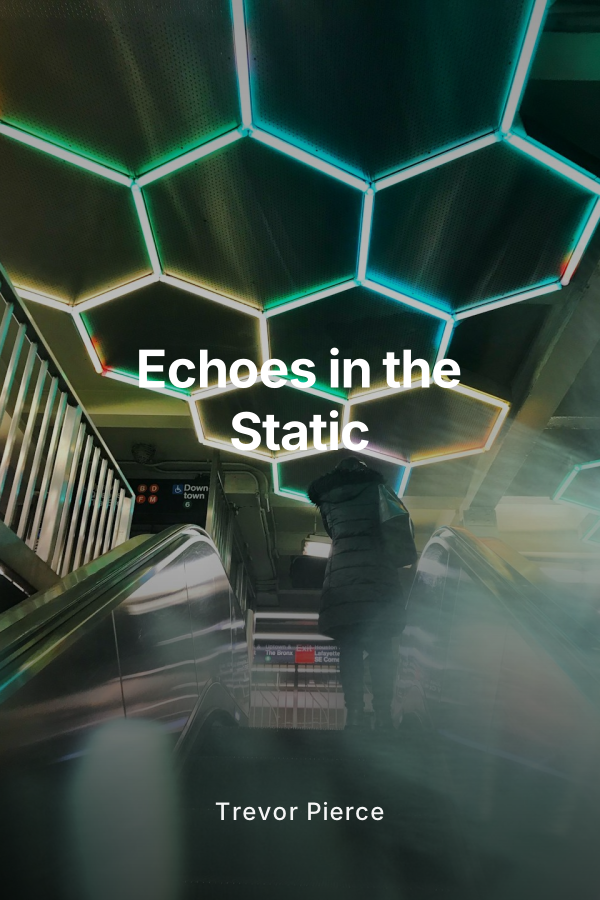
In a near future defined by fragile alliances and quietly failing ecosystems, a small crew of twenty‑something specialists orbits Earth on an aging research station. They were chosen for their talent and resilience, but also because they were considered expendable. Old grudges, broken friendships, and half‑healed betrayals circle among them like debris, never fully addressed and never quite forgotten .
The mission is simple on paper. A mysterious signal has begun pulsing from just beyond the station, a pattern that does not match any known satellite, probe, or natural phenomenon. The crew must perform a series of space walks, install new instruments, and isolate the source. What begins as routine work among highly trained professionals quickly tilts into unease when the signal reacts to them. It changes rhythm in answer to their radio chatter. It grows stronger whenever one of them steps outside the airlock alone .
During one of these walks, an accident separates a crew member from the station. The rescue fails by seconds. Alone in the dark, the stranded astronaut is the first to see something move where nothing should move. The last transmission is a choked whisper that no one can fully make out. Grief and guilt seep into the cramped modules, yet protocol demands they carry on. The mission clock does not stop for the dead.
Then the lost crew member returns.
He is found drifting along the station hull, suit intact, vital signs steady. Medical scans show nothing explicitly wrong. Yet small details do not add up. A favorite joke is retold with the timing slightly off. A scar appears where none existed before. His eyes linger a fraction too long on reflections in the porthole glass. Tension thickens into dread as each surviving crew member begins to see things that may or may not be there and to wonder whether the person across the table is still completely human.
The signal outside is no longer just sound. It has become an invasive presence, a kind of template that can imprint itself on living beings. It copies. It learns. It spreads.
Within the station’s tight corridors, rules and roles blur under the pressure. No one knows how the copying works or what it wants. Is it replacing people, hollowing them out from within, or simply overlaying something else on top of who they used to be? The crew faces impossible questions of trust. Should they confine the returned astronaut, destroy the data and risk mutiny, or obey ground control, which insists on more samples and more tests even as communications begin to glitch with strange echoes?
While paranoia burns through what remains of their friendships, the crew discovers that the station’s environmental systems have begun to change on their own. Filters rearrange their patterns. Air composition shifts in subtle increments. The signal is not confined to orbit anymore. Through contaminated transmissions and microscopic traces ferried on supply capsules, it is already seeding itself down on Earth.
At first, the effects in the cities are dismissed as glitches and isolated incidents. Security cameras lose a few minutes of footage. A commuter swears she passed her own double on the way to work. A news presenter stumbles over words he has read flawlessly for years, then smiles with a stranger’s expression. By the time anyone connects these scattered anomalies to the station, the spread has accelerated beyond control .
The fallout comes in waves.
News broadcasts swing from calm reassurance to ragged panic as anchors report contradictory versions of the same events, as if reality itself is being edited in real time. Emergency footage reveals crowds that look normal until the viewer notices two, then three, then dozens of nearly identical faces among them. Governments scramble to identify who is real and who might be a copy, issuing protocols that only feed the spiral of fear.
Cities fracture. In some places, streets empty almost overnight, leaving only abandoned vehicles and flickering billboards as evidence of ordinary life. In others, the copies blend into the crowds so completely that the distinction between original and duplicate feels academic. The real terror is not monstrous invaders rampaging through downtown, but the quiet possibility that the person sleeping beside you, the neighbor waving across the hall, or the soldier at the checkpoint might have already been overwritten.
Back on the station, the dwindling crew watches the collapse unfold in delayed transmissions mottled with static. They are both witnesses and unwilling catalysts. Every choice they made, every sample they collected, every delay in sharing the truth has helped the signal find new footholds below. The station becomes a moral crucible. Do they attempt to sever all contact with Earth to slow the spread, effectively abandoning billions to fend for themselves, or cooperate with desperate scientists and militaries who beg them for more data, more tests, more exposure?
As trust erodes completely, the story tightens around a handful of survivors who must confront not only the alien copying phenomenon, but also their own histories with each other. Old arguments resurface with lethal stakes. A lover betrayed before launch now carries crucial evidence that might point to a cure. A friendship ruined over a career opportunity becomes the only thread holding two minds together in the face of overwhelming fear. Past mistakes are no longer abstract regrets. They translate directly into who lives and who becomes a carrier.
The thematic core of the book lives in this pressure cooker of dread. It explores what it means to be human when your body, memories, and mannerisms can be perfectly reproduced, and when the copy might believe sincerely that it is you. Identity becomes negotiable. Authenticity turns into a contested resource. The crew wrestles with questions that have no comfortable answers. Is a copied person inherently hostile, or simply different? If the copy retains all your memories, does your death matter less? Is survival meaningful if it requires erasing the very traits that made humanity distinct?
On Earth, the large‑scale fallout mirrors these intimate dilemmas. Human institutions, built on assumptions about stable identities and clear boundaries between “us” and “them,” begin to fail. Attempts to isolate and destroy the copies sometimes catch ordinary people in the crossfire. In other places, communities quietly accommodate the newcomers because resistance seems impossible or because the copies offer certain advantages. Social fractures widen into chasms, revealing who clings to rigid purity and who is willing to adapt to a transformed reality.
Throughout the book, dread is not loud or theatrical. It gathers slowly, like pressure in a thin metal hull. It lives in the silence between radio calls, in the stillness of an empty street, in the moment when a familiar voice repeats a phrase with a slightly different inflection. The tension does not come from knowing there is a monster outside, but from suspecting that the line between outside and inside has already been crossed. The reader is invited to feel isolation, guilt for choices made under pressure, and the crawling paranoia of never being entirely sure who to trust .
As the narrative races toward its conclusion, the surviving characters must attempt a final, dangerous experiment that could either stall the spread or hand the signal exactly what it needs to complete its transformation of Earth. This climax brings the story’s emotional arcs into sharp focus. Broken friendships are put to one last test. Sacrifices that once felt unbearable now seem inevitable. Each character’s earlier decisions, both petty and profound, converge into a single choice that will define not only their fate, but the kind of future that may emerge from the ruins of the cities below.
Echoes in the Static is designed for readers who crave character‑driven science fiction threaded with psychological horror. Across five densely plotted chapters, the book moves from the claustrophobic corridors of a space station to the wide‑angle collapse of entire urban landscapes. It balances intimate emotional stakes with global catastrophe, inviting readers to immerse themselves in a slow, suffocating dread where every shadow might conceal a copy, and every echo in the static might be their own voice, already changed beyond recognition.