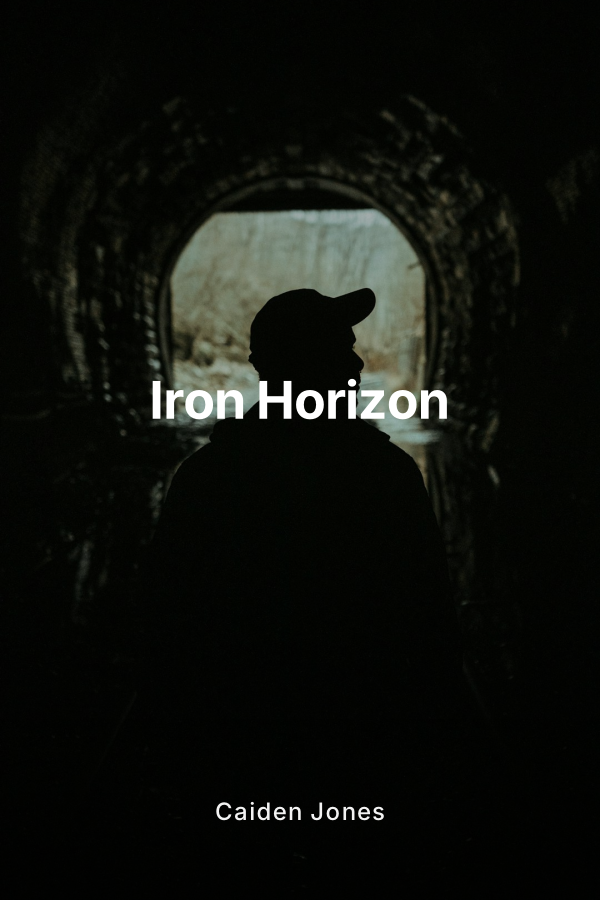
Iron Horizon is the fourth book in Ivy’s saga, a brutal and intimate contemporary thriller that follows seven young women as they are hunted, recaptured, and forced to engineer their own escape from a warehouse designed to erase them. Intended for adult readers who can sit with graphic harm, moral ambiguity, and unresolved endings, it continues the series’ central project: tracing the long shadow of captivity, disaster, and institutional failure while insisting that even in the worst rooms, someone is still counting hinges and reaching for another hand in the dark .
Years after tearing themselves free from a modern cotton plantation, surviving an EF5 tornado, and crawling out of a plane crash, Ivy, Rochelle, Zoey, Laurie, Harper, London, and Aalyrah are on the brink of legal adulthood. College brochures and job applications share space with storm dust and grief on kitchen tables that still bear physical scars from everything they have endured . They are no longer only “the seven from the farm.” They have rebuilt themselves as advocates, artists, organizers, tentative future students. Rochelle storms council chambers and hearings, dragging systemic failures into the light. Aalyrah forges an anti trafficking and disaster preparedness campaign out of volcanic rage. Zoey redesigns shelters and public spaces so survival and dignity can coexist. Harper writes, fighting the belief that survival obligates her to narrate the dead. Ivy maps the hidden patterns of danger that thread through their town. London lives as a strategist inside a brain that now demands as much rest as brilliance .
They do not know their past captors have never stopped watching.
The men the girls helped put away have been hardened rather than humbled by prison. What emerges from confinement is not only individual cruelty but a wounded system reclaiming its predators. Through a lattice of minor betrayals a sympathetic guard, a clerk trading transfer dates for cash, an old enabler who still frames the farm as a grim necessity these men slip through legal cracks that were never entirely closed . This time they want something smaller and more controlled, intimate enough for revenge. They track the seven using the bright trail of their own advocacy: social media posts, public speaking schedules, news features. They decide not to take the girls together but to dismantle their bond one body at a time .
Act One is an almost normal life being peeled open. Harper navigates AP forms and book drafts, shadowed by the sense that someone is three steps behind her. Ivy notices a car that appears too often in the grocery parking lot. Zoey spots an unfamiliar face at a mural unveiling and tells herself she is paranoid. Rochelle treats hate mail as the cost of public work. The reader can feel the net drawing tight around them long before the girls allow themselves to name the pattern .
Their recapture is not a single cinematic moment but a series of ruptures. One girl vanishes walking home from a late study session. Another is yanked into a van after a speaking event. A third disappears between a counseling appointment and the bus stop. Each abduction is calibrated to exploit daily routines and civic blind spots: a dim bus stop camera, a campus security patrol routed the wrong way, a streetlight long in need of repair. Those still outside must decide whether to trust the very systems that failed them or to orchestrate their own search while knowing they could be next. Those already inside are stripped, hooded, and delivered to an abandoned warehouse at the forgotten edge of a highway, a place that might as well be another planet .
Where the cotton farm used open fields and sunlight as weapons, the warehouse reduces the world to concrete, steel, and sound. The building is a maze of sealed rooms, each an instrument of control. The girls are no longer assigned to fixed torments; they are thrown into a rotation governed by whim. Guards yank them from thin cots, meals, or half sleep and drag them into chambers of randomized punishment: one room for clinical beatings measured in timers and recorded vitals, another where sexual assault hangs like a constant threat sometimes carried out behind cameras used to humiliate, sometimes withheld to unmoor any sense of safety, a third devoted to alternating sensory assault and deprivation, where blaring noise, freezing air, and suffocating darkness collapse time into raw panic .
Unpredictability becomes its own torture. Every footstep in the hall is a loaded coin flip. Because rotations follow no apparent logic, cause and effect disintegrate. Good behavior does not protect them. Resistance does not reliably incur greater harm. Captors change their choices mid gesture simply to prove that they can. The girls learn to flinch not only from pain but from the collapsing possibility that anything they do might matter .
Yet they are no longer children learning how captivity works. Their prior ordeals have altered them in ways the captors never anticipated. Survival reflex hardens into strategy within hours. Ivy’s mind begins mapping again, not just the layout of doors and walls, but the rhythm of locks, the smell of a particular guard’s cologne, the pattern of footsteps stopping outside certain rooms. London, dizzy and slowed by old injuries, starts tracking sound through concrete. Rochelle counts seconds between rotations and catalogs who returns bleeding and who comes back quiet and dry eyed. Zoey and Harper, once the emotional core of the group, begin embedding meaning in small gestures, turning terror into code and their own bodies into message boards .
Iron Horizon refuses to sensationalize the violence and yet does not flinch from its impact. Physical and sexual harms are named in blunt, unsparing language, but the narrative camera remains focused on faces, hands, breath rather than on the mechanics of assault. The horror lies in layered trauma, as every new blow lands on scar tissue, and in the recognition that this second captivity is orchestrated by people the girls once watched being led away in chains . Clear ethical boundaries hold in the background. None of the seven die in the warehouse. Their families are never dragged inside as bargaining chips. The captors’ goal is not to widen their circle of victims but to prove that even surviving a farm, storm, and crash has only delayed the inevitable breaking of these particular girls .
As the second act deepens, leadership under pressure shifts. Ivy initially acts as the strategist she has always been, her pattern seeking mind snapping back into place as soon as the fog clears. But when the emerging escape plan requires that one girl endure repeated placement in the most sadistic room to distract guards and gather information, Ivy freezes. The memory of choosing danger for Aalyrah during their first escape on the farm chokes her. It is London, living with the cognitive cost of earlier sacrifices, who finally articulates the brutal math: without someone absorbing the worst of the rotations, none of them will ever reach daylight again .
Aalyrah, whose fury has always dragged her toward every front line, volunteers before Ivy can intervene. Rochelle reacts instinctively against the idea, refusing the premise that their survival must once again be purchased with one girl’s body. The low, ragged argument that follows becomes the moral core of the book. Is it ethical to consent to greater personal suffering if that choice shields others you love? Is it an act of love or betrayal to allow someone you love to make that choice when you could physically stop her? They accept Aalyrah’s decision not because they find it morally clean but because every other option has collapsed. That acceptance opens a hairline fracture between Ivy and Rochelle, a rift in their solidarity that runs under every chapter and that the captors can feel even when no one speaks of it aloud .
Escape does not come as miracle or outside rescue. It begins with exactly the kind of mistake the captors believe they no longer make. A guard, overconfident and contemptuous, fumbles a key while jerking a girl mid meal and fails to fully engage an inner lock. A small cuff key skitters under a bolted bench. London spots the glint. Zoey, closer to the floor, palms the key and hides it where strip checks are unlikely to find it .
From this small error the seven methodically open an exit. They free wrists in stages and script a chain of controlled “incidents” calibrated to trigger overreaction without tipping into mass reprisal. A faked seizure draws multiple guards into one room at once. A door appears to latch but is left slightly open after quiet tinkering with its hinge. When two guards respond expecting a single “problem girl,” they walk into a coordinated ambush that leaves bones broken, consciousness shattered, and no corpses on the floor. Keys change hands. Cameras are disabled. An unconscious captor is dragged into a cell built for girls like them, the architecture of power beginning to reverse brick by brick .
Their breakout is messy and costly. Aalyrah absorbs injuries that will shape her gait and movement for years. London’s compromised balance turns every stretch of uneven ground into a potential fall. Harper’s lungs, still scarred by smoke and storm dust, fight for every breath. Laurie’s panic attacks threaten to lock her in place at the worst possible moments. Rochelle must make split second decisions between doubling back for someone and maintaining the group’s fragile lead. Ivy keeps moving even as every clang of metal echoes gunshots from the farm and the falling roof in the tornado . Step by step, bruise by bruise, they force themselves out of the warehouse and into an indifferent night sky. No sirens greet their escape. No headline is waiting. The world has not been holding its breath for them.
The final act of Iron Horizon turns outward and inward at once. Publicly, courts and hearings and policy debates swirl like a faint echo at the edge of the story. Privately, the town that once put their faces on murals and pamphlets as evidence that “the system works” must finally confront its complicity in their renewed suffering: the overlooked warnings, the chronic underestimation of risk, the bureaucratic blind spots that let their captors walk back into the world . The narrative is less interested in tidy justice than in the stubbornness of structural failure. Some captors are caught again. Others disappear into jurisdictional confusion and the underbrush of procedural excuses. Laws are debated, procedures revised, but the girls understand too well how paper rules crumble when most needed .
Individually, each of the seven must relearn herself in the shadow of this third captivity. Ivy’s pattern seeking shifts into structural rage. She no longer wants simply to map failures; she wants to rewrite the rules that make such failures inevitable. Rochelle’s advocacy calcifies into something sharper, less willing to soften truth for officials who brushed aside her earlier alarms. Zoey’s art evolves toward steel and shadow, speaking now of hidden rooms and mislaid keys as much as fields and storms. Harper’s writing becomes indictment rather than pure testimony, dissecting the media and legal machinery that gave predators a second access point to their lives .
Laurie confronts the line between vigilance and self blame, struggling not to read every missed cue as personal failure. Aalyrah, healing from injuries that turn her own body into contested territory, must decide whether her relentless, visible fight is self sacrifice, self harm, or something knotted between the two. London, moving through the world with new neurological damage layered over old, becomes a quiet refusal of narratives that equate heroism with intact bodies and unscarred minds .
Across three tonal phases the uneasy almost normal of post crash life, the suffocating brutality of the warehouse, and the unresolved aftermath in which freedom itself feels dangerous Iron Horizon keeps its gaze close to the girls. Perspectives alternate so the reader can feel each fracture in group unity and every tiny act of care that keeps them tethered anyway. The story offers no cathartic triumph. Instead, it asks whether, after so many blows from human hands and indifferent skies, these seven can allow themselves to imagine futures not organized entirely around the expectation of the next disaster .
Iron Horizon is ultimately a study in refusal. The girls’ captors try across three different cataclysms to reduce them to property, spectacle, or cautionary tale. In answer, the seven enact the same radical act again and again. They keep choosing each other. They keep choosing to live, not as symbols of a system’s success, but as stubborn evidence that survival can outlast both cruelty and the stories told to excuse it .