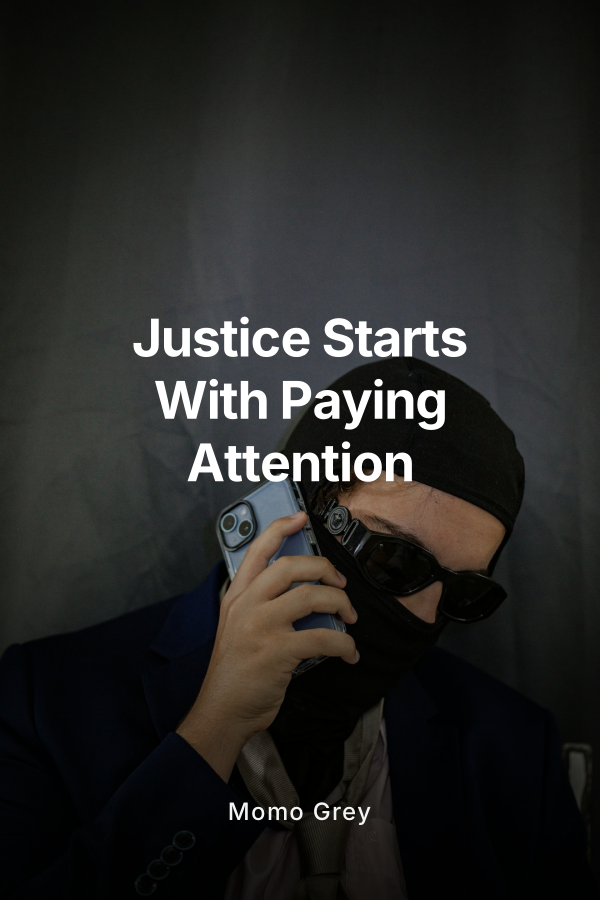
This book follows Sonia, a driven college journalism student whose life was shaped by the death of her father, a police officer who left her with one guiding phrase that she never forgot: “Justice starts with paying attention.” That final line from her dad, spoken as he left for what would be his last shift, becomes both a personal mantra and a dangerous compass when Sonia begins to notice a disturbing pattern on campus that no one else seems willing to see .
Haunted by grief yet sharpened by it, Sonia pours herself into investigative work for the campus paper. What starts as a routine deep dive into old local crime reports slowly turns into something far darker. Among her clippings, she discovers an article page that lists several young women, each close in age, each with an eerily similar cause of death, each with the name of the same high school handwritten and circled in her own cramped notes beside them, along with one margin question: “same school?”
At first she assumes she has simply misplaced the full article. The missing page nags at her, but between deadlines, classes, and memories of her father, she explains it away as careless filing. Only the reader understands that this is not an accident. We have already seen the subtle moment when her respected criminology professor, Dr. Hale, quietly slides that incriminating page into his own folder after class, his expression tightening for just a heartbeat while Sonia’s back is turned . He praises her curiosity, encourages her to “keep digging,” and returns every other page she has brought him to discuss. All but that one.
As Sonia investigates, the book traces her internal evolution from a grieving child who parroted her father’s phrase without grasping it, to a young woman who realizes that “paying attention” is not just about facts, but about patterns, silences, and the emotions that other people work hard to hide. The more she applies that lesson, the more she notices that the string of victims she is researching shares something invisible yet intimate: a shared educational past, a single school that keeps coming up in the margins. That small, obsessive note “same school?” grows into a full-blown theory that somebody has been preying on a specific type of girl tied to that place, over a span of years no one has stitched together.
Her relationship with Dr. Hale becomes the emotional and moral centerpiece of the story. To Sonia, he is first a mentor and intellectual ally who treats her as an equal long before anyone else does. To the reader, seen through fleeting details like the flicker of anxious eyes, the way he watches the door, or the way his gaze lingers a fraction too long on crime-scene photos, he is layered with ambiguity . Is he disturbed by the violence they study for class, or afraid of what Sonia is about to uncover? The narrative plays these questions carefully, inviting readers to interrogate how far respect, trust, and authority should go in an institution that prizes reputation over truth.
Parallel to the growing mystery, the book weaves deeply personal scenes from Sonia’s childhood: her dad buttoning his uniform shirt at the door, pausing to kneel and tell her that paying attention is how people get saved; Sonia repeating the words back in a sing-song voice; the gentle frustration on his face when he realizes she does not truly understand yet. These memories return years later in sharper colors as Sonia faces moral crossroads: whether to confront her professor, whether to approach the surviving families of the victims, whether to risk her own safety and academic future to publish what she now suspects.
The tension builds to a final sequence that unfolds mostly through Dr. Hale’s point of view. For the first time, the narrative steps fully into his mind as he arrives at his office, senses something off, and begins to notice small details that trigger a tremor of dread. The door is slightly ajar; the arrangement of photos on his wall has changed by subtle degrees; one of Sonia’s research images is lying where he did not leave it . His anxious eyes become the reader’s lens on a room quietly transformed into a reckoning.
In these closing moments, the story withholds any neat confession or on-page exposition about his guilt or innocence. Instead, his thoughts fracture into sensory shards. He remembers Sonia in class, head bent over her notes, the intensity with which she said her father’s line out loud: “Justice starts with paying attention.” Fragments of recognition flash across his mind, but they are never fully articulated. He spots a single photograph on the floor, bends to pick it up, and realizes he is looking at Sonia’s face staring back at him from a printout or a clipped image, her eyes meeting his from the page. He whispers her name, “Sonia?” The picture slips from his hand and falls, the sound swallowed by the silence .
The book does not tell us exactly what happens next. Instead, it leaves readers suspended at the edge of that dropped photograph, with one last collision of past and present: the echo of a father’s belief in attention as a path to justice, and the chilling suggestion that attention can also be a weapon when turned on the wrong person. Did Sonia finally expose a serial predator tied to that high school and shielded by institutional loyalty? Did she misread the signs and project her grief onto a man whose only crime was obsession with the same horrors that haunted her? The novel invites readers to confront the uneasy territory between truth and narrative, evidence and interpretation, mentor and monster.
Across its five chapters, the book moves from intimate family drama to procedural campus investigation, then funnels both threads into a tightly coiled psychological climax. It explores:
- How grief shapes the stories we tell about danger, safety, and justice
- The vulnerability of students within systems built on prestige and hierarchy
- The ethics of watching and being watched, especially when “paying attention” becomes indistinguishable from surveillance
- The fragile, shifting boundary between inspiration and exploitation in mentor student relationships
- The cost of refusing to look away, even when the truth threatens everything you rely on
Written in a tense, emotionally grounded style, the book is designed for readers who love character driven mysteries with morally gray figures and unresolved edges. Sonia’s journey offers not the comfort of a solved case, but the haunting satisfaction of having looked closely enough to know that there was always more beneath the surface: in the cases, in the classrooms, in the people we trust, and in the things our loved ones tell us just before the door closes for the last time.